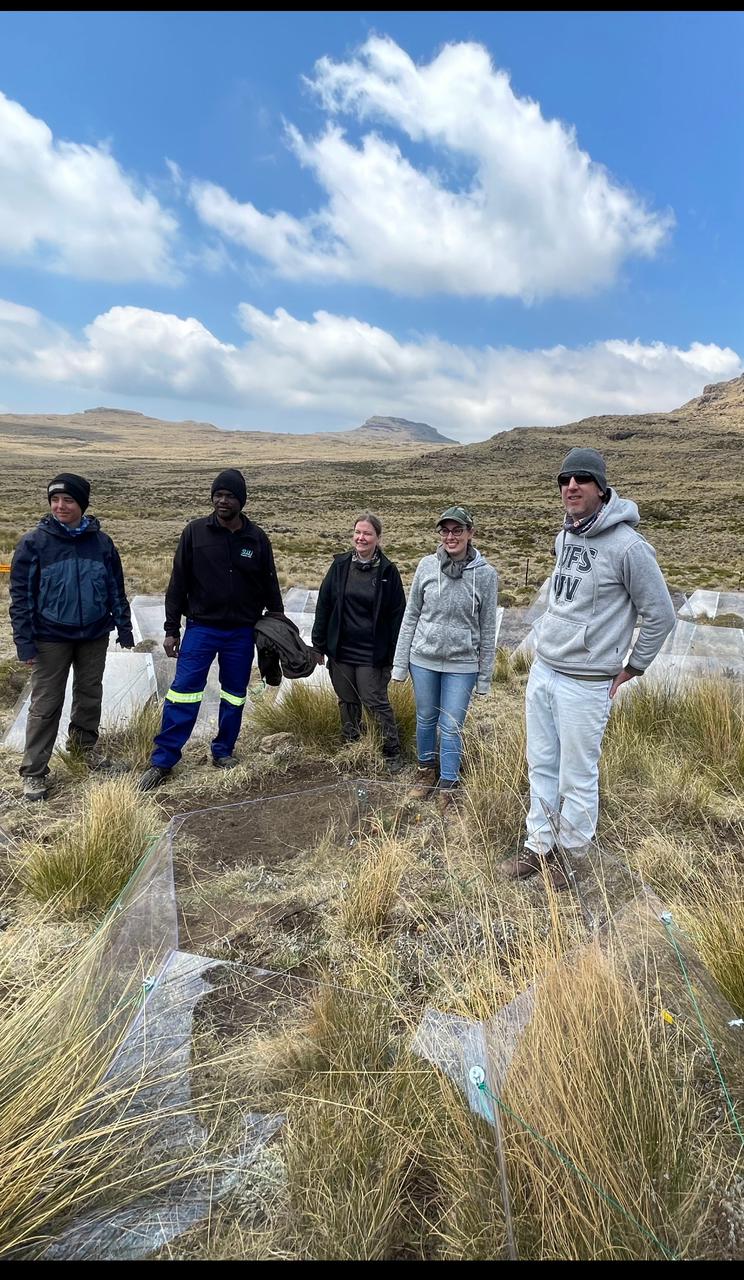
Maloti-Drakensberg this week became part of the global research project on the impact of climate change on alpine ecosystems.
The deepening effects of climate change on the environment has had devastating consequences for communities in recent months, with changing weather patterns giving rise to major floods and droughts globally.
To mitigate such impacts, countries are increasingly pooling resources and collaborating on projects.
One such initiative is a research project focusing on the Maloti-Drakensburg range in the Free State, which aims at a better understanding of the ecological drivers of range-expanding plant species at high altitudes.
Tuesday, 19 October 202, marked the official launch of the project, with a site visit to the summit of the Maloti-Drakensberg.
Researchers will seek to determine whether typical range-expanding species might colonise the alpine zone above 2 800 metres under simulated warmer conditions such as might exist in the not-too-distant future.
The highest peak on the Maloti-Drakensburg range is Thabana Ntlenyana, at 3,482 m.
Titled “RangeX”, the project is being undertaken by a multi-institutional research consortium under the Mountain Invasive Research Network (MIREN), with Switzerland leading the research.
The Department of Science and Innovation (DSI) is funding South Africa’s participation, which is being led by the Afromontane Research Unit (ARU) based at the University of the Free State’s Qwaqwa Campus.
The research leader, Dr. Vincent Clark, explained that little is known about the alpine zone in the Maloti-Drakensburg.
“We could be 100 years behind Switzerland with alpine research, in terms of what we know about the ecosystem. Yet this system is critical for water security for two countries, Lesotho and South Africa,” Dr. Clark said.
He added that, with climate change and increasing human pressure, it is not known what the system will look like in several decades whether or not ecosystems will collapse, resulting in total alpine desertification.
“We are using RangeX as a pilot to see if we can establish a 50-year research traction and really understand the system holistically and provide solution-oriented research for this whole environment, including social interventions and geopolitical discussions.”
The lower test site is near the Witsieshoek Mountain Lodge at 2 200 metres, this being the current natural upper limit for most of the selected plants.
The difference in average temperatures between the upper and lower sites is currently about 2 degrees Celsius.
The alpine zone is an extremely harsh environment, with winter temperatures dropping to minus 20 degrees Celsius and winds reaching up to 100 km/hour.
Only highly specialised species occur as a result. However, with climate warming, it is expected that many lower-elevation plants might begin to “climb” the mountain and invade the upper reaches, which could heavily impact the ecology and livelihoods of endemic alpine species.
The research plants comprise a selection of species from the lower parts of the mountain range that show expanding populations. Commonly occurring at around 2 300 metres, these include indigenous woody plants such as ouhout, non-native woody plants such as firethorns, and a selection of grasses, flowering bulbs, and succulents.
While not expecting the plants to survive the harsh winter temperatures at 3 100 metres, Dr. Clark said two summer seasons will allow the researchers to explore dispersal limitations, plant-plant interactions, soil abiotic and biotic conditions, pollinations, and temperature limitations.
The DSI’s Director for Earth Systems Science, Leluma Matooane, said that anticipating and responding to environmental challenges and opportunities required both a process-based understanding of range expansions and a shared understanding of the issues involved among researchers, natural resource managers and policy-makers.
“This and other knowledge, with science-based evidence, is expected to lead to improved policy and management of shifting species and biodiversity,” Matooane explained.
It is the first time that such experiments will be undertaken in the alpine context of the Maloti-Drakensberg.
The ARU will use the project to promote the establishment of an ambitious, long-term alpine research centre in the Mont-aux-Sources region, where the Free State, KwaZulu-Natal and Lesotho meet.
Other partners in RangeX are from Germany, Norway, Sweden, Denmark, Australia, Chile, and France, with research locations in the European Alps, Himalayas, Andes, Australian Alps, and Scandinavian Mountains or Scandes.
The DSI is a member of BiodivERsA, an initiative of the European Union’s Horizon 2020 programme, which promotes research in biodiversity and ecosystem services, and offers innovative opportunities for the conservation and sustainable management of biodiversity.