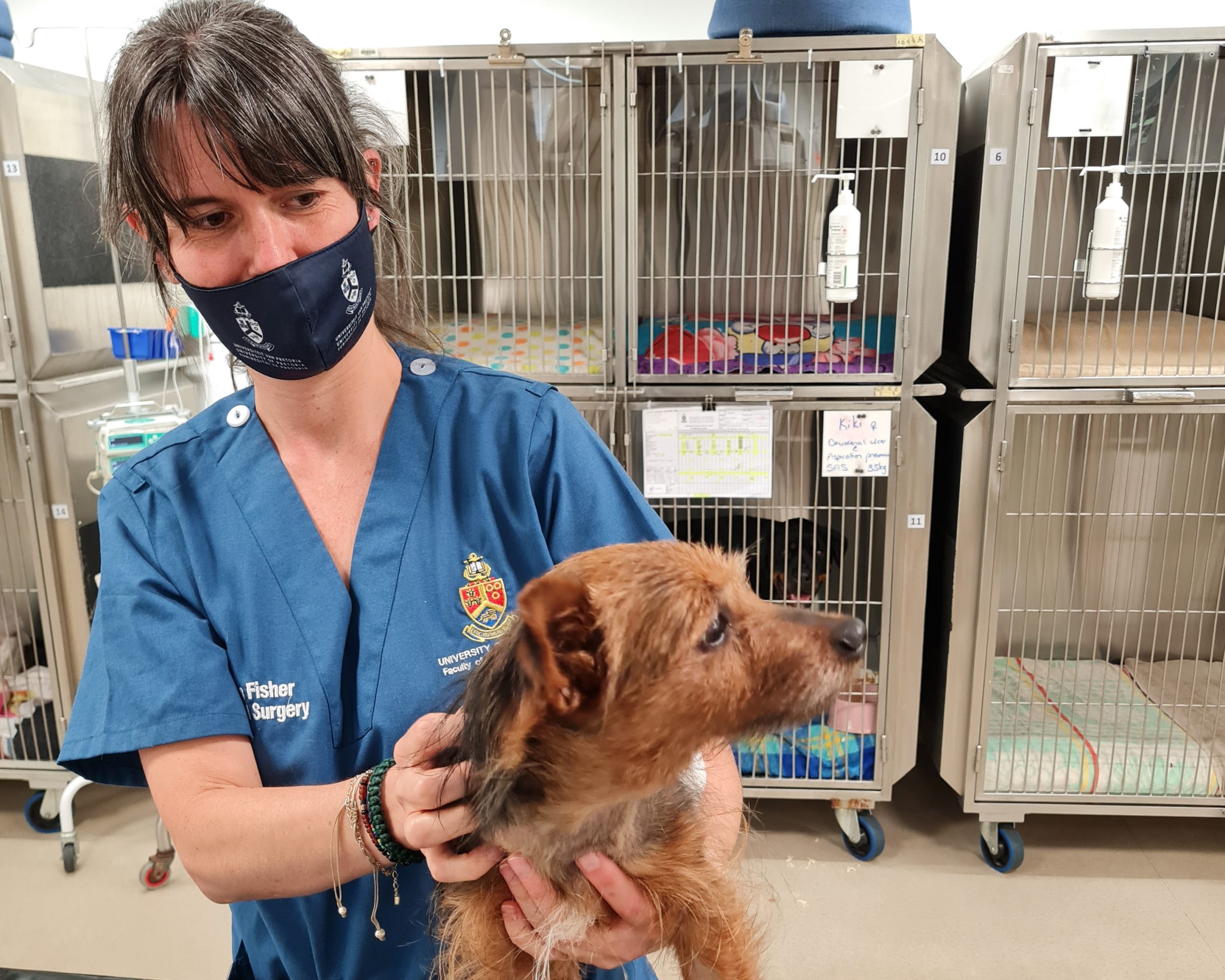
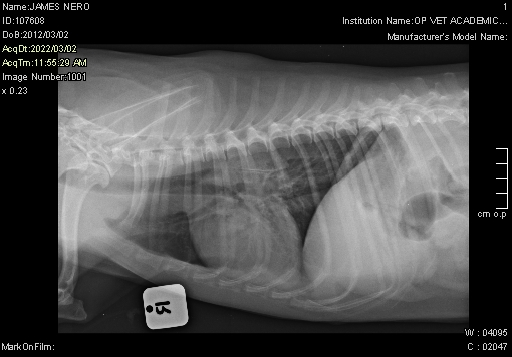
Nero, a Yorkshire terrier, has survived a terrible ordeal after he swallowed a bone that ended up stuck at the base of his oesophagus, just above his heart.
Nero was saved by vets at the University of Pretoria (UP) Onderstepoort Veterinary Academic Hospital.
Dr. Varaidzo Mukorera, a specialist in veterinary internal medicine in the Companion Animal Clinical Studies Department at UP’s Faculty of Veterinary Science, diagnosed the bone lodged in Nero’s oesophagus.
Opting for surgery rather than endoscopic retrieval of the bone, Dr. Mukorera then referred the case to Dr. Ross Elliott, a specialist veterinary surgeon in the same department.
“My main concern was that there was a perforation of the oesophagus,” recalled Dr. Elliott.
“The oesophagus is a muscular tube which forms part of the digestive system, linking the mouth to the stomach. When swallowing food, the walls of the oesophagus contract.”
Dr. Elliott performed the hour-long surgery in the Faculty’s Small Animal Surgery Clinic, under the tutelage of Dr. Adriaan Kitshoff, a diplomat of the European College of Veterinary Surgeons.
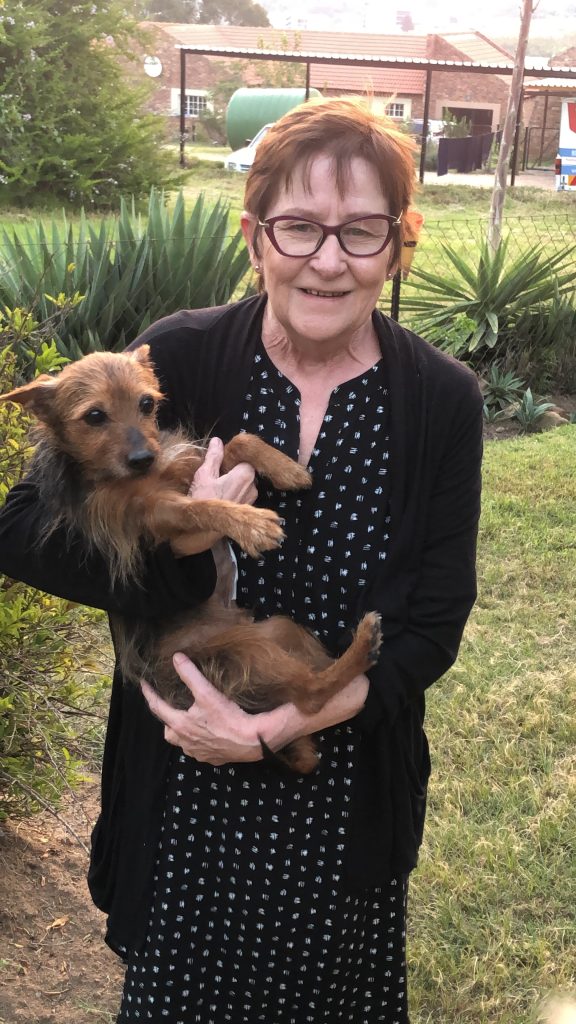
The resilient Yorkie spent 10 days in recovery before being discharged into the arms of his owner, Daleen James, a businessperson in Bryanston, Johannesburg.
“It was a complicated procedure as I had to perform a thoracotomy, a surgical procedure in which a cut is made between the ribs, to see and reach the lungs or other organs in the chest or thorax,” Dr Elliott said.
A portion of Nero’s oesophagus needed to be removed, as the bone had perforated the oesophagus in three places.
“The remaining healthy oesophagus was joined back together. The bone also caused damage to the aorta, the main artery carrying blood away from the heart to the rest of the body.”
Dr. Elliott repaired that leak, too.
In the week following the surgery, Dr. Elliott was concerned about surgical complications arising around the joining of the oesophagus.
Complications related to leakage from the joined oesophagus and an infection in the chest are very common after such surgery.
“Nero was kept under close surveillance. His limp body was held together by staples to ensure that the wounds healed swiftly.”
The team was anxious to ensure that there was no scarring, as a stricture narrows the oesophagus, Dr. Elliott explained.
The oesophagus is prone to scarring after such operations. In addition, the internal diameter decreases, making it harder for food to pass into the stomach.
“There is always a concern, when the oesophagus ruptures, that it does not heal quickly, or could lead to infection,” Dr. Elliott added.
“But ‘Super Nero’ recovered remarkably well. A day after surgery in critical care, Nero was standing in his cot, trying to get out.”
Daleen said she was relieved and thankful to Dr. Elliott for the miracle he performed on her beloved Nero.
“He’s doing very well,” said the doting owner.
The experience was very stressful, though.
Daleen says her nightmare began after Nero started coughing and vomiting.
When the coughing escalated to vomiting, Daleen took Nero to a vet in Fourways, Johannesburg.
The vet said Nero needed specialist attention and recommended the University of Pretoria’s Onderstepoort Veterinary Academic Hospital.
Before taking Nero to Onderstepoort, the vet told her the operation was a serious and big one, and that it might be better to put the dog down.
“My daughter and I said, ‘No way’,” recounted
Daleen. “But I was extremely worried.”
She added: “Dr. Elliott called me after the operation, saying that there was a 50-50 chance that Nero would not make it.”
Back home in Bryanston,
Daleensays Nero is already eating soft food and no longer using a feeding tube.
“The stricture risk is still there, but it can be sorted by stretching the oesophagus,” says Daleen.
“Nero means the world to me. I am glad he is on the mend and overcoming the worst. He’s a naughty doggy, but so cute.”
As for other dogs prone to the extremely common pet habit that landed Nero in such trouble, Dr. Elliott’s advice is simple: “Just don’t feed them bones.”