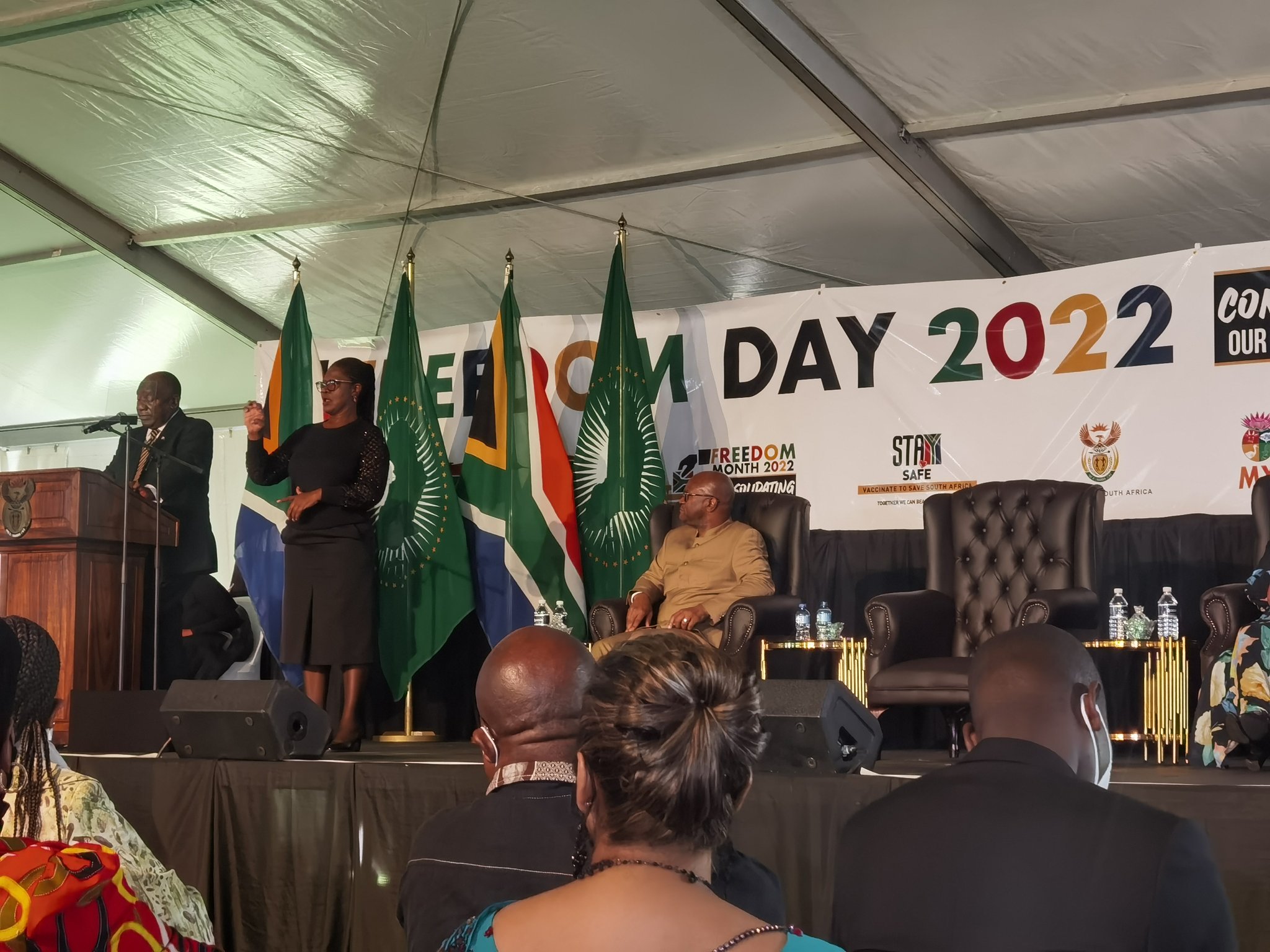
President Cyril Ramaphosa on Freedom Day recalled that, “28 years ago, just before midnight on the 26th of April, the old South African flag was lowered across the country for the last time”.
Speaking at the Middelburg Rugby Sportsfield in Mpumalanga, Ramaphosa said: “For 66 years it had been a symbol of repression, discrimination and segregation”.
He added: “Moments later, the flag of the democratic South Africa was raised for the first time.
“The next day, the 27th of April, a new era dawned as nearly 20 million South Africans cast their vote for the first time.
“We recall the immortal words of President Nelson Mandela on the day he was inaugurated, when he said: ‘Never, never and never again shall it be that this beautiful land will again experience the oppression of one by another. Let freedom reign’.”
Ramaphosa said in Middelburg, in the old cemetery, “is one of the darkest reminders of our divisive past. Segregation was enforced, even in death”.
English graves were separated from Afrikaans graves.
Whites were buried on one side, and blacks, Indians and coloureds on the other side.
“Such was the inhumanity that was apartheid. Never should it happen again,” said the president.
“Mpumalanga, like many other parts of our country, was a site of struggle against centuries of oppression of one by another.”
In 1959 the slave-like conditions of potato farm workers in Bethal spurred the successful countrywide potato boycott led by the South African Congress of Trade Unions.
“In Nelspruit in 1957 our imbokodo, the brave women of this province, led resistance to the pass laws,” said Ramaphosa.
“These women attacked the car of a magistrate who had come to enforce pass laws, and were met by police batons.”
In Standerton that same year, a group of 914 women marched on the mayor’s office to protest against passes and were arrested.
“We recount this history on Freedom Day not to hold on to the past,” said Ramaphosa.
“We recount them as a reminder that we are a nation that looks forward and that moves forward.
“Today, in the province of Mpumalanga and across our beautiful land, the people have tasted the fruits of freedom.
“The quality of life of our citizens has been improved.”
In democratic South Africa, 81 percent of people live in formal housing.
Nine out of 10 South Africans have access to clean water and more than 85 per cent have access to electricity.
In democratic South Africa, basic education and health care is no longer the privilege of a few, but available to all.
Ninety-six per cent of children of school-going age are in school.
Two-thirds of these learners attend no-fee schools.
Free tertiary education is being provided to young South Africans to study, a dream that was denied their forebears.
“Here in Mpumalanga, more than 600 000 children from poor households receive a meal at school through the National School Nutrition Programme,” said the president.
“This programme feeds more than nine million learners every school day across our country.”
In democratic South Africa, people have expanding opportunities to realise their potential.
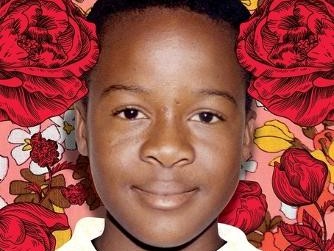
He said in a free South Africa, a young woman like Angela Kgothatso from Thembisile Hani District Municipality could overcome difficult circumstances to become Mpumalanga’s top performing matriculant for 2021, achieving 100 per cent in mathematics and physical sciences.
Ramaphosa said government support has enabled an aspirant farmer like Njabulo Mbokane from Ermelo to realise her dream, helping her along her journey from selling fish and chips from a street stand to becoming a successful commercial maize farmer.
He said in democratic South Africa, social grants provide a lifeline and source of income to millions of indigent people every month.
“In free South Africa, we have recognised the injustices of the past, and are implementing a programme to restitute and redistribute land to those who were dispossessed of their birthright,” said Ramaphosa.
The South Africa of today is democratic and open. The government is based on the will of the people, and every citizen is equally protected by law.
“The people’s voices are heard and their right to be part of any decision that affects their lives is protected,” said Ramaphosa.
“In our free society, anyone can approach our courts for recourse, for the enforcement of their rights and to challenge any executive decision.
“In democratic South Africa, neither government, employers or individuals can discriminate against someone on the basis of their sexual orientation.
“Same-sex couples can marry, adopt children and inherit from their partners.
“In South Africa today, nobody can be discriminated against or lose their employment because of their HIV or any health status.”
In democratic South Africa, gender discrimination in any form is outlawed and women married under customary law enjoy rights that were denied to them in the past.
In South Africa today, people are protected against the denial of basic services, and against arbitrary eviction from their homes by landowners.
Farmworkers and labour tenants are protected against eviction from farms, an issue that has a painful legacy here in Mpumalanga.
In South Africa today, there is freedom of belief and religion in communities, in schools and places of higher learning, and in workplaces.
In the past, African cultures were looked down upon and African languages denigrated.
Today all South Africans are free to practice their cultures, all our 11 national languages enjoy equal recognition, and there are efforts underway to make sign language an additional national language.
“Our independent courts protect citizens against the arbitrary use of power and can compel government to enforce their rights,” said Ramaphosa.
“We have laws to protect against gender-based violence, to uphold the rights of children and to empower persons with disabilities.
“Despite all these achievements, and despite much progress, we are not yet where we want to be.
“Having endured decades of injustice and hardship, in 1994 we were infused with hope and expectation.
“We held the vision of a promised land of freedom, equality and shared prosperity.
“However, that vision has been tarnished by acts of corruption and state capture.”
For some in positions of responsibility, the president said the pursuit of self-enrichment was more important than improving the lives of the people.
South Africans have shown that they are determined to restore that vision, to end state capture and fight corruption, and rebuild the institutions of democracy.
In recent years, the ruinous apartheid inheritance of poverty and unemployment has been worsened by global economic shocks, a devastating pandemic and by our own missteps and shortcomings.
“Gender-based violence, substance abuse and other societal ills have become rampant in our communities. Crime and violence is eating away at our society,” lamented the president.
“We can only defeat crime if we work together, as families, as communities and community leaders, as faith communities and leaders, and as individuals.”
Forty eight years ago, one of Mpumalanga’s most famous sons, Hugh Masekela first released his famous song about the pain of black men and women in this land of Africa.
He sang of the coal train that comes from Namibia, Malawi, Zambia, Zimbabwe, Angola, Mozambique, Lesotho, Botswana, Swaziland and all the hinterlands of southern and central Africa.
He sang of the men conscripted to dig, deep in the belly of the earth for almost no pay, far from their families and the loved ones they may never see again.
The lyrics of Stimela were about the lives of all the labourers on whose backs this country was built. They resound deeply today.
“We are confronting a new menace of violence against our brothers and sisters from other African countries,” said Ramaphosa.
“We have seen it in many parts of the country in recent weeks, and it is deeply troubling.
“There can be no doubt that we must work urgently to resolve issues of illegal immigration and its impact on our economy and society.”
Ramaphosa said there will never be any justification for violence.
“For those who seek refuge from persecution and have legitimate grounds, for any who have entered our country legally and have the legal right to be here, they will find South Africa a welcoming place,” he said.
“Fellow South Africans, on this Freedom Day we must ask ourselves what society we want to be.
“We are a people who respect the sacrifices of those who came before us.
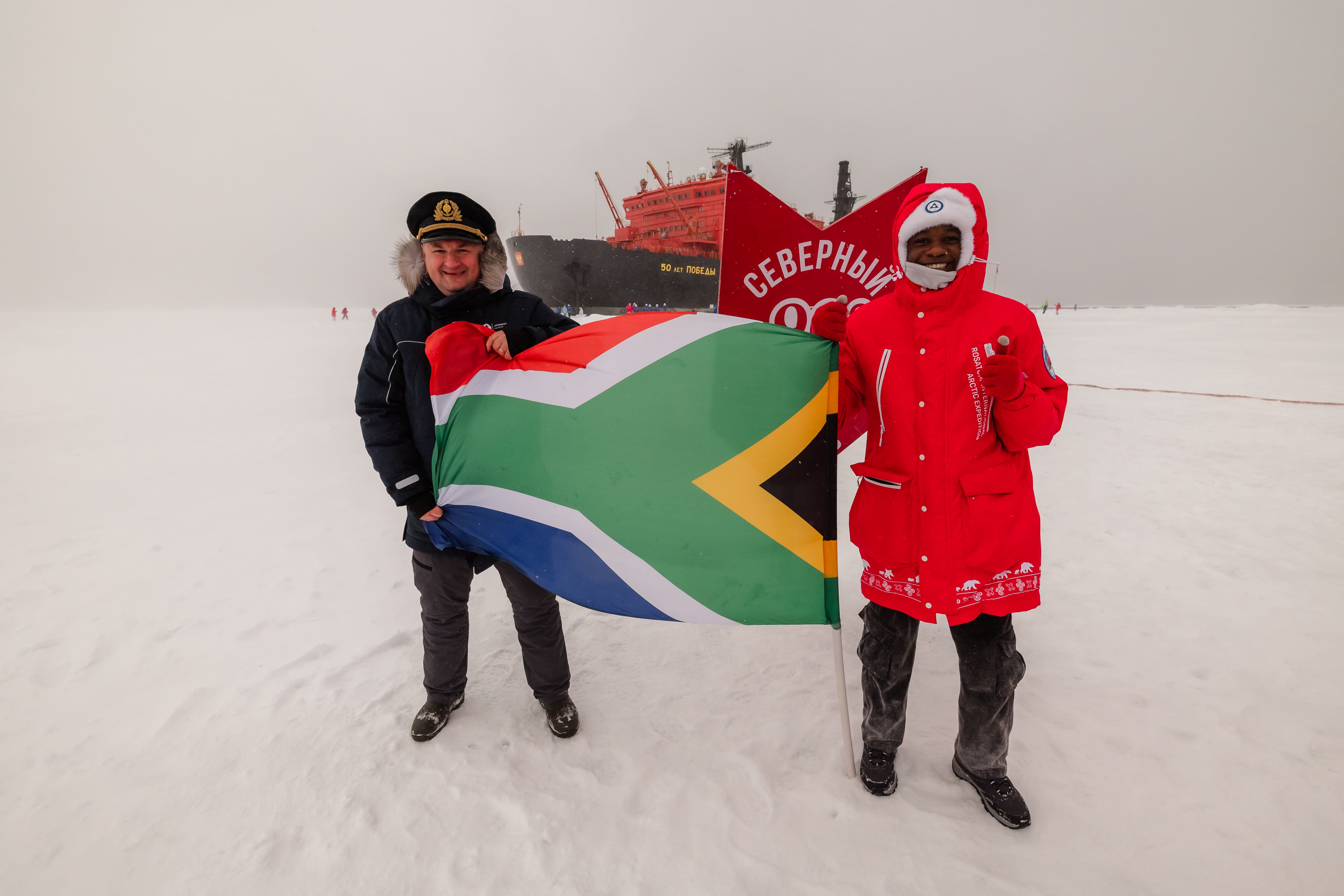
“We take great pride in our nationhood and in the national symbols of our country, including our national flag.
“We are a people of empathy, compassion and largeness of spirit.
“One need only look at the great acts of charity and humanity being extended to the victims of the devastating floods in parts of KwaZulu-Natal, the Eastern Cape and North West and the fires in Langa, Cape Town.
“As we mourn the many lives that have been lost, the unity and solidarity in the reconstruction effort reminds us once more of the values that make us a great people.
“We must ask ourselves what is needed to get us back on the path to the land promised by the Constitution.
“We must ask ourselves what our own individual contribution must be to building the society we want.
“We are a people who want to live in comfort and security not for ourselves alone, but for our neighbours.
“These are the kind of values that we need as we consolidate our democratic gains to rebuild South Africa.
“Overcoming poverty, unemployment and inequality are our foremost considerations.”
The president said through the Economic Reconstruction and Recovery Plan, government continues to work to create a conducive environment for business.
“In return, it is our expectation that business should step up their investment in communities and in human capital for the sake of developing South Africa,” he said.
Ramaphosa said as government at local, provincial and national level, “let us consolidate our efforts” to deliver on “our promises” to the people of South Africa by managing public resources wisely and by taking a firm line against corruption.
“As communities let us work together and with community policing forums to make our areas safer and crime-free.
“Let us not tolerate the abuse of women and children.
“Let us not allow discrimination against persons living with disabilities.
“Let us end all acts of hate directed at the LGBTQI+ community.
“Let us take a stand against those who want to sow division and anarchy in our communities by persecuting nationals from other African countries.
“If we have evidence of criminal activity, let us report those to the police and not take the law into our own hands.”
On Covid-19, Ramaphosa said South Africa was in a new phase of management of the pandemic, which he said was still very much “with us”.
“With the winter months approaching, let us take particular care of ourselves and those around us by getting vaccinated, getting our booster shots if needed, and by observing the public health protocols.”