South African organisation, the Molteno Institute for Language and Literacy, has won the United National Educational, Scientific and Cultural Organization (UNESCO) Confucius Prize for literacy for 2022.
The announcement was made this afternoon in Abidjan, Côte dIvoire, as part of the International Literacy Day celebrations held in the West African city this year.
Earlier this year, the South African National Commission for UNESCO provided assistance to the Molteno Institute for Language and Literacy in applying for the UNESCO Confucius Prize for Literacy 2022.
The Assistant Director-General for Education at UNESCO Stefania Giannini said: It is my pleasure to inform you that the programme School Readiness Through Community Participation has been selected as one of the winners of the UNESCO Confucius Prize for Literacy 2022.”
Giannini added: “I wish to extend my congratulations to the Molteno Institute for Language and Literacy in South Africa for this achievement.
“The Jury greatly appreciated the value of producing literacy resources for preschool children, which are linguistically and culturally relevant and cater to the needs of those living in rural areas.
“Moreover, it found significant the value-added from direct involvement of parents, which contributes to constructing appropriate play environments and liaising with local schools.
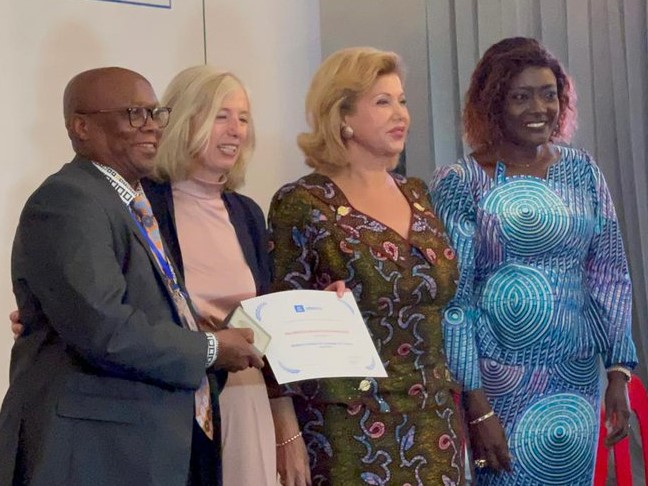
The award of the UNESCO Confucius Prize for Literacy comprises a silver medal, a diploma, and a cheque for US $30 000.
Molteno Institute CEO Masennya Dikotla, attended the prize-giving ceremony in Abidjan, the capital of Côte d’Ivoire.
He said: Moltenos core business in the African continent is to ensure children can read for meaning by the time they turn 10 years old or are in grade 4.”
“We do this through mother tongue-based education,” explained Dikotla.
“The program that won us this years prize is called School Readiness Initiative through Community participation.
“We mobilize local communities and parents to use their skills and trades to create natural playgrounds for their Grade R children to enable them to Learn through play.
South Africas Ambassador to Côte dIvoire, Zolani Mtshotshisa, congratulated the Molteno Institute.
I am proud to see an organisation from our country doing this great work in the area of education in general and literacy in particular,” said Mtshotshisa.
“This project is important it focused on the role of the community in the education of the children. We applaud the good work which has attracted the attention of stakeholders on a global level.
Mtshotshisa said the objectives of International Literacy Day are to remind the SA public of the importance of Literacy in improving Our Community, Our Economy, and Individual Lives.
It is a day to encourage organisations and individuals to re-imagine Literacy Learning Spaces; and Explore and share existing initiatives to leverage and transform literacy learning spaces to maximise literacy learning in adults and youth in various contexts.
International Literacy Day was declared by the United Nations Educational, Scientific and Cultural Organisation (UNESCO) in October 1966 at the 14th session of its general conference.
International Literacy Day was celebrated for the first time on 8 September 1967.
It has since been observed and celebrated annually in different countries and by all UN member states.
International Literacy Day serves to remind the public of the importance of literacy as a matter of dignity and human rights, and the foundation of all learning.
In 2022, International Literacy Day is being celebrated under the theme: Transforming Literacy Learning Spaces, which fits perfectly in the current context of the disrupted learning experienced due to Covid-19, and the commitment of the various UN member states to transform education and build forward differently.
According to the UNs Secretary-Generals Policy Brief Education in the time of Covid-19 and beyond (2020): in the aftermath of the pandemic, nearly 24 million learners might never return to formal education, out of which, 11 million are projected to be girls and young women.
The sub-theme theme is: Adapting Learning Spaces For All And Leveraging Learner-centric Spaces.
About SA UNESCO National Commission
The South African National Commission for UNESCO was established by Cabinet Decision No. 9 of 1996.
It was placed under the auspices of the Department of Basic Education to promote UNESCO’s objectives with regard to education, science, culture, and communication.
The National Commission also facilitates the planning, execution, and evaluation of UNESCO activities in South Africa.
More broadly the National Commission, in collaboration with relevant National Departments, actively participates in UNESCO’s activities pursued at sub-regional, regional and inter-regional levels.