Yemen is one of the poorest countries in the world and even before this current war began it has had a rather multifaceted history with conflict that has been going on for many decades.
The division in the country began to be much apparent in 2011, after the Arab uprising and protests in Sana’a over the level of corruption in government, education sector and the economy all over the country took place.
The current conflict in Yemen has been called a proxy war because there are multiple players involved – between Saudi Arabia and Iran, a Shia and Sunni conflict, and disagreements between the Houthi’s and the Yemeni government.
In reality, the armed conflict, internal political situation, and clear differences that are taking place is ultimately targeting infrastructure and killing millions of innocent civilians across Yemen.
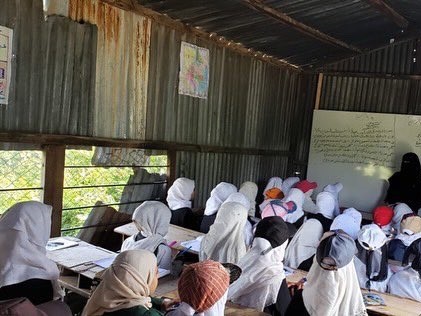
As a consequence of this, the lack of political stability in the country implies that the education system is practically non-existent.
The war has had a catastrophic impact on the country, not only economically but also on the nation’s health.
Serious nourishment weakness contacts 7.6 million individuals and an expected 2 million are malnourished, including 1.3 million children, of whom 320 000 are experiencing serious food scarcity and suffer acute malnutrition.
Yemen has been struggling throughout this war, and the education sector has taken a major hit.
The focus on spending has shifted to weapons to try to win the conflict.
The right to free basic education is written in the Yemeni legislation Act No. 45 of 1992 which guarantees the right to education.
However, basic services such as education have been diminished.
Before the conflict, Yemen’s education sector met the target of “Education for All” in 2000 as it applied the Dakar Framework.
Yemen saw enrolment increase from 73 percent to 100 percent and saw a significant rise in girls’ enrolment from 52% to 92% (GPE, 2013-15).
Although this achievement showed commitment to education, the MDG goals were not accomplished by 2015 with the start of yet another war.
For several years, the right to education continues to be an impossible goal for many Yemeni’s students.
Dozens of children are being killed in the war.
Attacks have damaged schools, traumatised teachers and students, and schools have become abandoned for becoming hazardous spaces where conflict is taking place nearby.
Yemen, which has still not achieved the MENA 2 global economy and development program goals in education services needs to prepare for the future skills demand.
If the war ends in 2022, human development predicts it will be set back a whole generation.
This indicates that the youngest Yemini generation will struggle to keep up with education altogether, as many students would have missed out as a result of the many years of conflict.
It will take many years to build a system to make up for lost education. Once again, this is a problem for access to basic education which ultimately affects education planning.
The situation that the Yemenis children face has direct implications for their human right of accessing basic education.
During the conflict, schools and places of learning are regularly targeted and it is estimated that in Sana, out of 80 schools and “36 are occupied by armed groups or armed forces”, this means around 120,000 children are missing out on learning in just one city as armed groups take over.
In addition, conflict can have a very significant effect on dropout rate, recruitment into the military or armed group, displacement and survival rates, economic, and social problems, and food insecurity.
A report conducted by UNICEF indicates that “nearly 3 200 have been killed, over 5 700 have been injured and nearly 3 500 have been recruited into armed forces and groups.”
This has serious and major implications for children.
According to the OCHA, the level of conflict has increased drastically since the beginning of the war, this is reflected in attendance, displacement, and kidnapping levels.
Teachers face multiple challenges to demonstrate any form of basic education as they are constantly thinking about their next salary, meal, and their students.
Teachers often feel the need to commit suicide because of the enormous pressures they are faced with day to day.
Oftentimes, teachers find that they have run out of spaces to teach as schools become occupied by armed groups.
At the same time, funding is being halted as the economy is weak which limits the value of education.
Therefore, Yemen in conflict represents the biggest challenge to attaining the UN SDG’s goal 4.
Moving forward, it is eagerly anticipated that a ceasefire will be negotiated between the different groups involved in the fighting.
Nevertheless, peace talks need to go ahead to ensure a military and political solution to end the war for the world to assist with humanitarian aid to the Yemeni people as soon as possible.
It is important to consider the importance of stabilising the situation first.
Focusing on the long-term necessities like basic education and investing in human capital.