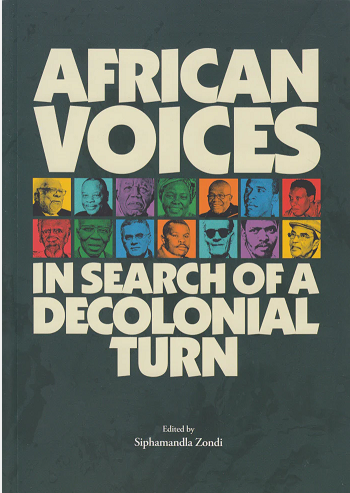
Edited by Siphamandla Zondi, this book may be summed up, as one among the successful contemporary texts, which deserve to be gregariously welcomed, as part of ongoing epistemic efforts, contributing towards incomplete “debates about decolonization and the Africanization of knowledge” (Pp.1), by African scholars refusing to be “silenced, erased, ignored, denigrated and submerged” (Pp. 9).
This book ought to be read, as a user manual “to join the call for epistemic rebellion and disobedience” (Pp. 10) from literature expected from the decolonial library (as opposed to Paul Zeleza’s paraphrased reference in this book to the existence of a “colonial library” (Pp.1).
The aforesaid forms part of an epistemic quest, by African scholar-activists “, to recentre Africa” (Pp.1).
The cohort of contributors in this book, systematically mused about marginalised insights, from historically obscured African scholarship.
The method of achieving the latter goal, aptly involved current African scholars selecting an African predecessor of their choice and addressing their oeuvre, to ascertain the germaneness of their philosophical ideas, to “decolonization” and “Africanization”.
In the maiden chapter Siphamandla Zondi opens, with a pedagogic overview befitting of an editor, who goes out of his way to channel the direction of the “protracted process” (Pp. 6) of engaging issues of an “African archive” (Pp.7).
Zondi’s Chapter 1 is built upon the useful foundation and tone, already set by Ethiopian scholar Mammo Muchie, in the didactic foreword.
Muchie stated upfront that this book was “about what African scholars and activists in the struggle for intellectual decolonization have written and said over the past few decades” (Pp. v).
I support Muchie’s view, that this book ought to be “understood in the context of the long road toward the decolonization and Africanization of knowledge and education” (Pp. v).
Muchie, however, could have avoided misspelling the name of South Africa’s pioneering female Pan-Africanist, not as Anne but as Alice Victoria Kinloch (AVK).
Zondi’s Chapter 1, is an instructive overview of this book.
As an opening chapter, it offers a historical background of Africa’s “epistemicides” (Pp.3), which support efforts following Ngugi Wa Thiong’o’s call to “decolonize our minds”, to liberate African minds.
Zondi furthermore introduced and evoked authoritative scholars and their jargon, such as Anibal Quijano and Ramon Grosfiguel’s “coloniality” (Pp.2), Boaventura de Sousa Santos’s “epistemicide” (Pp.3), Lewis Gordon’s “geography of reason” (Pp.3), Sabelo Ndlovu-Gatsheni’s ‘colonial matrices of power’ (Pp.4), “abysmal knowledge” (Pp.4) and “epistemic disobedience” (Pp.6).
Mindful of other books, also addressing epistemic ventures vis-a-vis contentious themes of “Decolonisation” and “Africanisation”, readers are expected to differ about the strengths and weaknesses of this book.
I opine that the strengths of this book exceed its weaknesses.
Part of the strengths included the realisation that all contributors, provided sufficient content in their responses to this book’s seminal questions, addressing the whereabouts of African voices, in efforts to break out of the silence and liberate “African discourse from the traps of Eurocentric epistemology and the tropes of the colonial library” (Pp.1).
Another strength of this book is the showcasing of the promising priorities of South African research institutions, in this case namely this book’s publishers the Africa Institute of South Africa (AISA) of the Human Sciences Research Council (HSRC).
It is vital to acknowledge AISA’s agreement to publish, what began as discussions among members, of the locally founded African Decolonial Research Network (ADERN) in Pretoria, South Africa.
Indeed the value of this book to “recentre Africa” (Pp.1), to sagaciously contest the hegemony of Western epistemology, must be embraced as part of the “agency of Africa and Africans” (Pp.4), as reminded by the nationwide tertiary outcry of RhodesMustfall and Feesmustfall.
On the basis that no book can be perfect, the weaknesses of this book similar to its strengths may expectedly differ, among its readers.
Whatever other critics may say, for me the gravest weakness of this book was its gender imbalance.
Having read how South Africa’s AVK (Pp. v) and the South African-born author (who later became a citizen of Botswana) Bessie Head (Pp.7) were fleetingly evoked, in this book’s opening sections yet in the looming chapters, only Kenya’s Wangari Maathai was engaged, left me troubled.
Being mindful of my locus of enunciation as a South African black male scholar, such sparse reference to especially black South African women among others from elsewhere in Africa, left the impression that Zondi, as the editor of this book fell into the pitfall of privileging patriarchal views of African voices, at the expense of the continually obscured matriarchal views.
I highly recommend this book.
* Dr Tshepo Mvulane Moloi
Postdoctoral Research Fellow at Ali Mazrui Centre for Higher Education Studies at UJ