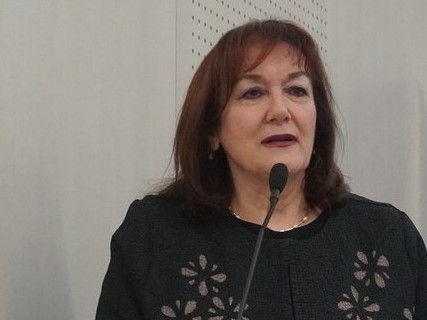
Giles Merritt reports on “demography commissioner” Dubravka uicas ambitions for a specialised new EU body to confront ageings threats.
With any luck, a new EU agency will be born next year to focus politicians attention on the problems of ageing.
If it happens, that would at long last spotlight the costs and chaos that the retirement of tens of millions of Europeans is certain to bring.
Correction: “With any luck” should probably read “with a great deal of luck”, and “may” be born substituted for “will”.
Efforts within the European Commission to get the EUs looming demographic disaster onto the political agenda are having to contend with widespread indifference, if not outright disbelief.
Yet were talking of around 40 million fewer taxpayers, and over 50 million more pensioners.
The implications are horrendous.
Some experts talk of ageing as the EUs nuclear threat
One of the raisons dêtre of the European Commission since its earliest days has been to look further ahead than can its member governments, which have to wrestle with pressing day-to-day events.
Its surprising, therefore, that even senior Eurocrats have shown such little interest in the challenges of ageing.
Maybe these difficulties are too daunting to contemplate, but its also possible that the Brussels commissions indifference reflects an institutional architecture more suited to handling yesterdays policy needs than tomorrows.
The commission does, however, have an Agitator-in-Chief whose role is to advocate a more coherent approach to demographic change.
Veteran Croatian politician Dubravka uica is the commission member whose portfolio spans demography and democracy.
As one of Ursula von der Leyens vice-presidents, uica had been expected to have enough clout to push ageing much higher up the EU agenda.
However, political inertia along with the sheer breadth of the problems being triggered by demographic change have dogged her efforts at almost every step.
uica now has a year or so to convince EU member states along with her commission colleagues and as many MEPs as can be mustered that a powerful new “Ageing agency” should be created before the end of 2024, when the next European Commission takes office along with a newly-elected European Parliament.
She is pinning her hopes on the Spanish and Belgian EU presidencies of the EU Council of Ministers linking their shared focus on ageing.
Institutionally, they would do so within an informal framework called “Friends of the Presidencies” that Croatia briefly initiated before its own EU presidency in the first half of 2020 was hit by the Covid-19 pandemic.
Few if any of the problem areas being thrown up by Europes ageing are EU competences.
But as their economic impact will hit the poorest southern and eastern member states hardest, theres a danger that without unprecedented and hugely expensive cohesion spending the European Union will itself be endangered.
Some experts talk of ageing as the EUs nuclear threat.
Will uica succeed in awaking Europes somnolent political leaders to the seriousness of demographic decline?
Ageings side-effects range from bankrupted pension systems to shrinking tax revenues, and from soaring healthcare costs to economically debilitating labour shortages.
Dubravka uicas view is that a new EU body is needed to establish a much clearer picture of the ways demographic change will affect different EU countries, and thus lay the groundwork for more concerted policy responses.
Of the two portfolios handed to uica by Ursula von der Leyen, that of democracy encompassed the “Conference on the Future of Europe”, which reported almost a year ago.
Although dismissed by many as a talking shop of limited relevance to the EUs institutional problems, the conferences proposals contain useful ammunition for uica.
Among the conferences proposals theres one on demographic transition that sets out the broad terms of a mandate for the agency.
It emphasises the need for improved childcare, healthcare, education and training to support Europes under-privileged young, for it is they who must bear the brunt of ageings costs.
It also points to pensions and retirement problems and the importance of tackling the EUs growing regional disparities.
Will uica succeed in awaking Europes somnolent political leaders to the seriousness of demographic decline?
It wont be easy to interest vote-seeking politicians in problems that not only lie ahead but also demand considerable sacrifices and spending as of now.
The hope amongst the comparatively few Eurocrats who share her concerns is that she will be rewarded with the birth of a new EU body that, if not as muscular as it needs to be, will at least be noisy.
*The views expressed in this Frankly Speaking op-ed reflect those of the author and not of Friends of Europe.
*This article first appeared on the Friends of Europe website and is reproduced with kind permission.
*The views expressed by the author of this article, Giles Merritt, are not necessarily those of The Bulrushes