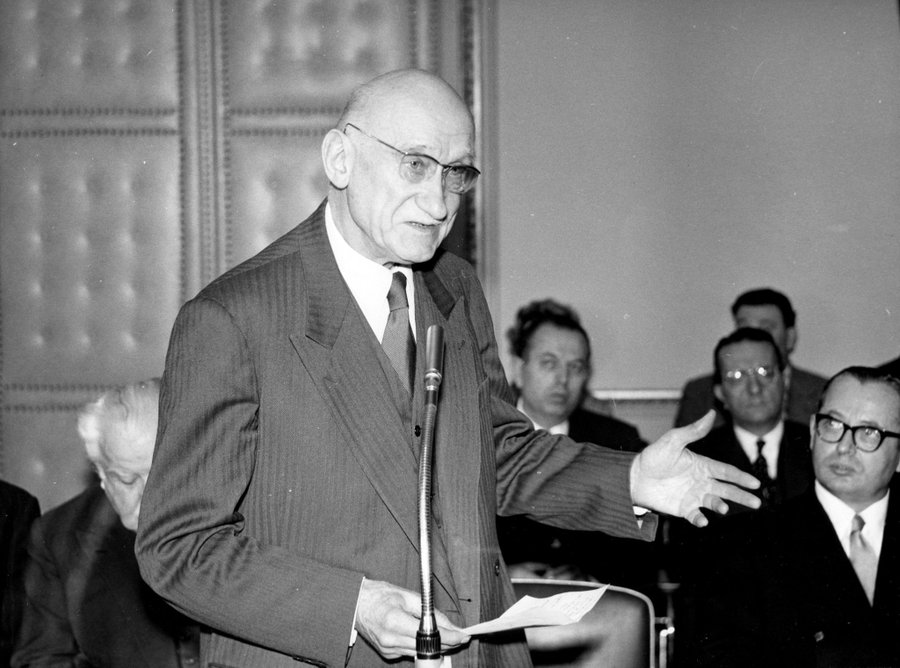
Giles Merritt risks raining on the EU’s birthday parade by asking whether its ‘founding fathers’ would find as much to celebrate as they might have hoped.
For Eurocrats, and for many in the so-called “Brussels Bubble”, May 9th is a holiday.
It’s “Saint Schuman’s Day” celebrates the anniversary of the 1950 Schuman Declaration that launched the European Coal and Steel Community, the embryonic forebear of the EU.
It’s also a good moment to reflect on the Union’s achievements and failures, and its prospects.
The first thing to celebrate would be the European Union’s popularity. Public opinion is more supportive than it has been for a good many years.
Even so, France’s Robert Schuman and his fellow founding fathers would be disappointed to find the EU becalmed in the political doldrums, lacking direction and momentum.
Put simply, it isn’t en route to a clear destination.
The outlook for the Union is less rosy. It’s unclear where it’s headed
The EU’s approval ratings nevertheless regularly hit 69 per cent, having previously languished for almost four decades well below 50 per cent.
Europhiles will probably greet this as a strong endorsement, although the reasons are more complex.
Researchers believe that the tailing-off of the 2015-16 migrant crisis and lower unemployment levels are the most significant factors.
Together, they point to the European public’s ignorance of the negative factors – demographic shrinking and ageing, and consequent manpower shortages – that are threatening economic growth, not stimulating it.
The EU’s robust response to the Russian invasion of Ukraine has also played a part in improving the EU’s image.
Commission president Ursula von der Leyen has projected a reassuring picture of intra-European solidarity and firmness of purpose. Beneath the surface, however, the outlook for the Union is less rosy.
It’s unclear where it’s headed, both in the global context and in terms of its own institutional structures.
Pressures for further enlargement of the EU are growing, but the Union is in no position to handle a wider membership.
Some sort of integrated relationship with Ukraine seems unavoidable, while the need to accommodate candidates from the Western Balkans is also increasingly difficult to sidestep.
War-torn Ukraine is just one of a long list of hopefuls that numbers Albania, Serbia, Kosovo, Montenegro, Bosnia & Herzegovina and North Macedonia, as well as Moldova and Georgia.
The EU’s own security is a crucial element. Whether they are inside the EU or not, the volatility of these countries, and in some cases their ambiguous relationship with Moscow, make them potentially troublesome.
At the same time, few EU policymakers believe that the EU’s present decision-making mechanisms and budgetary resources could cope with an expanded membership.
Realistically, an EU that numbers as many as 36 countries, and whose newcomers are weighed down by severe economic and political ills, could endanger the whole project of European integration.
It’s hard to know what founding statesmen like Schuman’s fellow Frenchman Jean Monnet or Belgium’s Paul-Henri Spaak would make of the EU today
How the EU’s enlargement conundrum will pan out is anyone’s guess. The underlying point here is that the Union is anyway running on the spot rather than moving forward.
That’s less the fault of its Brussels-based institutions than of the deadlocks between member states.
Politicians of all hues and ideologies are to blame for the way Europe’s political integration has ground to a halt.
There’s no denying that the day-to-day EU is a well-oiled machine.
Although the European Commission is a little less self-critical than might be wished, it handles its responsibilities competently and has developed forward-looking policies as well as circumstances have allowed.
Where it has fallen short, with potentially disastrous consequences, is in its failure to address the overwhelming problems of demographic change and Europe’s diminished role in world affairs.
The cost of ageing over the coming quarter-century will be cripplingly expensive, while Europe’s shrinking share of the global population, eventually to an estimated 4 per cent, will demand a radical foreign policy re-think.
Neither of these challenges can be handled without much closer political union, even though this has eluded EU governments and civil society since the onset of this century.
It’s hard to know what founding statesmen like Schuman’s fellow Frenchman Jean Monnet or Belgium’s Paul-Henri Spaak would make of the EU today. But it’s a fair bet that they would despair of the Union’s stubborn refusal to highlight the troubles that loom ahead.
As Monnet once warned: “Europe will be forged in crisis, and will be the sum of the solutions adopted for those crises.”
*This article first appeared on the Friends of Europe website and is reproduced with kind permission.
*The views expressed by the author of this article, Giles Merritt, are not necessarily those of The Bulrushes