In a momentous event on Monday, Kenya and the European Union sealed a momentous trade deal, guaranteeing unfettered access for Kenyan agricultural products into its prime export market.
President William Ruto presided over the grand ceremony held in Nairobi, which marked the official culmination of the Economic Partnership Agreement.
Once the agreement receives official ratification, the EU-Kenya Economic Partnership Agreement (EPA), which was meticulously concluded by both parties on Tuesday, will unleash the full potential of the Kenyan market within the European Union, except for arms.
This accord arrives at a crucial juncture as Brussels strives to fortify its economic ties with Africa, an endeavor aimed at countering the growing influence of China in the region, writes Kevin Mofokeng, a digital PR strategist.
In a groundbreaking agreement, Kenyan goods are now assured duty-free and quota-free access to the vast market of the 27-member European Union, which stands as Kenya’s paramount export destination and its second-largest trading partner.
In 2022, Kenya successfully exported a staggering 1.2 billion ($1.31 billion) worth of predominantly agricultural products to the EU.
Notably, the country’s prized exports such as tea, coffee, exquisite cut flowers, peas, and beans found their esteemed place within the European market.
Of particular significance, a remarkable 70% of Kenya’s entire flower production splendidly blossoms in the European domain.
On the flip side, the largest economy in East Africa, Kenya, has agreed to gradually and partially open its market to European goods.
Over 25 years, tariffs will be progressively reduced, fostering a mutually beneficial trade environment.
Presently, Kenya predominantly imports machinery alongside mineral and chemical products from the EU, thereby underscoring the potential for expanding trade relations between the two parties.
Kenya has fortified its position by safeguarding certain “sensitive products” through the exclusion from tariff reductions or the activation of protective measures in response to sudden surges in EU imports.
This strategic move serves as a shield to safeguard Kenya’s interests amidst the burgeoning trade relations between the European Union and the country, with trade volumes witnessing an impressive 27% surge between 2018 and 2022.
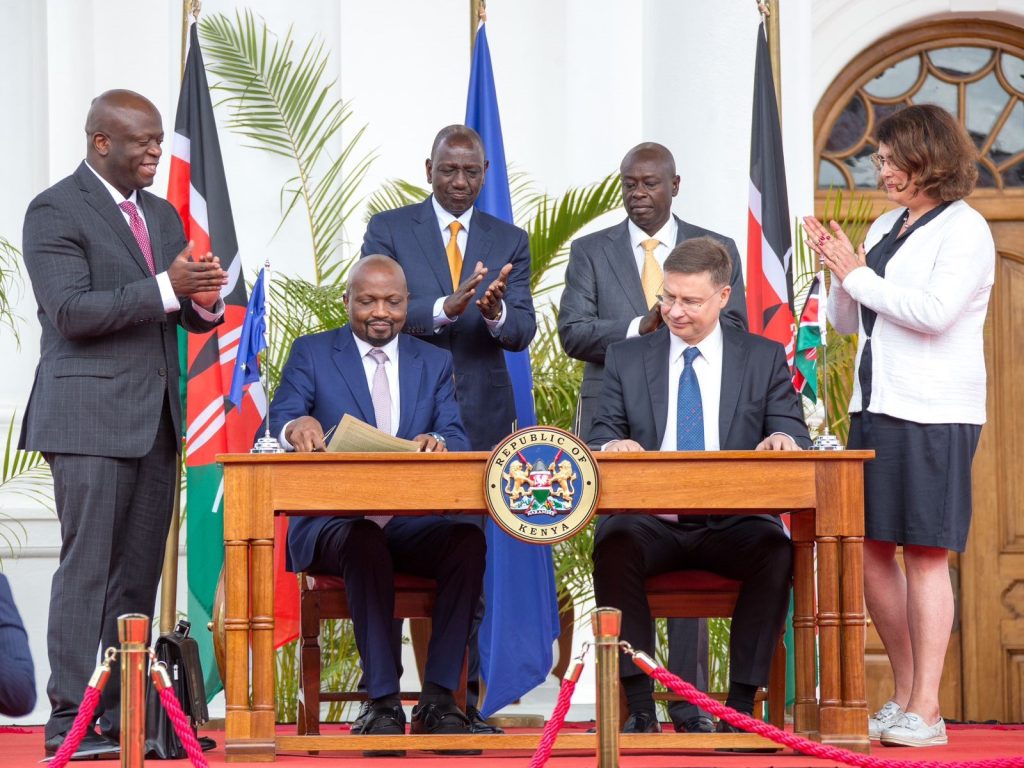
During the ceremonial culmination of the negotiations on Monday, Kenyan President William Ruto emphasised the significance of this milestone agreement, highlighting the economic benefits it would bestow upon Kenyan traders.
Ruto proudly proclaimed that this agreement not only amplifies the financial gains for Kenyan businesses but also establishes Kenya as a natural gateway for EU products to permeate the markets of East African states.
What does the EPA mean for Kenya?
This Economic Partnership Agreement (EPA) stands as a remarkable achievement, representing the first comprehensive trade pact between the European Union and an African nation since the EU’s signing of a similar accord with Ghana back in 2016.
The Economic Partnership Agreement (EPA) holds significant implications for Kenya, marking a pivotal moment for the country’s trade landscape.
As Sherillyn Raga, a distinguished research fellow at the renowned ODI think tank and an expert in macroeconomics and trade, aptly points out, this agreement arrives at an opportune juncture, offering the potential to diversify Kenya’s traded products and expand its network of trading partners within the European Union.
Currently, the Netherlands, Germany, and France stand as the primary destinations for EU imports, commanding considerable influence in the trade domain.
However, amidst the global upheavals caused by the Covid-19 pandemic, the repercussions of Russia’s conflict in Ukraine, and the relentless impacts of climate change, it becomes imperative to fortify Kenya’s economic resilience.
Raga, stresses the vulnerability inherent in relying on a limited number of trading partners or a concentrated range of products.
In light of this vulnerability, trade diversification emerges as a vital strategy to enhance Kenya’s ability to weather sudden and severe fluctuations in global prices and navigate the ever-changing economic landscape.
Indeed, the EPA signifies a crucial step towards bolstering Kenya’s resilience against future shocks, enabling the country to embrace a more diverse and robust trade portfolio.
In the immediate future, the trade deal between Kenya and the EU may not bring about substantial changes for Kenya’s exports.
It is important to note that Kenya already benefits from duty-free and quota-free trade with the EU through a temporary special arrangement that was established in 2014.
This arrangement was implemented after the EU’s negotiations with the East Africa Community (EAC) failed to materialise.
Nevertheless, the significance of the latest trade agreement lies in its formalisation, providing a definitive framework that solidifies Kenya’s market access to the European Union.
This formal recognition plays a crucial role in reducing uncertainty.
With Kenya’s market access formally secured, the stage is set for potential EU investments and financial support to flow into the country in the medium to long term.
This can stimulate economic growth and open doors to new opportunities for Kenya, paving the way for increased collaboration and mutual benefits between Kenya and the European Union.
The EU trade agreement holds far-reaching implications beyond mere trade dynamics.
It encompasses a comprehensive “development perspective” for Kenya.
In addition to facilitating trade, Kenya has committed itself to enforce binding obligations concerning critical areas such as environmental protection, climate action, combating gender inequality, and fortifying labor rights.
Crucially, this agreement encompasses trade-related development assistance that seeks to address various factors impeding Kenya’s exports.
These factors include deficiencies in productive capacities, infrastructure, human capital, and the ability to meet EU standards.
The agreement aims to tackle these challenges head-on, offering support to enhance Kenya’s overall export capabilities.
By addressing these limitations and providing targeted assistance, the agreement strives to promote sustainable development, foster inclusive growth, and empower Kenya to become a more competitive player in the global trade arena.
It underscores the commitment of both the EU and Kenya to foster a partnership that encompasses economic progress, social development, and environmental sustainability.
Why did Kenya decide to pursue the EU deal independently of the East African Community (EAC)?
Back in 2014, Kenya, alongside Rwanda, Burundi, Tanzania, and Uganda, engaged in negotiations for an Economic Partnership Agreement with the European Union.
However, while Kenya took the initiative to ratify the deal, the other EAC members did not follow suit.
It is worth noting that the EAC has since expanded to include the Democratic Republic of the Congo and South Sudan.
As a result, the EU-EAC free-trade agreement could not be enforced due to the absence of their signatures.
The remaining EAC members, designated as Least Developed Countries, already enjoy privileged access to the EU market without quotas.
Consequently, they felt less compelled to ratify the joint agreement.
On the other hand, as a lower middle-income economy, Kenya does not benefit from this provision, leading to a heightened sense of urgency to secure a favorable trade arrangement.
In early 2021, the heads of state within the EAC reached a consensus, allowing individual members who desire to implement the EU trade agreement to engage in direct negotiations with Brussels.
This decision reflects a flexible approach, accommodating the varying interests and priorities of each EAC member state.
What about Kenya’s other trade deals?
In light of the sluggish pace of regional integration in Africa, Kenya seems to be actively pursuing alternative trade agreements.
While the African Continental Free Trade Area became operational in 2021, only a few countries, including Kenya, have initiated limited trade of selected goods on a trial basis.
Given this context, Kenya appears to be seeking closer integration with non-African partners.
For instance, in December 2020, Kenya entered into a trade agreement with the United Kingdom following Britain’s departure from the European Union.
Moreover, Kenya is currently engaged in negotiations for a trade deal with the United States, expected to be finalised next year.
Under the African Growth and Opportunity Act, Kenya already qualifies for duty-free access to the US market until 2025.
However, a formal and enduring agreement would likely attract more investments, mirroring the situation with the EU.
Additionally, Kenya has entered talks with the United Arab Emirates, as both nations signed an intent to commence negotiations on a comprehensive economic partnership agreement in July 2022.
If this agreement is finalized, it would mark the first bilateral trade deal between the UAE, an oil-rich Arab state, and an African country.
Given that the UAE is a crucial trade partner for Kenya, particularly in terms of imports such as refined petroleum, tea, sheep, and goat meat, this agreement holds significant potential for trade and investment opportunities in the Middle East.
The current state of trade between these two nations reveals a significant trade imbalance that greatly favors the UAE.
While the UAE exported goods worth $1.8 billion to Kenya, its imports from Kenya amounted to a mere $328 million.
To rectify this disparity, Kenya has expressed a strong desire to enhance its non-oil trade with the UAE, particularly focusing on agricultural products such as coconuts and potatoes, among others.
Kenya is diligently striving to secure favorable agreements that would enable the expansion of its exports and diversify its trade partners.
This initiative by Kenya has the potential to set a noteworthy precedent for other East African countries, illustrating the possibilities and benefits that can arise from similar trade arrangements.
*The writer of this article is Kevin Mofokeng, a developmental writer and digital PR strategist based in Gaborone, Botswana.