Johannesburg – South Africa’s Southern Kalahari Bushmen (Khomani San Community) is inviting international hunters to “come and hunt in the Kalahari Desert”.
The invitation by the hunter and gatherer community aims to help support conservation and socio-economic development initiatives that they urgently need, writes Emmanuel Koro – a Johannesburg-based international award-winning environmental journalist.
Additionally, the Khomani San Community has also invited the wildlife management authorities and international hunting companies worldwide to take its offer to train wildlife hunting trackers and rangers to catch poachers.
“We want to share our intellectual property (indigenous knowledge) to track wildlife, with the international safari hunting companies and also train rangers to catch poachers,” said Brain Miaennies, a resident of Khomani San in an interview.
“We welcome credible organisations that would like to partner with us to simultaneously promote international wildlife hunting, wildlife and habitat conservation, and socio-economic development in the Khomani San Community.”
Miaennies said that the Khomani San Community is so underdeveloped and lacks one of the most basic necessities for humans – clean drinking water.
“We have no running water, yet a water supply pipe to a nearby town provocatively passes through our community,” said Miaennies.
“It’s like we are forgotten, and nobody seems to think we matter.”
He said that the Khomani San Community owns 80 000 hectares of land that is currently lying idle inside the Kgalikgadi Transfrontier Park that they won back, under the South African Government’s Land Claims Programme in 1999.
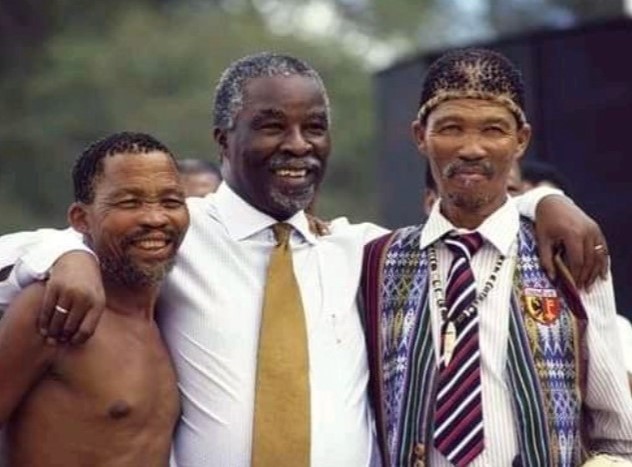
The former President of South Africa Thabo Mbeki was present on the day when the Khomani San Community’s land claim was signed.
This was followed by the establishment of the Khomani San Community Property Association whose role is to manage the future business operations on their 80 000-hectare land.
“We have papers that we own the land,” said Mainnes.
“Unfortunately, we can’t use the land because we don’t have international hunting partners, nor do we have partners to start training wildlife trackers and also train game rangers to catch poachers.”
He added that it’s high time they started using the vast piece of land for international hunting and also as a training field for wildlife trackers and wildlife ranchers training to catch poachers.
“We want international hunting to start on our 80 000 hectares of land lying idle inside the Kgalikgadi Transfrontier Park,” said Miaennies.
“We now know that through international hunting even one hunted lion can quench our thirst for clean drinking water that we need badly.”
Wildlife found in Kgalagadi Transfrontier Park where the Khomani San own 80 000 hectares include: Kudu, leopard, lion, cheetah, giraffe, eland, gemsbok, grey duiker, African wild dog, painted wolf, antbear (Aardvark), black-backed jackal, blue wildebeest, brown hyena, spotted hyena, springbok and steenbok.
Mennies said that the Khomani San residents’ current source of livelihood “involves working in nearby commercial farms.”
However, the Khomani San Community Leader, Petrus Vaalbooi, expressed hope that they should be able to create employment for the local residents by getting them involved in the international hunting industry, wildlife tracking training, and wildlife rangers training programme.
“As a traditional hunting community, we didn’t know until late last year that international hunting could bring us employment, including significant socio-economic conservation and developmental benefits being enjoyed by our counterparts in Botswana and other SADC countries,” said Vaalbooi.
Situated in South Africa’s Northern Cape Province and almost completely cut off from the rest of the world linguistically, because few of them understand English.
The N|uu speaking Khomani Sani rarely interact with other Southern African wildlife producer and hunting communities.
Since they reclaimed their land in Kgalagadi Transfrontier Park in 1999, they were not aware of the possibility of using it for international hunting, until late last year when they met with beneficiary Southern African hunting community representatives, including South Africa’s Makuya Hunting Community.
“If we hunt it will benefit the community developmentally and environmentally like what’s happening in Botswana and other Southern African hunting communities,” said Vaalbooi.
“This is going benefit our community immensely because we can also use the money to send our children to university and they can come back to help develop our community.”
Meanwhile, Miaennies said that although they haven’t done international hunting in Khomani San Community, they have hunted traditionally.
“We hunted traditionally for meat and made biltong during the Covid-19 harsh economic conditions when some families only had a meal every second day,” he said.
“We also want to be allowed to continuously hunt traditionally because it’s part of our rich tradition and we need to fight for it.”
Miaennies added: “I think it’s a missed opportunity that we own a large piece of land in Kgalagadi Transfrontier Park, and we have not used it for international hunting as other Southern African wildlife-producer communities are doing.
“It’s a violation of our human and indigenous rights.
“The Khomani San could have been supported by international hunting revenue long ago.
“By now we should be enjoying similar socio-economic benefits that other SADC hunting communities are benefiting from, including having strong men and women and we shouldn’t be having drug problems because international hunting jobs would be keeping our youth occupied.”
Turning to the opportunity to train people to do wildlife tracking, Waaltboois said: “I think the world knows that the Khoisan are hunters and gatherers.
“It’s in our blood to train people to track wildlife for hunting and I was trained traditionally.
“The sun and the moon show us the way to wildlife.
“We are conservationists and also nothing is thrown away when we kill wildlife.
“We use it for meat and medicine, beauty artefacts, etc.
“In our community, we have 10 highly qualified wildlife trackers – it’s a natural gift that was traditionally passed on to them.”
Miaennies said that during the apartheid era his grandfather “was jailed for using his wildlife tracking skills to kill a buck for food.”
“Using our tracking skills we can tell that a wild animal has passed the place an hour or five hours ago or 24 hours ago,” said Miaennies.
“These are the indigenous knowledge skills that we want to maintain forever, passing them on from one generation to the next.
“We see this as a great opportunity if we can train the world to track wildlife.
“People should know how to track wildlife and they can also use the skills to avoid snake bites and attacks from dangerous wildlife.
“It’s a matter of survival.
“There are many things that the Bushmen can teach the world.
“You don’t have to go to university to become a trained rancher and wildlife tracker, come to Khomani San.”
To demonstrate that they are conservationists and want to lessen the impact of climate change on people and nature, the residents of the Khomani San Community recently appealed to South Africa’s Department of Forestry, Fisheries and Environment to support them in planting half a million trees in Rietfontein, Philandersbron, Loubos, Mier, Andriesvale and Askham.