
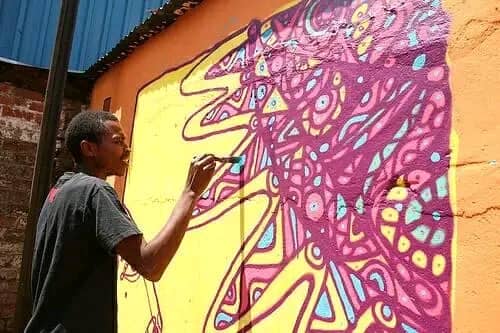
Harare – Sometime around 2014/15 I met Gideon Gomo, a sculptor and mentor, at Village Unhu in Athlone, Harare.
I had walked from Mbare, as I customarily did.
This was my “starving artist” phase.
Gideon commended my determination and hunger for art.
“I miss that,” he said.
I was baffled that such a prolific sculptor could envy this stage of one’s art career.
He was happy to flip through my sketchbook and give me advice.
As he flipped through he paused at pointed at some zigzag patterns I’d incorporated into a drawing.

“I don’t understand why this pattern is so common. I feel that it’s overused”.
I pondered about this and realised how ubiquitous this pattern was.
One can see it on the Great Zimbabwe monument, on ceramics, huts, and ritualistic regalia and paraphernalia.
I could not find a ready answer and this stayed with me for years.
My answer only came when I revisited a book on Hermetic Philosophy that I had bumped into a few years before.
Let me explain.
Take a moment to imagine that you are the first human being to exist.
You have just woken up from a deep slumber and you start observing your surroundings.
As time passes you may notice how the sun moves across the sky and in its absence, it is dark (nighttime).
This process of day and night continues over and over again.
The seasons and your moods will seem to follow these same laws of movement (vibration), duality (night/day, happy/sad, winter/summer), and rhythm (back and forth).
You may notice that just as the seasons are revolving, so is your mood.
What happens on a large scale of life (seasons), also happens on a small plane (hormones).
As above, so below.
This is the law of correspondence.
When the sun is present, your environment is hot and in its absence your environment is cold.
When it rains, the plants will thrive, when it doesn’t, they wilt.
That is, every cause has an effect and every effect has a cause.
This is the law of Cause and Effect.
Nothing happens by chance, everything happens according to law.
The laws mentioned above are just some of the seven Hermetic Laws of ancient Egypt.
These are the universal laws that govern our existence.
The back and forth, up and down, round and round behaviour of existence is reminiscent of the chevron (zig zag) and spiral patterns.
These patterns are common in many cultures across the globe.
They appear on pottery, clothing, jewelry, architecture, and other ritualistic objects.
Did the ancients use these patterns intuitively or was it a deliberate effort to highlight the universal laws?
Knowing how existence/nature works helps humans harness the full potential of the elements.
It is therefore worth introducing the Hermetic Philosophy in school curricular.
As I look back, I realise that if I had learnt about Hermetics in my early school days, I would have definitely performed better in the sciences.
My present thought is: How can contemporary artists use these symbols in new ways for future generations?