Giles Merritt reports on the farmers’ woes and rural deprivation now confronting EU policymakers with daunting political challenges
Europe’s farmers are angry, and so are more and more voters in deprived rural communities throughout the EU.
Turmoil looms, and for Brussels this threat of a “back to the future” crisis revives memories of when agriculture was politically explosive.
“Agrarian populism” is the new buzzword, and mainstream parties are rightly worried by it.
Past controversies over wine lakes and butter mountains will seem golden days by comparison.
Farm policy was pushed onto the back-burner by the EU’s “Big Bang” enlargement, eurozone debt issues and then Covid, but it’s high on the agenda now and more divisive than ever.
A toxic mix of farm closures, soaring food prices, pesticide pollution and the impoverishment of rural Europe are entangled in a Gordian knot that defies clear-cut solution.
The first half of this year brings these competing issues together in a “strategic dialogue” that Eurocrats hope will map a way forward.
Parties to the discussion all have serious gripes which reflect not just their sectoral interests but also the well-being of European society as a whole.
Food production and export is an increasingly vulnerable economic mainstay.
This summer’s EU-wide elections to the European Parliament could see a surge in the numbers of eurosceptic MEPs
Farmers have become an endangered species.
The extinction of all but major landowners threatens widespread rural unemployment and the near-death decline of countless villages and small towns.
Two-thirds of Europe’s nine million farms are family smallholdings of less than five hectares, and these are being bankrupted at an alarming pace.
They may be small fry but they are also the backbone of rural life, especially in eastern and southern Europe.
The financial support they receive through the Common Agricultural Policy (CAP) pales beside the more generous subsidies gobbled up by more efficient big landowners.
Four-fifths of all CAP income support goes to the larger farms that are the top 20 per cent.
Europe’s agricultural workforce has thus shrunk in two decades by a third.
Unsurprisingly, younger people aren’t attracted by agriculture, so under-40s now comprise a mere 11 per cent of farm managers.
Ageing Europe is becoming overwhelmingly urban.
By mid-century, country dwellers who are presently 30 per cent of the EU population, will be only 16 per cent.
This shrinkage of the rural workforce spells trouble for the largely rural agri-foods sector.
In payroll terms it is twice the size of farming, accounting for 20 million jobs, and already faces labour shortages.
With the many ancillary services around food production equally vulnerable, the prospect of deserted countrysides has become starkly real.
The political cost is that populists on the far-right stand to reap the most gains from rural decline and discontent.
This summer’s EU-wide elections to the European Parliament could see a surge in the numbers of eurosceptic MEPs, which has prompted the dominant centre-right EPP group to hurriedly rebrand itself as “the farmers’ party”.
The EU and its member governments cannot, however, wash their hands of looming catastrophes in their countrysides
The reality, though, is that it’s the populist parties that have more appeal.
In France, the Rassemblement National’s campaign for its leader Marine Le Pen to be elected president in 2027 is already focused on wooing “forgotten” rural voters, and a similar approach is evident in Germany, the Netherlands, and a growing number of EU member states.
It’s hard to see how European farmers’ discontent can best be addressed.
Economic pressures, not least those triggered by the Ukraine conflict, have greatly inflated fertiliser and energy costs, while environmental and animal rights activists are insisting on expensive anti-pollution and livestock handling measures.
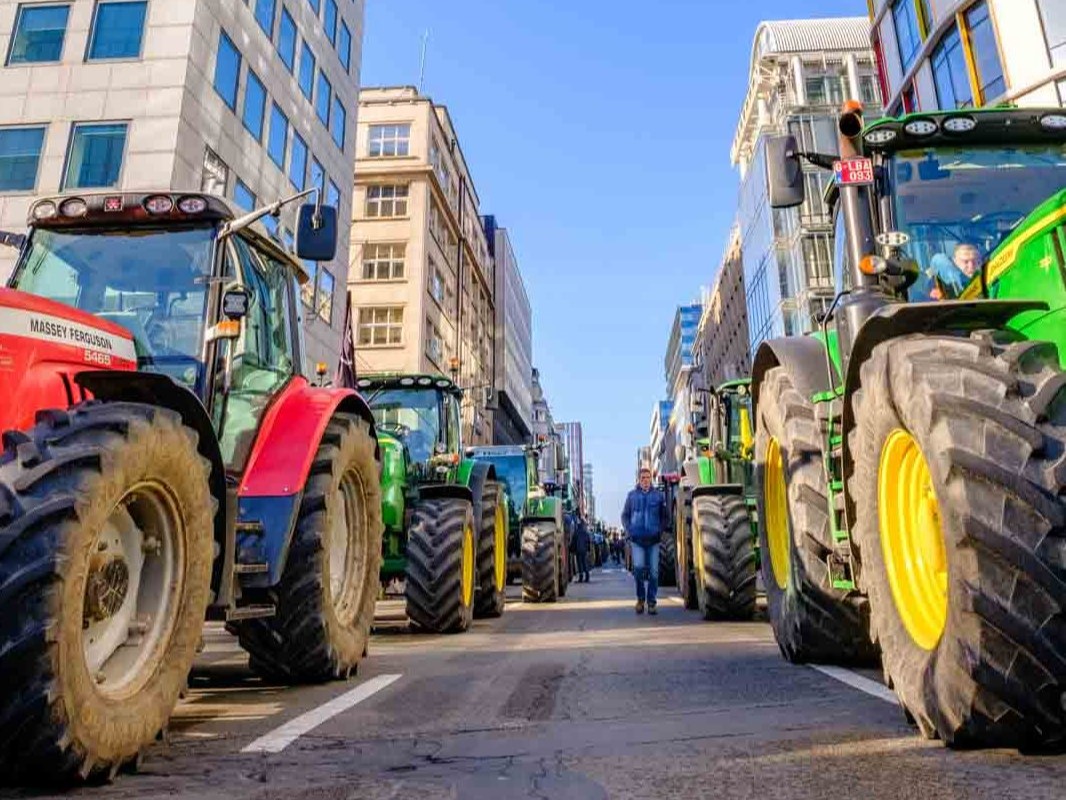
The result has been the rash of protests and tractor blockades disrupting Europe’s cities.
Yet calls by farmers for huge increases in financial support look set to fall on deaf ears.
The days when the CAP absorbed the lion’s share of the EU budget are long gone.
The Union’s widening responsibilities have whittled the share of farm subsidies, and with defence spending a new priority will no doubt continue to do so.
Even if more money could be found in the EU’s 2028-34 budgetary arrangements, it’s far from clear how the inexorable demographic pressures on European agriculture can be countered.
An EU-backed report has described policy instruments for rural development as “dispersed and ineffective”.
The EU and its member governments cannot, however, wash their hands of looming catastrophes in their countrysides.
They must find a strategy to reverse rural decline.
The “Farm to Fork” package that’s part of the EU’s Green Deal is failing to do this, but if rural impoverishment continues, and populism gains more ground, the political price will be unaffordably high.
*The views expressed in this Frankly Speaking op-ed reflect those of the author and not of Friends of Europe.
*This article first appeared on the Friends of Europe website and is reproduced with kind permission.
*The views expressed by the author of this article, Giles Merritt, are not necessarily those of The Bulrushes