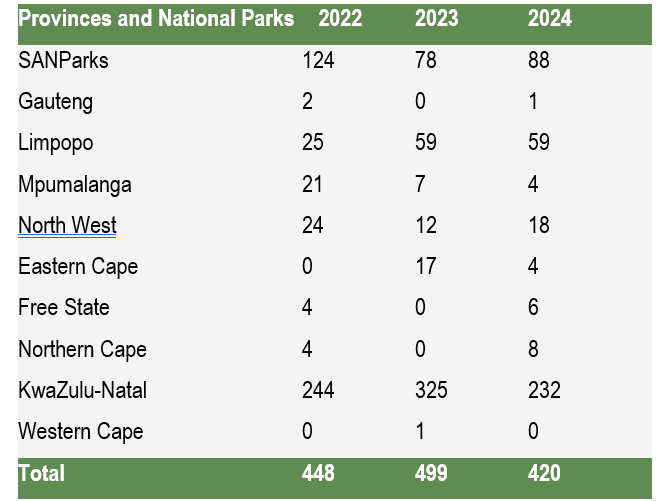
Pretoria – At least 420 rhinos were poached in South Africa, last year with 320 being killed on state properties and 100 on privately owned parks, reserves, or farms.
“This was a decrease (of 79) in comparison to 499 rhinos poached in 2023,” said the Department of Fisheries and the Environment on Thursday, (6 March 2025).
The department said the hardest-hit province continues to be KwaZulu-Natal which lost 232 rhinos, however, this is a notable decline from the 325 lost in 2023.
“The significant reduction can largely be attributed to the Ezemvelo KZN Wildlife Dehorning Programme, which was implemented in Hluhluwe-iMfolozi Park from April to October 2024,” said Forestry, Fisheries and the Environment Minister Dr. Dion George.
The World Wide Fund for Nature funded programme had an immediate impact, with monthly poaching numbers dropping from 35 in April to fewer than 10 per month between May and September 2024.
“In October, however, poaching syndicates adapted their tactics and began targeting dehorned rhinos, leading to a sudden spike in poaching incidents in Hluhluwe-iMfolozi Park, and in that month alone, the province lost 27 rhinos,” revealed Minister George.
“‘Fortunately, the provincial anti-rhino poaching team responded swiftly, intercepting the new syndicate and preventing further losses.
“The considerable efforts resulted in the province ultimately achieving a 67% decline in rhino poaching over the eight months.”
Kruger National Park reported a total of 88 poached rhino for 2024.
This was 10 animals more than the 78 that were reported for Kruger National Park during the same period in 2023.
Up until the end of November 2024, rhino losses reported in the Kruger National Park stood at 67, but a significant escalation in rhino poaching activities was experienced during December 2024 and this has continued into January 2025.
A total of 21 rhino were reported poached in Kruger National Park during December 2024 and a further 17 were reported poached during January 2025.
“This escalation in rhino poaching in the Kruger National Park is of great concern,” said Minister George.
Both SANParks and Ezemvelo KZN Wildlife continue to implement several actions and initiatives as set out below to counter the threats in the hotspot areas:
- Polygraph testing of staff is continuing at Kruger National Park in line with its Integrity Management Plan. The Skukuza SAPS Stock Theft & Endangered Species Unit and the Mpumalanga Hawks (Directorate of Priority Crime Investigations) are supporting with investigations as linkages have been found between failed polygraph tests and the surge in poaching during December 2024;
- To date, investigations that have flowed from these polygraph results and subsequent investigations into the individuals, have resulted in disciplinary action against two employees in Ranger Services at Kruger National Park;
- Information related to the various rhino poaching crime scenes and modus operandi has been shared with the National DFFE Environmental Enforcement Fusion Centre in order to determine linkages between the various incidents across the country and in particular Hluhluwe-iMfolozi Park in KZN;
- Co-operation with various stakeholders was strengthened to assist in alerting customs and law enforcement officials in transit and destination countries to be on the lookout for illegally traded horns over the December/January period when there was an increase in poaching in Kruger National Park;
- Ezemvelo KZN Wildlife is focused on implementing its Rhino Guardianship Strategy, which also played a role in reducing poaching in the province. This Strategy was initiated in August 2024.
- The Ezemvelo Integrity Implementation Plan was completed and approved for implementation, integrity assessments of Hluhluwe-iMfolozi Park staff by an independent service provider commenced, and a Hluhluwe-iMfolozi Park Integrity Management Plan was completed and approved for implementation. Polygraphing of 55 Ezemvelo rhino reserve managers were completed and polygraphing of 58 field staff was completed.
“We continue to see some very good convictions in relation to rhino-related cases, with lengthy direct imprisonment terms in respect of cases related to rhino poaching, assisting in the poaching of rhino and trafficking of rhino horns,” the minister said.
“However, the time that it takes to finalise many of these cases does remain a concern and unfortunately where the suspects are released on bail, the data tells us that a large number of them continue to commit crimes (often relating to rhino poaching and/or horn trafficking).
“Accordingly, expediting these cases through our courts as well as vigorously opposing bail will no doubt result in safeguarding more rhino.”