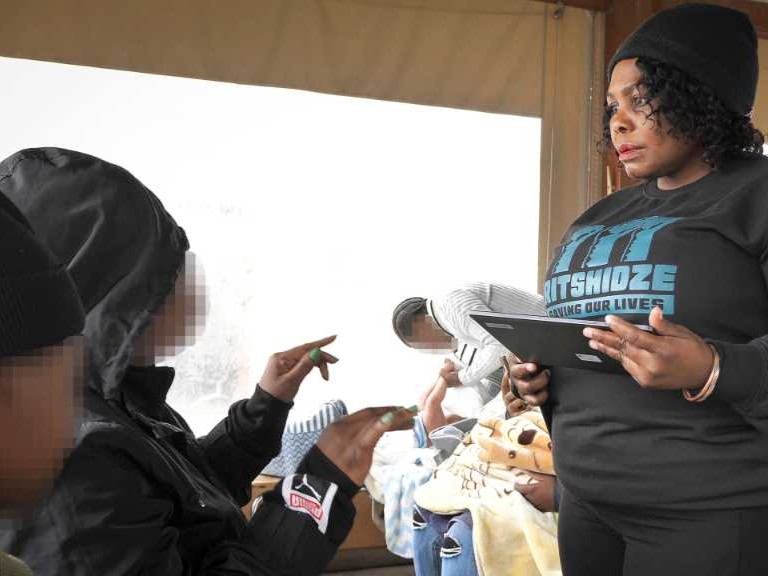
Johannesburg – Over the years Ritshidze has documented hundreds of testimonies and produced countless data that document how people stop taking their ARVs because of the poor conditions in our clinics.
The long waits and poor treatment make some people anxious to go to the clinic, and can push others out of care altogether.
This is why TAC has been calling for more places to be set up for people to collect their ARVs in the community, closer to where they live or work.
Known as “external pick-up points”, places like pharmacies, churches, or even the Post Office, are places people can choose to collect their ARVs outside the clinic — avoiding long clinic queues.
It makes it quicker, easier, and more convenient for people living with HIV to collect ARVs — keeping people on treatment and improving long-term retention.
It also reduces the overall burden on our over-congested clinics and overburdened health workers. It is a win-win.
Some of these pick-up points were being run by U.S government funded NGOs.
More importantly PEPFAR funded staff heavily supported the national and provincial supply chain mechanisms that enable the dispensing, pre-packing and medicine delivery systems by contracted private service providers to these external pick-up points.
However now, following the U.S. funding suspension in South Africa, some people living with HIV have reported postponements in their collection days, without clear instructions on when they can collect.
This puts people at risk of interrupting treatment if they run out of pills before the new collection date arrives. We spoke to Maite from Limpopo who shared her experience:
For the past four years Maite Letsoalo has received a three month supply of her antiretroviral (ARV) pills at an external pick-up point in a pharmacy in Capricorn, Limpopo.
Collecting her ARVs at the pick-up point has been a game changer, allowing her to manage her condition with relative ease without having to wait in long clinic queues.
But that all changed in late February this year with an SMS message from the pharmacy.
The SMS advised her of a delay in the dispensing of her ARVs and that she would be notified of the new collection date.
Two days after her original collection date passed with no SMS update, Maite was in a panic.
“I am very worried; it is making me stressed. Right now, I am using pills from some extras from the days I have missed my tablets,” says Maite.
“I am also sharing pills with my partner. But he is in the same position as me because he was also collecting his ARVs from the pharmacy.
“His phone is broken, so he doesn’t even know when he has a collection date.”
Maite was diagnosed with HIV in 1999, but she was only initiated on treatment in 2012 – eight years after ARVs became available in the public health sector.
“In those days it was very bad; I was surviving by my support group teaching me about living healthy and managing stress,” says Maite.
“I only had vitamin B and antibiotics.
“By the time I got my ARVs in 2012 it helped me so much because my CD4 count was very low and going down and that is something that makes you very scared.”
Maite says she’s facing the same kind of fear now as the disruptions and delays in getting ARVs to people living with HIV is becoming a looming disaster.
“It is very dangerous for those of us who have already started treatment because when we stop taking the pills, our CD4 counts drop very quickly and the pills can stop working,” she says, of the risk of resistance developing when people interrupt their treatment.
Maite used to be a coordinator of the adherence club at the Rethabile Clinic in Capricorn before the project was shelved in 2017.
This was after Global Fund funding for adherence clubs was shifted to other priorities and the Department of Health undertook to take on club facilitation and management but never did.
For this reason she is well known at the clinic and knows it will be easier for her to navigate the clinic queues if she is forced to collect ARVs at the clinic, and the external pick-up point doesn’t rematerialise. Maite also knows that this makes her one of the “lucky” ones.
She says: “For many people they will not be able to do that because the clinics don’t always treat people right and the queues are too long. It means people will just end up defaulting.
“Government must understand that for many of us who are not working we can’t just go and buy the medication, we have to use the clinics, but the clinics are not helping people properly,” she says.
“Government must make sure that the external pick-up points are working and they should bring back adherence clubs,” says Maite.
“The clubs were very much important because they made sure people could get their medication quickly without having to join the normal queues at the clinic.
“Patients also had ongoing counselling and support from each other.”
Having lived through the worst of the HIV/AIDS epidemic in the country and surviving 13 years of living with HIV before starting medication, Maite knows how hard it can be to have a positive mindset to live with HIV.
Right now, she says, is one of the toughest moments for South Africa’s HIV response.
If the government can’t be truthful about the problems this is causing and ensure that people have an uninterrupted supply of their medicines, people will simply stop making the effort to stay on treatment.
“At this time with what has happened from America, it’s very difficult to stay strong; I won’t lie,” says Maite.
“These delays to get ARVs to people and when they don’t communicate, it will cost people’s lives.
“We can’t go back to the days when we were just burying people; HIV should not be a killer.”
The government has launched a campaign to get 1.1 million more people on HIV treatment, but this will not happen while it is becoming harder for people living with HIV to collect ARVs and stay on their treatment.
We need the South African government to step in following the suspension and loss of U.S. government funding to ensure that services are maintained, including the maintenance of external and facility-based pick-up points, that make it much easier for people living with HIV to collect treatment.
This is part of a series of stories that TAC is collecting to expose the realities in our clinics following the U.S. government funding suspension.
Follow our website and social media channels as we publish testimonies that highlight the impact on the lives of people living with HIV and other public healthcare users.
To find out how we are affected by the funding suspension see: https://www.tac.org.za/news/us-funding-cuts-to-health-and-hiv-services-threaten-lives/