The local markets and beyond have been in turmoil since 2 April 2025, following U.S. President Mr. “Tariffs” Donald Trump’s so-called “liberation speech,” which prompted him to impose tariffs on virtually everything, including goods from territories with no permanent human habitation, except for penguins and seals.
Our neighbour, Lesotho, drew the shortest straw, facing a punitive 50% tariff.
Trump capitulated 48 hours later and paused the tariff madness for 90 days.
This played out while South Africa faced its own “madness moment,” a proposed Value-Added Tax (VAT) increase, and the ANC railroaded the budget framework through Parliament with support from parties outside the Government of National Unity (GNU).
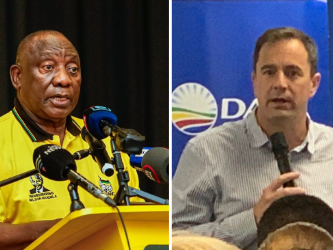
The Democratic Alliance (DA), the second-largest member of the GNU, refused to support the budget framework, citing concerns over outstanding spending reviews and the proposed VAT increase.
Initially, the government suggested a 2-percentage-point VAT hike, but after negotiations, this was reduced to a more palatable 0.5 percentage point increase over two years.
Curiously, the DA is supported by unlikely bedfellows uMkhonto we Sizwe (MK) and the Economic Freedom Fighters (EFF).
The DA has since initiated legal proceedings to challenge the parliamentary process that led to the adoption of the budget framework and its subsequent submission to the National Assembly for a vote.
The party contends that the procedures followed were fundamentally flawed and unlawful.
Furthermore, the party is questioning the constitutionality of the Value Added Tax Act, which empowers the Minister of Finance to implement VAT increases without the explicit concurrence of the National Assembly.
The DA argues that this provision undermines parliamentary oversight and is seeking judicial intervention to address these concerns.
The ANC has upped the ante with Deputy President Paul Mashatile, who ought to exercise caution if he aspires to be King, making a reckless statement asserting that DA cabinet members who reported for duty after failing to support the budget framework should be ashamed of themselves.
The President’s typically diplomatic spokesperson was uncharacteristically blunt following the DA’s latest manoeuvre.
Vincent Magwenya remarked, “You can’t be part of a government whose Budget you opposed.”
As the political bickering unfolds, the “ominous” markets and investors are aghast, and losses are mounting.
The Johannesburg Stock Exchange (JSE) has suffered significant losses, with the All-Share Index plunging over 4.5% at one point, reflecting investor anxiety over political instability and policy uncertainty.
The bond market mirrored these concerns, with yields on the benchmark 2030 government bond rising by 7.5 basis points to 9.39% on 3 April, indicating decreased investor confidence.
Let’s not even discuss the damage this ANC-DA impasse poses to the brand of South Africa, a country of former President Nelson Mandela’s “miracles.”
We ended apartheid through negotiations and established a second GNU without a single shot fired after the ANC lost the majority vote in the May 2024 elections, something unheard of in some corners of the globe.
Amid this turbulence, the media’s role in making sense of chaos is crucial.
Thus, it has been refreshing to read Carol Paton’s (News24) measured yet incisive analysis of the current political imbroglio.
Her commentary remains a hallmark of evidence before emotion, a quality sorely needed in public discourse. Paton rightly calls for a new approach that moves beyond the DA-ANC duopoly.
In her view, it shouldn’t just be a two-party show; we need everyone in the room. She urges all political actors to unite “in the country’s interest.”
The ANC must shoulder some responsibility for its gung-ho attitude, as though oblivious to the negative consequences of frequent mayoral changes in our metropolitan municipalities – changes that have contributed to the near-total collapse of our cities.
Now, imagine transplanting those metropolitan musical chairs to the national government.
A minority government will neither restore investor confidence nor renew the “people’s contract” because such a formation is inherently fragile, heightening anxiety each time the National Assembly considers a vote of no confidence in the President.
The ANC consistently claims, “the ANC is not a leader of itself, nor just of its supporters. History has bequeathed on it the mission to lead South African society.”
Therefore, it cannot behave like Uncle Sam, passing the budget framework with a shrug and to hell with the consequences.
The people and the markets value and expect political stability – a prerequisite for prioritising economic growth, job creation, the fight against poverty, and improving food security.
President Cyril Ramaphosa must walk the talk like he said last year, “Every effort must be made to ensure that the GNU remains true to its founding spirit of collaboration in good faith to drive a programme that improves the lives of all South Africa’s people.”
It was, therefore, somewhat reassuring, albeit belated, after several ANC leaders had spoken out of turn and somewhat disparagingly about the DA’s political maneuverings, to hear the ANC Secretary-General Fikile Mbalula reaffirm the party’s commitment to reopen negotiations with all parties, including the DA.
This came during a press briefing following the party’s National Working Committee (NWC) deliberations. But, as ever in our politics, the bluster didn’t stop there.
In the same breath, Mbalula declared that the ANC is not beholden to the DA and that the GNU wouldn’t collapse without it.
Perhaps Mathematical Literacy wasn’t his strongest subject at school. You cannot run Africa’s most advanced economy, home to the most traded currency in the world with a parliamentary majority of eight, assuming both ActionSA (six seats) and Bosa (two seats) join the gravy train.
He also made it abundantly clear that the ANC considers the EFF and MK its ideologically sworn enemies. In any event, who in their right mind wants to see an EFF-MK formation enter the GNU?
The DA also needs to mature in its approach.
While Carol Paton may offer them some backing, it was politically shortsighted to drag non-budget issues into a process meant solely to resolve the budget impasse.
The committee has a clear mandate, budget and fiscal matters. Introducing everything but the kitchen sink undermines the seriousness of the moment.
The DA must accept that decisions made by the Sixth Parliament and administration remain valid and cannot be challenged arbitrarily.
They must come to terms with their losses concerning the Basic Education Laws Amendment (BELA), the Expropriation, and the National Health Insurance (NHI) Acts.
These matters are better suited for strategic discussions, not budget debates. Furthermore, legislative amendments can be introduced in Parliament if the DA seeks a remedy.
Moreover, the DA’s demand for its member and current Deputy Minister of Finance, Ashor Sarupen, to co-chair Operation Vulindlela represents a clear case of political overreach.
The DA has now painted itself into a corner, charging headlong into the courts instead of resolving matters in the boardroom.
What’s at stake here isn’t the reputation of the DA or the ANC; it’s the lives of ordinary people on the ground.
Both parties need to grow up. Fast. And if they can’t, perhaps it’s time to bring the adults into the room, former President Thabo Mbeki, anyone?
*Bhekisisa Mncube is an author and columnist who won the 2024 Standard Bank Sikuvile Journalism Award for columns/editorials and the same category at the 2020 Vodacom Journalist of the Year Awards. The views expressed by Bhekisisa Mncube are not necessarily those of The Bulrushes