George – A year before the five-storey building under construction at 75 Victoria Street, George, Western Cape, collapsed, workers noticed cracks in columns, strange vibrations in the slab, and even visible holes through the walls in the basement.
Worse still, the concrete used in the slabs did not meet required specifications.
The so-called “competent person” responsible for the structural system did not have the necessary competency requirements to oversee a project of this complexity.
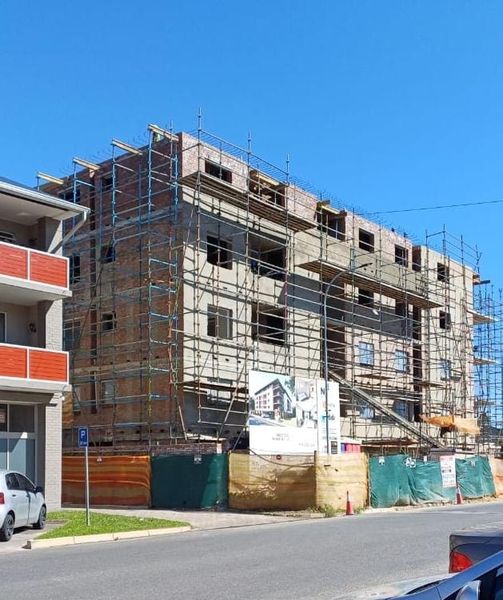
Despite these warning signs, site managers reportedly instructed workers to patch the damage with sand and mortar, rather than halting construction and escalating the matter for formal investigation.
The workers continued building until disaster struck.
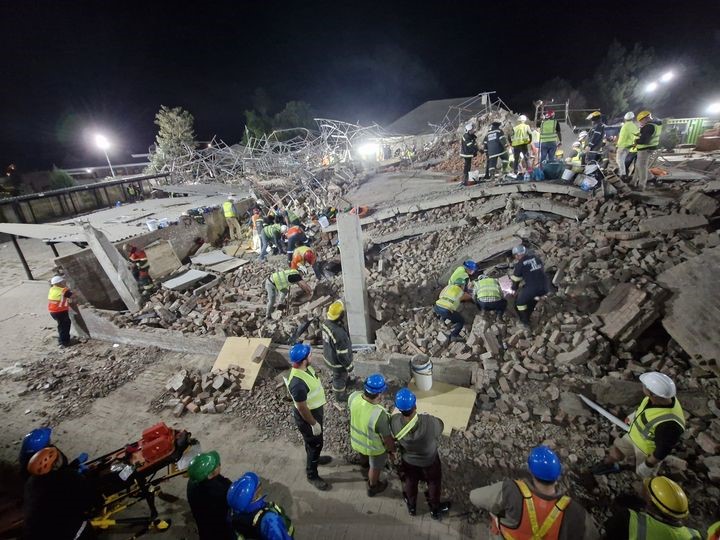
On 6 May 2024, the building collapsed onto the workers, killing 34 and injuring 28 others.
RELATED: George Building Collapse: At Least 4 Bodies Recovered, 24 Rescued, 51 Still Trapped – The Bulrushes
Today, Saturday, 19 July 2025, Minister of Public Works and Infrastructure, Dean Macpherson, released these damning findings after a thorough investigation.
Speaking to reporters in George, Minister Macpherson said: “I want to express my deep gratitude to the families for receiving us today, for their strength, and for allowing us to walk this painful road alongside them.
“Their dignity in the face of tragedy and loss is something that we should acknowledge. Their courage is inspiring.
“And their pursuit of justice is entirely justified.”
Macpherson took time out to comfort a distressed woman before he released the damning outcomes.
Apart from the cracks in columns, strange vibrations in the slab, and even visible holes through the walls in the basement, the minister listed even more shocking anomalies.
He said the geotechnical study of the site, critical in determining soil stability and groundwater conditions, was not only incomplete but grossly deficient.
“Key tests and geological mappings were missing,” lamented the minister.
He revealed that the Health and Safety Agent appointed to monitor site compliance resigned midway through the project, stating clearly that they could no longer ensure safe working conditions.
“This was a dereliction of duty as it was not reported to any of the relevant authorities,” Minister Macpherson said.
“That should have stopped the project in its tracks.”
The minister also pointed out that there was a shocking lack of coordination between regulatory authorities.
“Planning departments, NHBRC inspectors, DPWI professionals, and Department of Labour officials all worked in silos,” he said.
“No one saw the full picture. No one sounded the alarm with the force and speed required.”
In the aftermath of the collapse, the Council for the Built Environment (CBE), a statutory body of the Department, initiated a full investigation looking into the systematic failures that led to the building collapse.
“Parallel to this investigation, the Engineering Council of South Africa (ECSA), which is one of the six councils under the CBE, undertook an investigation that investigated the culpability of the engineer involved in the construction project,” explained the minister.
The findings of serious anomalies were made on completion of both investigations by the CBE and ECSA.
“The CBE report is a comprehensive and technically detailed report prepared by a multidisciplinary team of experts,” said Minister Macpherson.
“Its findings are serious, far-reaching, and in many respects, alarming.”
He said the investigation confirmed that serious safety concerns were raised well before the collapse.
Some of these observations were made as early as 2023.
“Our system currently allows engineers to self-assess their own competence,” stated Minister Macpherson.
“This is a loophole that must be closed and with speed.”
The National Building Regulations and Building Standards Act was last meaningfully amended in 1996.
“The built environment has changed. Our laws have not,” Minister Macpherson noted.
“These are not minor oversights. These are systemic failures, failures of planning, oversight, enforcement, and culture.”
He said what happened here more than a year ago was a “lethal convergence of these failures”, which resulted in the deaths of 34 people.
“At every problem, there was a chance to turn back, but because of a weak regulatory environment, there was either no incentive or requirement to do so,” Minister Macpherson said.
An appeal window to these findings is underway, which expires on 3 August 2025.
“This report must form part of the police investigation, as we must establish criminal negligence for what happened.
“If criminal wrongdoing is established, those responsible must be prosecuted without delay.
“We must ensure that people are held accountable for 34 souls losing their lives.
“No contractor, engineer, or official should be beyond the reach of the law.”
Amelia Mtshali, chairperson of the Council for the Built Environment, CEO of the Council for the Built Environment, and Thembinkosi Madikane, President of the Engineering Council of South Africa, presented the technical findings and recommendations.
*See the statement by the Council for the Built Environment (CBE) here, and the statement by the Engineering Council of South Africa (ECSA) here.