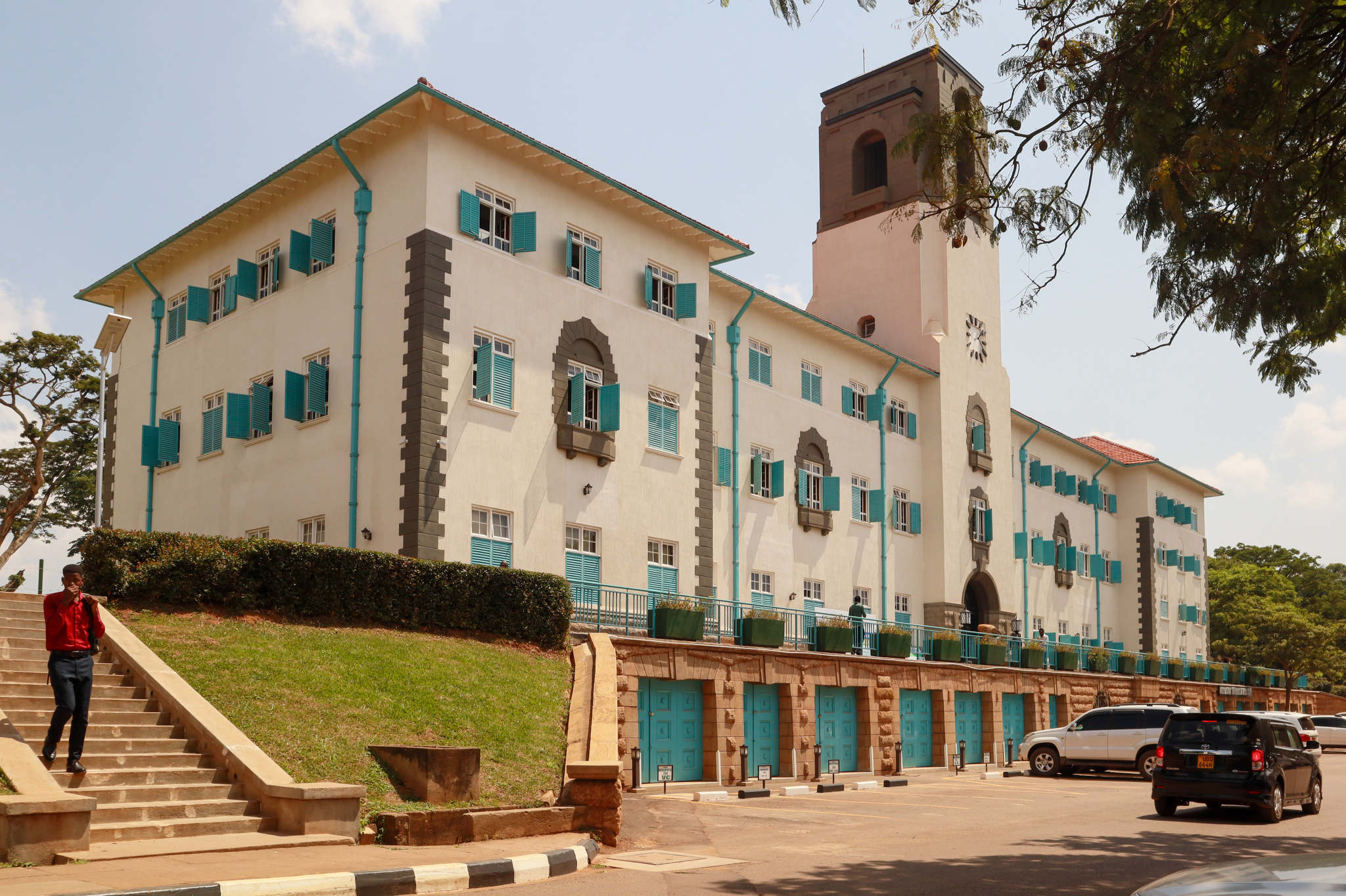
Kampala — In April, dozens of students gathered at the Kyambogo University’s student center.
The then-student council president, Akiso Benjamin, called the meeting to address growing frustrations with the university’s administration over issues such as penalties for late registration, missing academic results, and students being blocked from exams, despite paying most of their tuition fees.
Eight days prior, he’d formally written to the administration about these issues, but they didn’t respond, he says.
Midway through the meeting, police stormed in.
“Students started panicking, running out of the building,” he says.
The police fired live ammunition and tear gas that spilled into lecture halls where classes were in session.
They arrested 20 students, including Akiso.
They charged him and nine others with three counts of participating in a riot, incitement to violence, and unlawful assembly.
Patrick Onyango, the Kampala metropolitan police spokesperson, says the police acted on a request from university officials as students were carrying out an illegal demonstration and forcing others to participate.
By the time the police came in, he says, they had reason to believe students were about to turn violent.
But students and human rights experts say armed responses to students who are protesting government or university policies in Uganda have become a disturbing and unlawful trend.
They say such actions violate students’ constitutional rights to assemble and protest and have turned universities that were once centers of political activism into hubs of fear.
“[Public universities] funded by taxpayers’ money have been policed and militarised to the extent that even a peaceful assembly by students is unacceptable to the administrations,” Akiso says.
But Reuben Twinomujuni, principal communication officer at Kyambogo University, sees it as a security issue.
While the university respects students’ freedom of expression and is open to dialogue, he says, they must also consider the safety of the wider student community.
“We want to make the university a safe environment place for everyone,” he says, adding the protests were driven by a small number of students whose goal was to create chaos.
“We can’t let the few mess up things for the rest.”
While he acknowledges the university received the letter of demands, Twinomujuni says at the time the vice chancellor was on sick leave.
The vice chancellor returned the same day the protests broke out and responded to the letter, Twinomujuni says, but the situation had already escalated.
The issue doesn’t affect Kyambogo University alone. According to a report by Human Rights Watch, in October 2019, security forces responded with similar force to student protests at Makerere University over fee increases.
They used tear gas, raided student dormitories, and made mass arrests, according to the report.
Journalists attempting to cover the protests, and who already face increasing violence from security forces in the country, were arrested too.
Earlier this year, students from various universities were arrested while protesting KCB Bank’s alleged financing of the East African Crude Oil Pipeline.
Local news outlets have documented many other crackdowns on student protests by security forces over the last few years.
Such a response to students isn’t new in Uganda or the broader region.
As early as the late 1960s, some of East Africa’s oldest universities — like University College, Nairobi, the predecessor of today’s University of Nairobi in neighboring Kenya, and Uganda’s Makerere University — had strong student movements that often drew harsh crackdowns from governments.
But it was easier to hold such protests in the past than it is now, says Joe Besigye Bazirake, a research associate at Nelson Mandela University, South Africa, and a former student at Makerere University.
“At Makerere, students would hold protests from the university to the town council, which was revolutionary,” he says.
“But that is impossible today.”
There’s a reason for the more aggressive approach, he says.
The government in Uganda understands just how powerful student movements can be. “They are young, observant, active with ideas of how they want to be governed,” he says.
In fact, some government leaders started organizing when they were university students, he says.
Among them is the country’s president, Yoweri Museveni, who was already politically active in secondary school and later at the University of Dar es Salaam in Tanzania, where he led a Pan-Africanism activist group.
They know people pay attention to what happens in universities, Bazirake says.
“If Makerere is on fire, the nation pays attention. Power pays attention.”
This aggressiveness “makes universities [a] hostile environment for students,” says Henry Byansi, a lawyer who represented Akiso’s case in court and is also programs manager at Chapter Four Uganda, a legal nonprofit.
It isn’t just the use of an armed police force, says Ankunda Shivan, a first-year student of land surveying and geometrics at Makerere University.
Repression in universities has taken various forms over time.
For example, she says the administration now controls the student guild elections at Makerere University.
For the past three years, elections have been conducted entirely online.
Physical campaigns are no longer allowed.
This shift, she believes, is part of a broader effort to suppress students.
But Zahara Nampewo, deputy dean at Makerere University’s school of law, says administrations must make tough decisions, especially when students’ expressions of their freedoms turn violent.
The university, she says, banned physical elections after a student visiting from another university died during election-related activities at Makerere University in 2022.
“Yes, students’ freedom of association and physical campaigns are important… [but] the safety of every student and everybody working and walking through this university is paramount,” she says.
Still, she adds, it’s important for administrations to open space for meaningful dialogue with students.
It could reduce and even end the involvement of armed state forces in universities.
Akiso and the nine other students charged by authorities were released on bail four days after their arrest, but their ordeal was far from over.
The university suspended them for 30 days and barred them from accessing the campus.
This meant they couldn’t sit for that semester’s exams.
Then in July, the university expelled Akiso, a decision he intends to challenge in court.
He believes the university’s actions are meant to scare students into silence.
But he is not deterred.
“No matter the situation, I am determined to continue expressing my right to peacefully assemble when universities set unfair polices and ignore our issues,” he says.
*Nakisanze Segawa is a Reporter-in-Residence based in Kampala, Uganda.
*This story was originally published by Global Press Journal, which delivers bold, investigative, and in-depth explanatory reporting on the world’s most urgent issues