
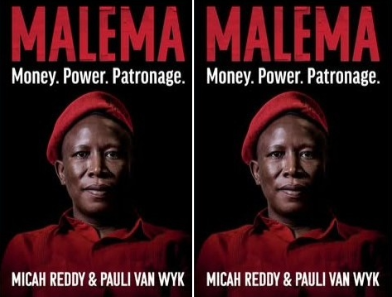
Malema, a book by Micah Reddy and Pauli van Wyk, published by Tafelberg, embodies the duality of compelling investigation alongside historical gaps and editorial missteps.
It is a rigorously reported account that brings valuable insights about the riches of Malema, but could reach greater heights with tighter historical framing and more disciplined editing.
Julius Malema is the founder and President of the Economic Freedom Fighters (EFF).
The book is most effective when it follows the money, documents networks of patronage, and exposes how power circulates in contemporary South African politics.
One vivid investigative high point occurs when the authors meticulously track the transaction trails of a high-profile infrastructure project, such as the City of Johannesburg fleet tender, revealing how funds earmarked for social development were diverted to enrich EFF political elites.
The same was done with the Oil tender in the City of Tshwane.
These detailed case studies illustrate the intricate web of alliances and financial manoeuvres that characterised the political landscape, resulting in the hijacking of public procurement and the accumulation of personal capital by Malema and his ilk.
These sections reflect the authors’ investigative strengths. However, repetition dulls the narrative impact and, more critically, the book frequently substitutes moral certainty for political context.
Several factual and historical errors, totaling at least four significant inaccuracies, weaken its authority.
First, the authors misname the Reconstruction and Development Programme (RDP) as the “Redistribution Development Programme”.
This is not a stylistic slip but a substantive historical error.
Emerging from the early 1990s policy debates, the RDP was seminal in shaping post-apartheid South African society, aiming to address historical imbalances through development and economic redistribution.
As a cornerstone initiative, it symbolised a new era of transformation and equity.
Therefore, such a mistake signals insufficient care with political genealogy.
Second, the book incorrectly refers to Ismail Momoniat as a “deputy director,” a very junior position.
Yet, in 2018, Momoniat was Deputy Director-General: Tax and Financial Sector Policy at South Africa’s National Treasury.
This is a senior executive role.
The distinction matters, particularly in a book that seeks to establish credibility through institutional accuracy; it beggars belief how proofreaders, editors, and publishers didn’t pick the error.
Third, the book treats phrases such as “white monopoly capital’ and ‘expropriation without compensation” as if they are straightforward inheritances from liberation-era discourse.
This is historically imprecise.
While the language draws on struggle idioms, its contemporary political deployment is rooted in post-1994 factional battles and, in the case of “white monopoly capital”, was aggressively amplified during the Bell Pottinger–Gupta period.
To provide a more robust analysis, it’s crucial to trace the evolution of these slogans through critical political junctures.
For example, the term ‘white monopoly capital’ gained prominence during the politically charged climate following Thabo Mbeki’s recall in 2008, which shifted into sharper focus during Jacob Zuma’s presidency, 9 May 2009 – 14 February 2018.
Similarly, “expropriation without compensation” became a rallying cry around the 2017 ANC elective conference, fueled by shifting land reform debates within the country, initially championed by the EFF.
By mapping these turning points, the authors could have anchored their critique in specific political moments, supported by clear dates and context, thereby sharpening the analysis and strengthening their claims.
There is also a glaring numerical error: R250 million spent on upgrades to the Zuma Nkandla presidential compound is cited as R250 000.
This is not a minor typo. It radically alters the scale of the looting being described and should have been caught during editing.
More fundamentally, the book frames Malema as a near-singular moral and political aberration, casting him as an outlier rather than locating him within South Africa’s broader political-economic corruption nexus.
In doing so, it avoids a deeper interrogation of the broader post-apartheid political economy and corruption ecosystem, where the line between politicians and tenderpreneurs is blurred, producing politically connected wealth across party lines.
The narrative implicitly suggests that Malema is an outlier rather than a product of a system that has repeatedly rewarded proximity to power.
This omission is particularly striking given South Africa’s record of politically mediated accumulation.
President Cyril Matamela Ramaphosa, for instance, emerged from the transition with no personal capital and later became a multi-billionaire through political access, deal-making, and elite networks.
There are a dime a dozen who made it this way, echoing a pattern observed in similar nations undergoing political transition.
Malema did not invent this script; he learned it within the ANC ecosystem.
The book gestures towards this reality but does not confront it directly.
By incorporating scholarship on post-apartheid accumulation, such as studies detailing the formation of economic elites and the political mechanisms that facilitate their rise, the narrative could offer a more systemic critique.
This broader context not only situates Malema within a larger pattern but also invites readers to consider the structural conditions that foster such personalities and practices.
The book Malema is a valuable contribution to contemporary political journalism, but it stops short of being a definitive account.
Its investigative work is strong, yet its historical looseness, factual errors, and reluctance to interrogate the full post-apartheid record limit its analytical reach.
With tighter editing and a more honest engagement with South Africa’s political economy, it could have been a far more potent book.
As future political biographies are penned, authors would do well to place personalities inside the machinery that shapes them, ensuring a perspective that is both comprehensive and insightful.
*Bhekisisa Mncube is an author of The Ramaphosa Chronicles and a columnist best known for the widely read Letter to Mahlamba Ndlopfu, and is a recipient of the national 2024 Standard Bank Sikuvile Journalism Award and the regional 2020 Vodacom Journalist of the Year Award for columns and editorials.