Cape Canaveral, Florida — Four astronauts are more than halfway to the Moon aboard NASA’s Orion spacecraft, but the most pressing drama of Artemis II has unfolded not in the vacuum of space but in a compact hygiene bay the size of an airplane lavatory.
Early in the mission, the crew’s Universal Waste Management System — the most advanced space toilet ever flown — malfunctioned, forcing the astronauts to fall back on low-tech contingency bags while mission controllers scrambled for a fix.
(Source: cnn.com)
The glitch, first reported as a blinking fault light shortly after launch on 1 April 2026, and later escalating to a frozen urine vent line by early Saturday, 4 April 2026, tested the crew’s composure at a moment when humanity’s return to lunar orbit was just days away.
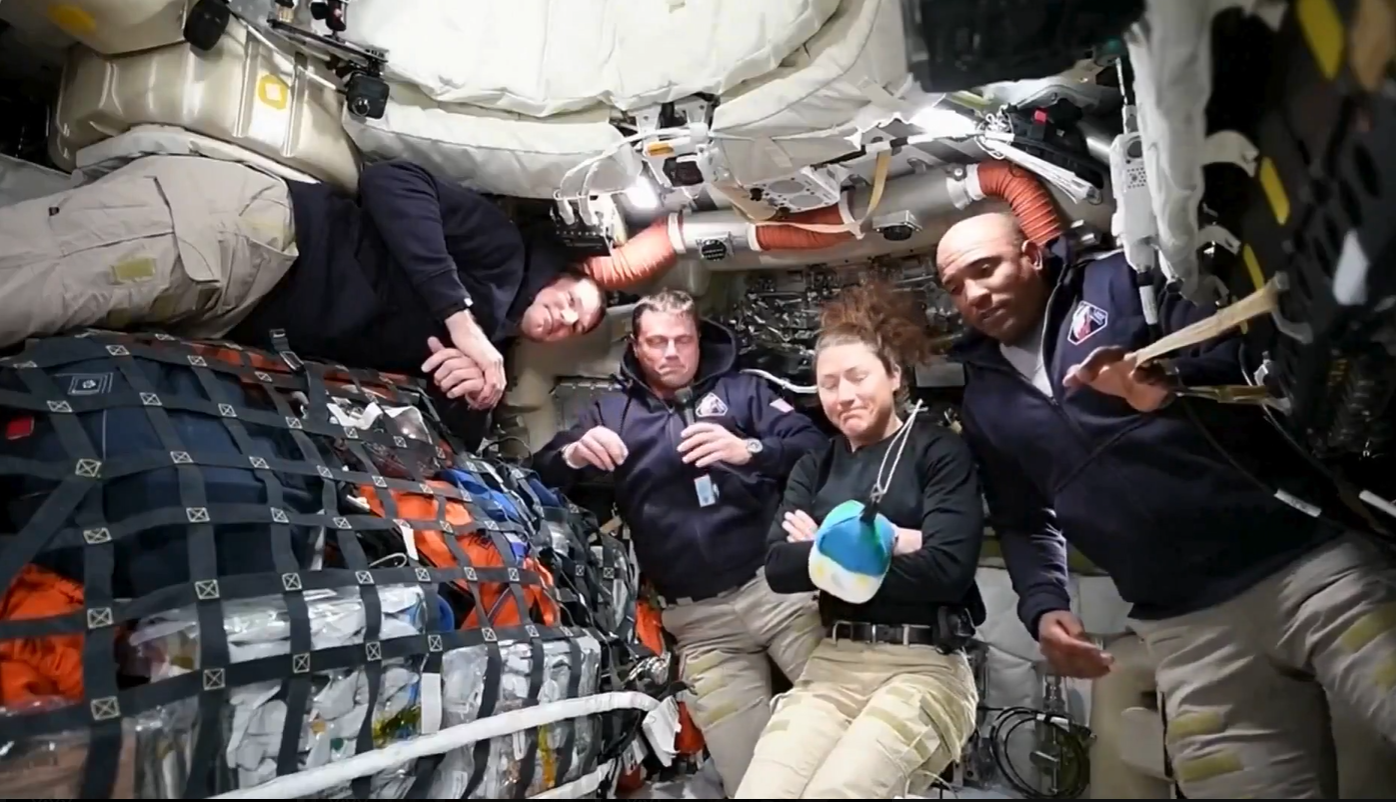
Yet the response from Commander Reid Wiseman, Pilot Victor Glover, Mission Specialist Christina Koch and Canadian Space Agency astronaut Jeremy Hansen has been characteristically professional — and laced with the wry humor that has defined the mission so far.
(Source: cnn.com)
The Orion toilet, formally the Universal Waste Management System (UWMS), represents a $30 million leap forward from the plastic bags and rudimentary funnels of the Apollo era.
Designed by Collins Aerospace and refined from International Space Station technology, it sits in the floor of the 16.5-foot-wide crew module behind a door and privacy curtain.
In microgravity, where nothing falls naturally, the system relies on powerful airflow and suction rather than gravity or water.
A funnel-and-hose attachment handles urine for both male and female astronauts; a contoured seat manages solid waste.
Handrails and foot tethers keep the user anchored, while separate collection paths prevent mixing.
Urine is vented overboard through a heated line to avoid freezing in the cold of space.
Faeces are compacted into an odour-controlled canister with filters and stored for return to Earth — a necessity on this 10-day flight, unlike the water-recycling loops of longer ISS stays.
The entire process is loud enough to require ear protection, and crews coordinate usage like roommates in a very small apartment.
(Source: thehill.com)
“It is probably the most important piece of equipment on board,” Koch quipped in a dispatch from orbit, earning her the affectionate title “space plumber” from her crewmates after she helped troubleshoot the initial pump failure by priming the system with additional water.
(Source: cnn.com)
The second issue hit harder.
In the early hours of flight Day 3, more than 200 000 miles from Earth, mission controllers noticed the toilet could no longer dump waste.
Flight Director Judd Frieling diagnosed frozen urine blocking the vent line — a common hazard in the extreme temperatures of deep space.
The crew was asleep when the problem surfaced, but by Saturday afternoon, controllers had a plan: rotate the spacecraft so sunlight would thaw the blockage.
The maneuver worked. Waste was expelled, and by 3:30 p.m.
EDT the system was declared “go for fecal use” while engineers monitored full restoration.
(Source: cnn.com)
For the hours the toilet was partially offline, the astronauts turned to their backup: the Collapsible Contingency Urinal, or CCU — essentially an updated version of the Apollo-era bag-and-funnel system.
Urine collected in the plastic pouches was later vented overboard once the line was clear. Solid waste collection continued via the toilet’s seat, though airflow assistance was limited. Koch reported at least one full CCU needing disposal, prompting a brief pause while controllers warmed heaters to avoid attitude-control complications. No one panicked. “We were all breathing a sigh of relief,” Koch told mission control.
(Source: cnn.com)
The incident, while inconvenient, lasted only hours and never threatened the mission timeline.
It underscored how even the smallest systems can become critical 200 000 miles from home — and how thoroughly NASA prepares for them.
Backup bags and diapers (maximum absorbency garments) remain standard contingency gear, a reminder of the unglamorous realities that Apollo crews endured for days on end.
Meanwhile, the journey itself has been otherwise textbook.
Artemis II lifted off from Kennedy Space Center’s Launch Complex 39B at 6:35 p.m. EDT on April 1 atop the towering Space Launch System rocket.
After a flawless translunar injection burn on flight Day 2, Orion — nicknamed Integrity — broke free of Earth orbit and set course for the Moon.
By Friday, 3 April 2026, the crew had surpassed the Apollo-era distance record, reaching more than 155 000 miles from Earth.
Stunning live views of the planet’s crescent and first glimpses of the lunar far side have captivated audiences worldwide.
Monday’s lunar flyby remains the highlight: Orion will skim just 4 000 miles above the Moon’s surface, offering the astronauts unprecedented close-up views of the far side never seen directly by human eyes. High-resolution photography and live commentary are planned.
The crew will then swing around for the return journey, splashing down in the Pacific Ocean around April 10 after a total mission of about 10 days.
(Source: nasa.gov)
For Wiseman, Glover, Koch, and Hansen — the first humans to venture this far since 1972 — the toilet drama has become just another story to share when they return.
It humanises a mission whose stakes are enormous: Artemis II paves the way for Artemis III’s lunar landing as soon as 2027.
Every solved glitch, every vented bag, every coordinated bathroom break proves that deep-space exploration still hinges on the most basic human needs — and the ingenuity required to meet them.
As the spacecraft hurtles onward, the crew’s calm professionalism has reassured ground teams and the public alike.
In the vast silence between Earth and the Moon, even a frozen toilet line can be thawed by sunlight, teamwork, and a little rotation.
The Artemis generation is learning, one plumbing fix at a time, what it truly takes to live — and relieve oneself — among the stars.
*Disclaimer: This article was compiled using AI tool Grok on X and may contain inaccuracies.