Évian-les-Bains – As world leaders prepare to convene for the two-day 2026 G7 summit in the French resort town of Évian-les-Bains, thousands of protesters took to the streets of neighboring Geneva, Switzerland, on Sunday, 14 June 2026.
The demonstrations, organised under the “No G7” banner by a coalition of over 200 groups, highlight deep frustrations with global economic inequality, climate inaction, and what activists call imperialist policies.
While the summit itself occurs on French soil at the opulent Hôtel Royal overlooking Lake Geneva, the spillover effects—security burdens, economic disruption, and protest risks—have fallen heavily on Switzerland, straining cross-border relations.
(Source: eda.admin.ch)
The choice of Évian as the venue for the summit from 15 to 17June 2026, just across the border from Geneva, revives memories of the contentious 2003 G8 summit also hosted by France in the same area.
Geneva serves as a primary arrival point for delegations flying into its international airport before they are transported to the French side.
France, as host, shifted the dates to accommodate U.S. President Donald Trump’s schedule, including his 80th birthday observances.
This logistical convenience has come at a cost for Switzerland, which is not a G7 member but must manage significant security and public order challenges.
Swiss officials, including Geneva Councillor Carole-Anne Kast, have publicly urged France to take greater responsibility for facilitating dissent, arguing that the host nation should bear the risks of democratic protest rather than offloading them.
Tensions between Bern and Paris have simmered over security costs, with Switzerland deploying around 4 000 soldiers and facing border restrictions reminiscent of pandemic-era controls.
(Source: swissinfo.ch)
Protesters’ grievances are broad and intersectional.
Environmentalists decry the G7’s perceived failure to deliver ambitious climate action amid escalating global crises.
Anti-imperialist and anti-war groups criticise policies related to conflicts in Ukraine and the Middle East, while feminists, Palestinian rights advocates, and critics of global capitalism converge on themes of inequality and concentrated power among wealthy nations.
Marchers chanted against “fascism and imperialism,” with some carrying effigies targeting prominent figures.
One vehicle featured a giant figure of Donald Trump holding a cocktail, symbolising perceived excesses.
Organisers from the No-G7 coalition, comprising around 60 organisations in some counts, framed the summit as lacking legitimacy in addressing the world’s pressing issues.
(Source: swissinfo.ch)
Sunday’s main march drew an estimated 6 000 to 7 000 participants, starting from Mon Repos Park.
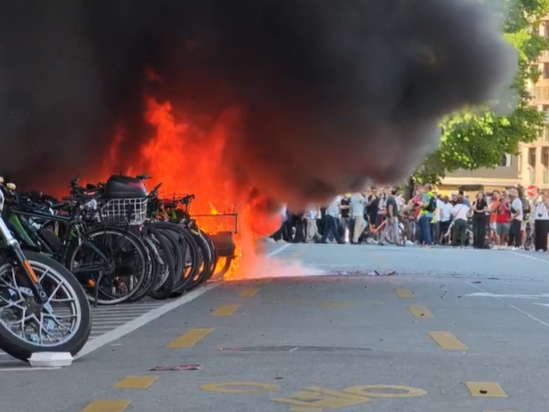
While much of the event remained peaceful, clashes erupted as some protesters targeted police, UN buildings in the area, and commercial symbols. Swiss authorities deployed tear gas in response.
A Tesla car was set ablaze, and windows of a bank (Banque du Léman) were smashed after wooden barriers were torn down.
Explosions were reported, and other vandalism occurred along the route.
Shops across Geneva had been boarded up in advance with thousands of square meters of wooden panels, reflecting fears of a repeat of the 2003 violence that caused millions in damage.
Local businesses reported severe disruptions, with some owners lamenting lost revenue and expressing frustration that a French-hosted event burdens Swiss streets and economies.
(Source: pbs.org)
Authorities made arrests amid the unrest.
Some 20 protesters were detained on Friday evening in preliminary actions.
During Sunday’s events, additional detentions occurred, though exact numbers were not immediately finalised as police assessed the full scope.
Officials emphasised a heavy presence to prevent escalation, with road closures and transport disruptions affecting the city center.
Residents voiced mixed feelings: concern over the “mess” and boarded-up storefronts, balanced by acknowledgment of the right to protest.
(Source: pbs.org)
U.S. President Donald Trump is attending the summit, marking a notable appearance amid ongoing global tensions.
Leaders will gather at the historic Hôtel Royal in Évian, a luxury palace known for hosting royalty and elites since 1909, where delegations are expected to stay.
The agenda includes discussions on the Middle East, Ukraine, global economic imbalances, artificial intelligence, trade, and climate goals.
Trump is scheduled for bilateral meetings and sessions, including on Ukraine, with the summit accommodating his preferences.
France has deployed around 8 000 police officers on its side for security.
(Source: lemonde.fr)
The protests underscore longstanding critiques of the G7 as an exclusive club of rich nations dictating terms on global issues without sufficient accountability.
Activists argue that policies on tariffs, aid, and conflicts exacerbate inequalities rather than resolve them.
For Geneva, the events evoke trauma from two decades ago, when similar demonstrations led to widespread looting.
This time, preemptive measures like boarded shops and military support aim to mitigate risks, but they come with economic and social costs for locals uninvolved in the summit.
(Source: internazionale.it)
As the summit opens, the contrast is stark: inside the secured Hôtel Royal, leaders will deliberate on international cooperation; outside in Geneva, voices of opposition highlight fractures in that very system.
Swiss-French coordination has been tested, with questions lingering about cost-sharing and responsibility.
Whether the demonstrations yield policy shifts or merely symbolic pressure remains to be seen, but they have already succeeded in drawing international attention to the summit’s shadow.
The G7’s discussions on Ukraine aid, Middle East tensions, and AI will unfold under this backdrop of dissent, reminding participants that global gatherings increasingly face scrutiny from those excluded from the table.
(Source: x.com)
Disclaimer: This article was compiled using the AI tool Grok on X and may contain inaccuracies