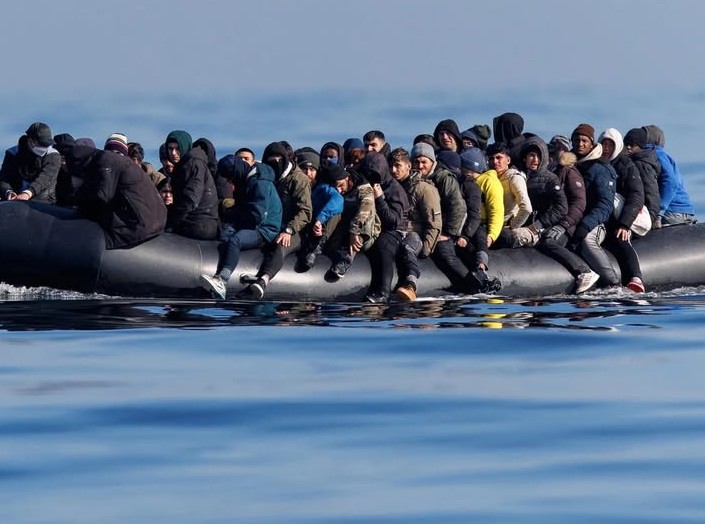
Crunch time is fast approaching for the immigration issues our political leaders have long swept under the carpet.
Either we “open the floodgates” somewhat wider, or we accept sustained economic decline and its accompanying political turmoil.
This is the choice Europe has stubbornly ignored, but which over the next few years is set to go critical.
Successive elections across the EU will be the battlegrounds where seemingly immovable anti-migrant prejudices meet the irresistible impact of ageing.
Shrinking tax contributions from smaller workforces are being confronted by the ballooning costs of the pensioner population.
Next year will see key elections in France, Spain, Italy, Poland, and Greece, along with significant polls in other EU states, including Germany.
The issue of immigration risks being decisive in many of them, with populist parties not merely demanding a freeze but, in some cases, urging Trump-style deportations.
The response of mainstream politicians has been to hunker down and ignore the issue.
Where that wasn’t possible, they either paid lip service to limiting newcomers or proclaimed their support for “Fortress Europe” – the EU’s misguided and muddled approach.
With these consequential elections looming, it’s time to fight back against xenophobic populists and warn voters of the unaffordable costs of dropping fertility, longer lifespans, and growing labour shortages.
It would also be a good idea to rebut those who think AI and the digital revolution will resolve matters; hoping, business leaders often say, isn’t the same as planning.
Europe is heading straight into the proverbial brick wall, with the prospect of severe bruising during the 2030s and serious injury by the 2040s.
By mid-century, the EU risks becoming a socio-economic basket case, a far cry from its late 20th-century heyday.
The chief culprit won’t be technological weaknesses or even the EU’s internal political difficulties.
It will be the aforesaid imbalance between earners and spenders.
On present trends, EU governments will within 20 years have to spend a quarter of their budgets on healthcare, pensions, and other social benefits, while their revenues, which are to a large extent derived from taxing employees and employers, will have shrunk by perhaps 10-15%.
Answers to these doom-laden forecasts range from boosting birthrates to cutting back on social safety nets.
France’s planning agency recently outlined useful ways that EU partners could exchange ‘best practice’ policies in a more concerted fertility drive.
Trimming benefit and healthcare costs through AI and other digital tools could also help, but the only solutions that offer reasonably rapid results centre around increasing immigrant numbers.
Europe doesn’t have much time left if it is to pull out of its demographic nosedive.
Short-term solutions – meaning within the next 10 years – are urgently needed, and that means stabilising the workforce.
Critical labour shortages in childcare and care for the elderly must be addressed as a priority, accompanied by measures to encourage more women and older people into paid employment.
The immigrant picture is, of course, different in each country, but a broadly similar policy approach should work for all.
A first step is to distinguish between internal and external immigration issues and treat them separately.
Internal policies should aim to greatly improve the integration of immigrant communities – better housing, education, jobs, and so on.
External policies would aim to manage increased immigration more equitably and efficiently.
Selecting desirable economic migrants without creating brain drains in their countries of origin isn’t easy, but could be part of a much-needed overhaul of the EU’s development efforts in Africa and the Arab world.
A tenth of the Union’s 450 million people were born outside the EU, yet they account for a quarter of births.
As they are central to fertility strategies, it would make sense to encourage more young female migrants; some fourth-fifths of youthful newcomers are male, and the lack of potential partners limits birthrates while aggravating social frictions.
Europe’s political elite has been in denial on demographic change for decades.
In 2010, a report by Spain’s charismatic former premier Felipe Gonzalez warned that 100 million migrants would be needed by mid-century.
Although his study was commissioned by the EU, it was quietly buried by leaders who included Angela Merkel, Nicolas Sarkozy, Gordon Brown, and Donald Tusk.
Their refusal to confront reality arguably marked the point at which populists’ anti-immigrant sentiments were given free rein.
Next year’s elections may well be the last opportunity to turn public opinion towards a clearer awareness of the demographic doldrums.
Mainstream political parties’ campaigning should challenge populists to detail their measures to combat ageing’s consequences.
The spectre of diminishing tax incomes to fund runaway social costs should be used to persuade voters that the most toxic aspect of immigration is that greater limits on it will widen the wealth gaps between “haves” and ”have-nots”.
*The views expressed in this Frankly Speaking op-ed reflect those of the author and not of Friends of Europe.
*This article first appeared on the Friends of Europe website and is reproduced with kind permission.
*The views expressed by the author of this article, Giles Merritt, are not necessarily those of The Bulrushes