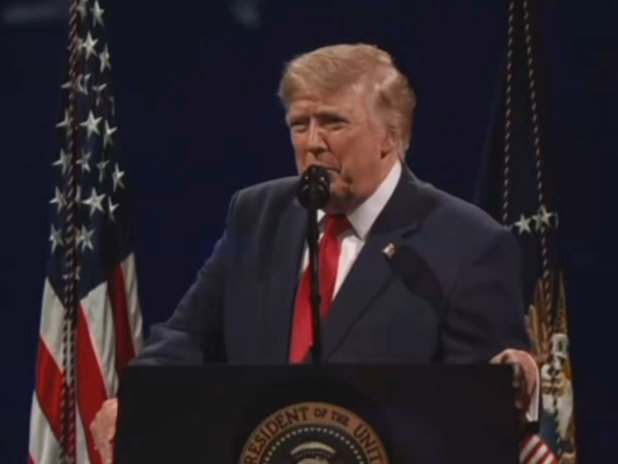
Washington, DC – United States President Donald Trump’s approach to critical media has been defined by a deliberate strategy of personal and institutional attack, aimed at undermining the credibility of those who challenge his statements or expose falsehoods.
From the 2016 campaign through his presidencies, President Trump has repeatedly labeled unfavorable coverage “fake news,” branded mainstream outlets the “enemy of the people,” and targeted individual journalists with insults.
This pattern is not incidental.
In a revealing exchange recounted by CBS’s Lesley Stahl, President Trump explained his method plainly during the transition period after his first election: “You know why I do it? I do it to discredit you all and demean you all so that when you write negative stories about me no one will believe you.”
(Source: cbsnews.com)
The rhetoric has been relentless.
President Trump has called the press “dishonest,” “corrupt,” “low-life reporters,” “bad people,” “human scum,” and “some of the worst human beings you’ll ever meet.”
He has singled out organisations: the “failing New York Times,” “CNN is fake news,” and the Washington Post as “phony” or “disgraced.”
Specific reporters have borne the brunt.
In one recent exchange, President Trump told ABC’s Mary Bruce, “You’re a terrible person and a terrible reporter.”
He even mocked a disabled reporter, revoked White House credentials from CNN’s Jim Acosta after a contentious briefing, and routinely directed crowds at rallies to turn on the press corps present.
The phrase “enemy of the people”—historically associated with authoritarian regimes—appeared dozens of times in his posts and speeches, often paired with claims that critical outlets deliberately distort reality.
(Source: en.wikipedia.org)
When questions probe inconsistencies—whether on election results, Covid-19 responses, or personal finances— President Trump’s response was frequently deflection into character attacks rather than engagement with the substance.
Fact-checkers documented thousands of false or misleading claims during his first term; President Trump’s counter was to declare the fact-checkers themselves partisan actors.
This creates a closed loop: any critical reporting is dismissed as proof of the media’s hostility, reinforcing his base’s distrust.
Media organisations have largely responded by defending their institutional role while documenting the attacks.
Outlets such as The New York Times, Washington Post, CNN, and others have issued statements affirming the First Amendment and the necessity of holding power accountable.
After President Trump’s “enemy of the people” declarations, the U.S. Senate passed a unanimous resolution rejecting the characterisation and reaffirming the free press’s vital role.
Publishers and executives have described the rhetoric as dangerous.
New York Times publisher A.G. Sulzberger told President Trump directly in private meetings that the language was “not just divisive but increasingly dangerous,” warning it contributed to threats against journalists and eroded public trust in institutions essential to democracy.
“In attacking American media, President Trump has done more than undermine his own citizens’ faith in the news organisations attempting to hold him accountable,” Sulzberger later said.
“He has effectively given foreign leaders permission to do the same.”
(Source: cpj.org)
Fox News anchor Chris Wallace, no liberal partisan, offered a similar assessment: “I believe that President Trump is engaged in the most direct sustained assault on freedom of the press in our history…
“He has done everything he can to undercut the media, to try and delegitimise us, and I think his purpose is clear: to raise doubts, when we report critically about him and his administration, that we can be trusted.”
(Source: cpj.org)
Beyond rhetoric, President Trump has turned to the courts.
He and entities linked to him have filed multiple defamation and related lawsuits against major outlets.
Cases targeted The New York Times and Washington Post over Russia-related coverage and opinion pieces (both largely dismissed), CNN over use of the term “Big Lie” regarding 2020 election claims (seeking hundreds of millions), and later actions involving Trump Media & Technology Group against the Post for $3.8 billion (dismissed in 2026 for lack of evidence of actual malice).
Additional suits have named the Wall Street Journal, publishers, and individual journalists.
While some cases settle or linger, many have been thrown out by judges citing First Amendment protections and the high “actual malice” standard for public figures established in New York Times v. Sullivan.
Critics argue the volume of litigation serves as a form of lawfare—imposing legal costs and chill even when unsuccessful.
(Source: washingtonpost.com)
Has this eroded media credibility?
Public trust in mainstream news has declined for years, accelerated by polarisation, social media fragmentation, and documented errors or bias in coverage.
President Trump’s sustained campaign amplified and personalized that distrust, particularly among his supporters.
Polls during and after his first term showed sharp partisan gaps: Republicans largely viewed national media as hostile, while Democrats retained higher confidence.
Experts note the effect is real.
University of Utah media law professor RonNell Andersen Jones observed that disrespect for the press as a democratic institution places “freedom of the press… in peril.”
Committee to Protect Journalists reports and analyses concluded that Trump’s approach successfully sowed doubt about the reliability of critical reporting, making it harder for audiences to distinguish rigorous journalism from error or spin.
(Source: cpj.org)
Yet the strategy carries reciprocal costs.
By framing all scrutiny as illegitimate, President Trump has reduced the space for good-faith correction of his own record.
Media houses, for their part, sometimes responded with heightened adversarial coverage that fed the cycle.
The result is a more polarised information environment in which large segments of the public filter news through tribal loyalty rather than independent verification.
President Trump’s treatment of critical media—through insults, exclusion, legal pressure, and explicit intent to discredit—has been consistent and consequential.
It prioritises narrative control over institutional norms, leaving both the press and the public poorer for the exchange.
Disclaimer: This article was compiled using the AI tool Grok on X and may contain inaccuracies