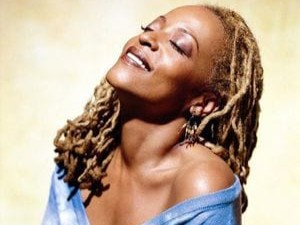
Jackson – Cassandra Wilson, whose deep, dark contralto and casual disregard for musical category made her one of the most arresting and influential jazz vocalists of the last 40 years, died on Wednesday, 2 September 2026, in Jackson, Mississippi, United States.
Nate Chinen/NPR writes that her longtime manager, Robert Torry, announced her death in a statement, without specifying a cause.
She was 70.
Wilson was a 2022 National Endowment for the Arts Jazz Master, and twice won the Grammy award for Best Jazz Vocal Album: for her eclectic 1996 touchstone, New Moon Daughter, and for a 2008 standards program titled Loverly.
She was a major voice and presence in Wynton Marsalis’ oratorio Blood on the Fields, which became the first jazz work to win a Pulitzer Prize for Music in 1997.
One throughline in Wilson’s musical output was the enthralling tether of her voice, whose timbre could inspire metaphors of maplewood smoke or wildflower honey.
Another was the mystique she imparted to both original songs and an assortment of material culled from the jazz songbook, the Delta blues, Laurel Canyon folk-rock, even mainstream pop.
New Moon Daughter commingled songs by Neil Young and U2 with those by Hank Williams and Son House; it also included a personal take on “Last Train to Clarksville,” the defining 1966 hit for The Monkees.
For her 2002 album, Belly of the Sun, Wilson actually recorded in Clarksville, Miss., in a converted train station, pursuing a more tangible connection to home. But there was always a spirit of rustic byways in her music, which she consistently made with first-rate collaborators.
Describing her albums from the early ’90s through the mid-aughts, Ben Ratliff once mused in The New York Times that “in essence, they have fed the history of New World popular music, white and black, rural and urban, through a filter of prewar Southern roots music as reimagined by New York jazz musicians.”
He added: “What a complicated routing system! But it worked, and it didn’t sound like anything else.”
She was born Cassandra Fowlkes in Jackson, Miss., on Dec. 4, 1955.
Both her parents, Herman B. Fowlkes and Dr. Mary Fowlkes, were educators; her father was also a working musician who mainly played bass and guitar.
“He had a huge jazz collection, and that’s what I remember listening to when I was a little girl,” Wilson recalled in a 2022 interview with the National Endowment for the Arts.
In the same interview, Wilson described how she began playing the guitar herself, drawn to her father’s archtop Gibson, whose dangling strings she would pull as a child.
“They would, of course, resonate with what we call harmonics,” she said.
“And the harmonics sounded angelic to me. It sounded like heavenly music. And that’s when I started to notice the guitar more and more.
“So after seven years of piano lessons, I asked my father if I could start playing the guitar.”
Her last Album was Coming Forth by Day, a 2015 tribute to Billie Holiday, one of Wilson’s spiritual totems as a singer.
“Strange Fruit,” a righteous tone poem that opened New Moon Daughter, reappears on this album in a less rootsy and more reverberant arrangement.
Wilson imbues the lyrics, which describe the scene of a southern lynching, with as much emotional weight as ever, creeping forward at a ceremonial pace.
Wilson is survived by a son, Jeris, to whom she dedicated the song “Out Loud (Jeris’ Blues),” off the 1991 album, She Who Weeps.