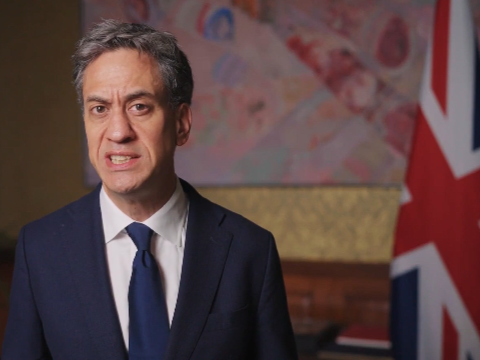
London – In a sharp escalation of Western pressure on Israel’s West Bank policies, the United Kingdom has announced a ban on imports of goods from Israeli settlements in the occupied Palestinian territories.
The ban announced on Tuesday, 8 September 2026, included measures targeting companies and individuals facilitating settlement expansion.
France and Canada joined the UK in imposing similar import restrictions, with a dozen countries signaling support for trade curbs aimed at preserving a two-state solution.
(Source: gov.uk)
UK Foreign Secretary Ed Miliband told Parliament the government’s official view is that Israel’s occupation is unlawful, citing the International Court of Justice’s 2024 advisory opinion.
He described “ethnic cleansing of Palestinians in areas of the West Bank — perpetrated by settler terrorists,” asserting that “all too often, the Israeli government has turned a blind eye to this and worse.”
The package includes a ban on advertising settlement property in the UK, new designation powers against those supporting or profiting from settlements, and strengthened sanctions.
Implementation is expected within six to nine months.
Trade volumes from the occupied territories have been modest, around £38 million in 2025, but the measures carry symbolic and political weight.
(Source: nytimes.com)
Israel responded furiously.
Foreign Minister Gideon Sa’ar called the accusations “outrageous lies” and “morally distorted,” announcing the closure of the British Consulate in East Jerusalem (accredited to the Palestinian Authority), removal of British personnel from a US-led Gaza coordination mission, termination of British training for Palestinian Authority forces, and entry bans on certain British officials and nationals.
Sa’ar framed the steps as necessary after a series of what he described as anti-Israel decisions by the UK government.
(Source: reuters.com)
The UK move comes against a backdrop of rapid settlement growth and rising displacement of Palestinians.
Israeli authorities have advanced tens of thousands of housing units in recent years and authorized numerous new settlements and outposts.
Peace Now and other monitors have tracked hundreds of outposts, many established or expanded since 2023, often with state support or little enforcement against unauthorized activity.
The E1 project near Jerusalem, involving tenders for over a thousand homes, has drawn particular international concern for potentially bisecting contiguous Palestinian territory.
(Source: hrw.org)
UN agencies, Human Rights Watch, and Amnesty International have documented accelerating forced displacement.
OCHA data indicate that more than 100 predominantly Bedouin and herding communities have faced full or partial displacement since early 2023 due to settler violence, access restrictions, demolitions, and related pressures, affecting thousands of people.
Additional large-scale displacements have occurred amid Israeli military operations in northern West Bank refugee camps.
Settler attacks resulting in casualties or property damage have surged, with reports of homes, water infrastructure, livestock, and farmland targeted, sometimes in the presence of or with limited intervention by Israeli forces.
Fatalities from settler violence have risen compared with prior years.
(Source: aljazeera.com)
Palestinian communities in Area C, which comprises over 60% of the West Bank and is under full Israeli civil and security control, face particular pressure.
Demolitions of structures built without Israeli permits—rarely granted to Palestinians—combine with restricted grazing and water access.
Settlers have established herding outposts that expand effective control over land.
Reports describe cycles of intimidation, arson, and physical assaults that leave residents feeling they have no choice but to leave.
Israeli officials have at times condemned specific attacks and prosecuted some perpetrators, yet critics, including the UK government, point to high levels of impunity and statements by some coalition members supportive of settlement expansion or population transfer.
(Source: ohchr.org)
Violence is not one-sided.
Palestinians have carried out attacks on Israelis in the West Bank, and Israeli security forces conduct frequent operations against militants.
The broader context includes the aftermath of the 7 October 2023 Hamas attacks and the ensuing Gaza war, which has intensified West Bank tensions.
Israeli governments across the spectrum have long maintained that settlements are legitimate expressions of historical and security claims, rejecting characterisations of the territory as occupied in the classic sense and arguing that final status must be resolved through negotiations.
Successive administrations have facilitated settlement growth while some have periodically frozen construction under international pressure.
The UK ban and related European and Canadian steps highlight growing isolation of Israel’s settlement policy among traditional allies.
Previous UK guidance already denied preferential tariffs to settlement goods and advised against business there; the new measures convert advice into prohibition and extend to services.
Similar national actions by Ireland, Spain, and others, plus pressure within the EU, reflect frustration that diplomatic warnings have not slowed expansion.
What does this mean for Israel’s consistent denials of war crimes and genocide accusations?
Israel rejects claims of genocide in Gaza and systematic war crimes, asserting that military operations target Hamas and other armed groups, that civilian casualties result from the challenges of urban warfare against an enemy that embeds among civilians, and that it investigates alleged violations.
On the West Bank, it maintains that settlements are not illegal under its interpretation of international law and that security measures and law enforcement respond to terrorism rather than enable ethnic cleansing.
The ICJ’s advisory opinion on the occupation and ongoing proceedings related to Gaza have been contested by Israel as politicised or exceeding the court’s role.
Gaza’s Ministry of Health states that at least 1355 Palestinians have been killed by Israeli fire or strikes since the ceasefire that took effect on or around 10 October 2025.
The same ministry reports that after the October 7 Hamas attack in Israel and before the ceasefire, the Israeli Defence Force killed as many as 67 000 Palestinians in revenge strikes, of whom about 20 179 were children, and 10 427 were women.
The UK’s formal adoption of the “unlawful occupation” framing, explicit reference to ethnic cleansing by settlers with government acquiescence, and economic measures add weight to the international legal and political case against settlement policy.
They do not themselves adjudicate genocide or war-crimes charges, which remain matters for courts, the ICC, and future investigations.
However, by treating settlement activity as a systematic enterprise facilitating displacement—backed by data on outposts, housing approvals, community erasures, and violence patterns—the policy shift undermines Israel’s portrayal of these developments as isolated or defensive.
It signals that key partners no longer accept assurances that expansion and associated violence are aberrations rather than features of the status quo.
Critics of the ban argue it unfairly singles out Israel, ignores Palestinian rejectionism and terrorism, risks harming Palestinian workers employed in settlements, and plays into domestic politics.
Supporters counter that continued economic engagement with settlements normalises an enterprise widely viewed under international humanitarian law as prohibited population transfer into occupied territory.
The consulate closure and reciprocal measures illustrate the diplomatic cost of the confrontation.
As legislation is drafted and further national measures emerge, the practical impact on settlement economics may prove limited.
The political signal is clearer: major Western governments are treating the accelerating displacement of Palestinians and the expansion of settlements as an urgent threat to any viable two-state outcome, and they are prepared to impose tangible costs.
Whether this alters Israeli policy or hardens positions ahead of domestic political cycles remains an open and contested question.
In December 2023, South Africa instituted proceedings against Israel at the International Court of Justice (ICJ), alleging that Israel’s military campaign in Gaza following the 7 October 2023 Hamas attacks violates the 1948 Genocide Convention by committing acts of genocide against Palestinians.
The Court issued several provisional measures orders in 2024 requiring Israel to take steps to prevent genocidal acts, ensure humanitarian access, and report on compliance; South Africa has repeatedly submitted dossiers claiming non-compliance.
Israel filed its Counter-Memorial in March 2026 (contesting jurisdiction and the merits), after which the ICJ ordered South Africa to submit a Reply by 22 November 2027 and Israel a Rejoinder by 22 May 2029; the case remains in the written pleadings stage, with no final judgment on the merits expected for several years.
To justify the mass killings of Palestinians, Israel points to 7 October 2023, when Hamas and other Palestinian armed groups launched a coordinated surprise attack from the Gaza Strip into southern Israel.
The assault combined a massive rocket barrage with ground infiltrations by militants who breached the border fence at multiple points, used motorised paragliders and boats, and targeted civilian communities, military bases, and the Nova music festival near Re’im.
Attackers killed 1 200 Israeli civilians and took about 250 others hostage.
It was the deadliest single day for Israel since its founding.
(Source: britannica.com)
Reports indicate that 168 hostages were returned alive and the bodies of 85 hostages (killed on 7 October or while in captivity) were recovered and repatriated.
Disclaimer: This article was compiled using the AI tool Grok on X and may contain inaccuracies