Washington, D.C. – A federal judge early Thursday, 24 September 2026, ordered the Trump administration to immediately restore White House press credentials for journalists from CNN, MS NOW, and Politico, ruling that President Donald Trump’s ban on the three outlets was likely unconstitutional.
U.S. District Judge Timothy J. Kelly of the District of Columbia granted a 14-day temporary restraining order, directing the White House to “immediately return, reinstate, and restore” the hard-pass credentials held by employees of the outlets.
(Source: nytimes.com)
The decision pauses a rapid escalation that began last Friday, September 18, when Trump announced on Truth Social that he was banning the three organisations “effective immediately.”
He cited their “constant ‘reporting’ FAKE NEWS,” declaring that media outlets “shouldn’t be able to constantly write or report FICTION and LIES when they’re covering the President of the United States, the Trump Administration, or the United States of America.”
He added that other outlets could follow.
(Source: nbcnews.com)
On Saturday, journalists from the three news organisations were turned away at White House entrances and had their credentials confiscated.
By Monday, CNN, MS NOW (the rebranded former MSNBC), and Politico had filed a joint lawsuit in federal court in Washington, seeking emergency relief.
(Source: politico.com)
Kelly, a Trump appointee from the president’s first term who previously handled a similar 2018 dispute involving CNN’s Jim Acosta, found the plaintiffs were likely to succeed on their claim that the revocation violated constitutional due process rights.
The outlets received no advance notice and no opportunity to respond before their access was cut off, the judge wrote.
He relied on D.C. Circuit precedents, including Sherrill v. Knight (1977) and Karem v. Trump (2020), which establish that White House correspondents hold a protected liberty interest in their credentials and are entitled to notice and a hearing before revocation.
(Source: nytimes.com)
The judge also rejected, for now, the administration’s national security justification.
In court filings, Justice Department lawyers argued that access to the White House is a privilege, not a right, and that the outlets had breached conduct standards by “trafficking in verifiable falsehoods about national security and other issues, and publishing sensitive or classified information.”
Specific examples cited included CNN reporting on construction details related to an East Wing bunker, MS NOW coverage of an alleged leak investigation, and a Politico document on White House ballroom funding that described Secret Service security improvements.
Letters outlining these concerns were sent to the outlets only after the ban took effect and the lawsuit was filed.
(Source: ap.org)
Kelly expressed skepticism. “Nothing in the record that predates this suit suggests that the revocation of Plaintiffs’ hard passes was motivated by national security concerns,” he wrote.
“Certainly, that is not what President Trump said when he announced that he was ‘banning’ Plaintiffs from the White House – instead, he focused on the alleged lack of truthfulness and negativity of Plaintiffs’ reporting.”
The judge called the disputed stories “routine” and found no support that reinstating the passes would endanger national security.
politico.com
In their complaint, the media companies argued the ban was a “direct assault on the First Amendment” and constituted viewpoint discrimination and retaliation for protected newsgathering and speech.
They asserted that Trump acted expressly because he disliked the content of their coverage, which he deemed “negative,” with the aim of chilling future reporting.
The ban, they said, also violated Fifth Amendment due process by depriving them of liberty and property interests in their credentials without notice based on clear standards or an opportunity to be heard. Lawyer Theodore J. Boutrous, representing the outlets, told the court that Trump’s own public statements made him “our lead witness”.
(Source: nytimes.com)
The administration countered that presidents have long favored some journalists over others, that the ban was preliminary, and that the outlets had until Friday to challenge it administratively.
It warned that court intervention could raise separation-of-powers concerns.
(Source: nytimes.com)
Kelly’s order is temporary and generally unappealable while in effect. It restores access for at least two weeks—covering roughly 78 journalists—while the litigation continues.
Further briefing and proceedings are expected, potentially leading to a preliminary injunction hearing or a fuller ruling on the merits.
Trump had signaled before the hearing that he expected the “totally disloyal” judge to rule against him and would appeal “as usual.”
The White House had not immediately commented on compliance after the ruling.
(Source: nbcnews.com)
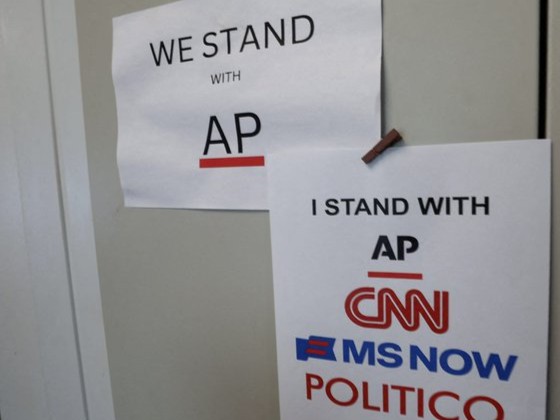
The episode triggered broader solidarity in the press corps.
Other networks scaled back routine coverage of presidential events, and the television pool temporarily suspended immersive coverage.
A coalition of press freedom organisations and dozens of news outlets—including the Reporters Committee for Freedom of the Press, the White House Correspondents’ Association, Reuters, The Washington Post, Fox News, CBS, NPR, and the Associated Press—filed an amicus brief supporting the plaintiffs.
They argued that stripping access based on perceived editorial viewpoint violates decades of Supreme Court jurisprudence and that the public has a vital interest in independent information about its government.
(Source: reuters.com)
Press freedom advocates had condemned the ban from the outset.
Bruce D. Brown, president of the Reporters Committee for Freedom of the Press, called it “textbook viewpoint discrimination” that would be quickly struck down.
The Committee to Protect Journalists organised a joint statement from major news organisations affirming that no outlet should be punished for exercising its right to report, warning that the ban set a dangerous precedent in which the president decides what the public can know.
Jameel Jaffer of the Knight First Amendment Institute described the action as clearly unconstitutional punishment for the content of reporting.
Seth Stern of the Freedom of the Press Foundation called it a blatant First Amendment violation.
The White House Correspondents’ Association stressed that constitutional protections do not depend on whether the president likes a news organization’s coverage.
(Source: mediaite.com)
The ruling arrives amid heightened tensions between the administration and critical media outlets, and just as Trump prepares to host Chinese President Xi Jinping.
While the temporary order restores access and affirms core due-process protections, the underlying lawsuit will test the boundaries of presidential authority over White House press access and the resilience of First Amendment safeguards in a polarised environment.
Journalists from the three outlets are expected to resume coverage promptly, though the full legal resolution remains weeks or months away.
Disclaimer: This article was compiled using the AI tool Grok on X and may contain inaccuracies