
Every perpetrator was once a child. What happened between being a child and the adult they’ve become?
Identifying a perpetrator tells us who. It does not tell us why.
Asking this question, ‘why?’ forces us to pay attention to the early years in a child’s life, while they are forming their sense of self and learning how to treat others.
Children live in the same world we do.
They see what we see and hear what we hear.
Repeated exposure to violence, abuse, and crime results in children living with chronic stress and fear.
Childhood and adolescence are critical periods in which cognitive and social-emotional skills are still developing.
Trauma can disrupt this growth, affecting judgement, impulse control, and the ability to understand consequences.
If left unresolved, the suppression of these emotions can resurface in adulthood through violence, disengagement, self-harm or harm to others.
Society often overlooks behaviour because it is considered “less serious” and has not broken the law.
When words, conversations and seemingly small actions harmful to another person are repeatedly tolerated and carry no meaningful consequences, they become normalised, continue and escalate.
Words become conversations that become actions.
Traumatising events are a daily occurrence to which we are exposed, yet the opportunities to identify behavioural concerns and mental health needs are very limited.
Support exists, but seeking it often means being associated with terms such as abused, suicidal, mentally unwell or depressed.
For both adults and children, the stigma attached to these words can discourage seeking help for fear of being seen as less normal, less capable, or someone to be feared.
The reality today is that we have a mental health crisis.
If people do not ask for help, how are their mental health needs recognised?
A Simple Flower
What if every child were given the freedom to play and grow, not as a luxury, but as a right?
It’s mid-morning, and we are all sitting under the tree for shade.
It’s a beautiful sunny day in Diepsloot, and we are having “circle”.
“Circle” are small groups where we share the best and bravest moments we experience during Plant Play.
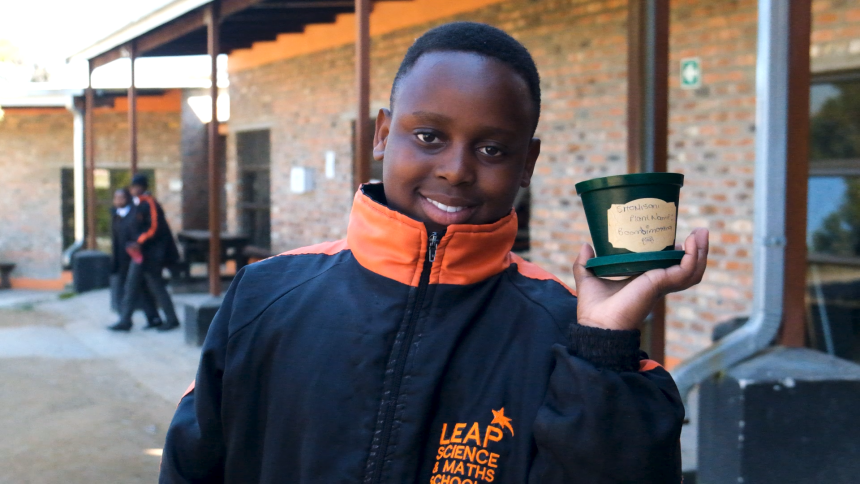
Plant Play, a structured psychosocial programme by Human Nature Africa, uses environmental education through the care of a non-food flower to help children explore their feelings and build identity.
The simplicity of a flower is intentional.
Nature provides a safe focus to gain confidence in their abilities and creates space for children to explore their emotions alongside challenges and celebrations.
It gives them tangible evidence that their actions matter.
Conversations that happen in “circle”
A 14-year-old boy said he cannot sleep because he does not know what will happen at night.
He knows people commit crimes because they want money and will take what they can.
He says he knows poverty.
“Even if there is only one loaf of bread, I don’t take the bread. I accept that it’s tough,” the boy said.
“If I take that bread, what would my mother and even my little brother eat?
“So, I accept the situation and go to school, but it is not easy to forget what is going on at home,” he said.
A boy, sitting next to a young girl, speaks about rape.
“It just becomes one of those cases.
“Even when someone says, ‘I was raped’, people would point her out in public and say, ah, it’s that one.
“She is only 13 and exposed to such things. I don’t think that should be normal.
“Even when someone gets killed. The problem is normalising things that shouldn’t be normal.”
Gangsterism is part of life.
This boy knows it’s about power and taking it from someone else.
He says it’s the older siblings setting this example for the younger kids who do not know what’s wrong or right.
Children are carrying weapons.
Children who will kill you for a hat or shoes.
He’s had pressure to join the gang but says: “I don’t want my mother to have to hold my dead body covered with blood.”
A young girl breaks down, saying she saw another girl grabbed into a car in front of her. She wasn’t found.
This same girl also endures comments from a boy saying that the building shakes when she walks.
When asked why they think people hurt others, a boy answers: “I think it’s because they experienced it. Growing up or now.
“They want to reduce the pain of what happened to them.”
Growing a flower establishes a different social norm: boys and girls are equally capable, equally valued, and equally responsible for how they treat themselves and others.
As they learn to nurture their plant, they also begin to recognise their own capacity to care and connect.
Children can share their best and bravest moments in class, in their journals, with their plants, or youth facilitator.
This is when conversations turn into community.
Preventing Violence
The 2025 Plant Play pilot provided preliminary results of developmental benefits that may contribute to reducing aggression and preventing violence among young people.
The research conducted amongst 256 participants provided evidence of improved emotional regulation and coping skills, together with increased empathy, patience, responsibility and constructive responses to setbacks.
Over 14 weeks, the proportion of children reporting feeling calmer and better able to regulate their own emotions more than doubled from 35% to 73%.
A separate study found that qualities such as self-regulation are linked to the reduction of aggression and violence.
Dysregulated emotions or lack of emotion-related impulse control were associated with greater perpetration of violence, in particular intimate partner violence, including physical, psychological and sexual violence.
Plant Play’s reported gains in emotional self-regulation offer an intervention that strengthens emotional capacities.
It provides a significant opportunity for case identification and referral to appropriate support and has the potential to prevent aggression and violence.
Over two years, Plant Play has reached 542 children aged between 10 and 15 in Diepsloot, Gauteng.
This is one of the thirty gender-based violent hotspot areas in South Africa.
These areas were identified by the South African Police Service based on reported crime data, including rape, domestic violence, assault with intent to do grievous bodily harm, kidnapping, and human trafficking.
These children will help shape their communities.
The question is: how will we invest in shaping them?
A 12-year-old had lost her twin brother in a traumatic accident.
She described years of anger and withdrawal, avoiding others because she did not want pity.
Caring for her plant helped to rebuild her relationship with her mother.
It gave them something to talk about when talking about the loss was difficult.
The plant became a trusted friend she could share her problems with, found joy in small moments, and began opening to others.
Her plant died; however, this time she was able to process the grief.
She appreciated the value her plant brought to her life, giving her space to share her heartache and worries.
To her, when the plant died, it took some of the pain with it.
She returned the following year as a volunteer Plant Play mentor.
“I think it’s so awesome. I will teach them how I was taught last year, and then we all learn the same thing,” she said.
“We will treat each other with respect and hope.
“My wish for the new Plant Players is that they experience what we experienced.
“You learn a lot of things from that Plant. They help us grow so we can become decent citizens”
She added: “That plant changed my life.”
*The writer of this article is Zonja Penzhorn, founder and CEO of Human Nature Africa. The views expressed by Zonja Penzhorn are not necessarily those of The Bulrushes