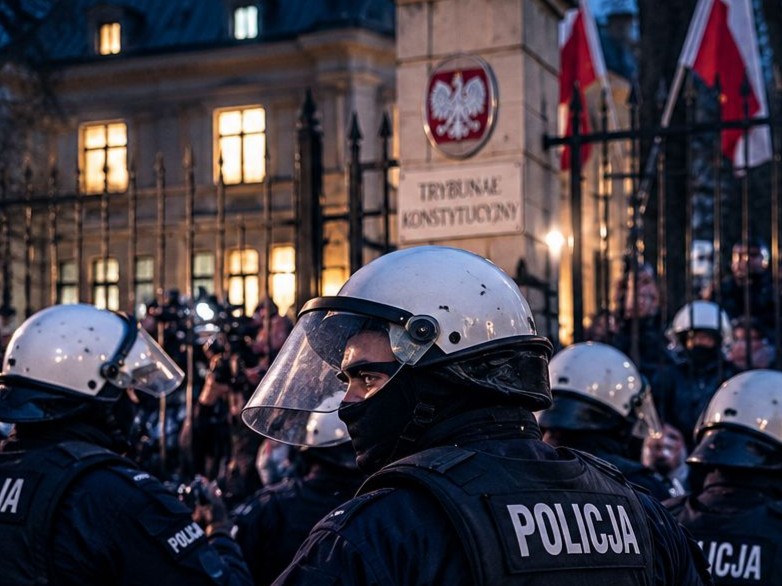
Warsaw – Poland is facing one of the most serious constitutional confrontations in its post-communist history, with Prime Minister Donald Tusk and President Karol Nawrocki locked in a bitter struggle over control of the country’s Constitutional Tribunal.
The Constitutional Tribunal is the court responsible for determining whether laws comply with the constitution.
What began as a dispute over judicial appointments more than a decade ago has evolved into a broader battle over who has the authority to shape Poland’s democratic institutions and define the rule of law. [euronews.com], [polskieradio.pl]
The latest chapter unfolded dramatically in October 2026 when rival factions within the Constitutional Tribunal claimed authority over the court, prompting protests, police deployments and accusations of a constitutional coup.
President Nawrocki, a political ally of the conservative Law and Justice (PiS) party, even cut short an overseas trip and returned to Warsaw as tensions escalated.
Prime Minister Tusk, meanwhile, defended efforts to remake the court as necessary to restore judicial independence. [politico.eu], [reuters.com]
At the centre of the dispute lies a deceptively simple question: who gets to appoint the judges who interpret Poland’s constitution?
How the crisis began
The roots of the crisis stretch back to 2015, when Poland’s then-governing Civic Platform (PO) coalition, the political camp from which Tusk comes, sought to appoint five Constitutional Tribunal judges before losing power in an election.
After PiS won that election, the incoming parliament rejected those appointments and selected its own candidates instead.
President Andrzej Duda, also aligned with PiS, swore in the new judges while refusing to accept the oaths of judges chosen by the previous parliament. [euronews.com], [polskieradio.pl], [yahoo.com]
The Constitutional Tribunal subsequently ruled that three of the appointments made by the outgoing parliament had been valid, while two had not.
However, the political dispute did not end there. Instead, it opened a constitutional conflict that would shape Polish politics for years.
Critics argued that PiS had installed judges in seats that were already legally occupied, while PiS maintained that it was correcting an abuse by its predecessors. [euronews.com], [yahoo.com]
The PiS years
After taking power, PiS introduced a series of judicial reforms that altered how the Constitutional Tribunal operated, including changes to procedures, voting rules and court administration.
The government argued that the reforms were designed to improve accountability and remove remnants of a post-communist elite.
Opponents saw something different.
Domestic critics, the European Union and international legal bodies argued that the changes weakened judicial independence and increased political influence over the courts.
The Constitutional Tribunal became a symbol of a larger conflict between Warsaw and Brussels over democratic norms and the separation of powers. [euronews.com], [politico.eu], [reuters.com]
Over time, the court itself became increasingly controversial. Its rulings included decisions supporting a near-total ban on abortion and challenging the supremacy of certain aspects of European Union law.
Critics contended that the tribunal no longer functioned as an independent constitutional watchdog. [politico.eu]
Tusk’s return and a new confrontation
When Donald Tusk returned to power in late 2023 at the head of a pro-European coalition, one of his major promises was to restore the rule of law and reverse judicial reforms introduced under PiS.
However, he faced a major obstacle: institutions created or influenced during the previous government remained in place. [theguardian.com], [reuters.com]
The presidency became particularly important. Although Poland’s prime minister leads the government, the president possesses significant constitutional powers, including the ability to swear in judges and veto legislation.
The conflict intensified in 2026 when President Nawrocki reportedly refused to administer oaths to several judges elected by the parliamentary majority aligned with Tusk.
According to Tusk’s supporters, this prevented the court from functioning properly and blocked efforts to reform the tribunal. Nawrocki and his allies argued they were defending the constitution against government overreach. [euronews.com], [politico.eu]
Matters came to a head when Judge Anna Korwin-Piotrowska announced the suspension of the tribunal’s leadership and declared herself temporarily in charge.
Tribunal president Bogdan Święczkowski rejected the move as illegal and described it as a coup.
Rival groups effectively claimed authority over the same institution, exposing deep uncertainty over who legitimately controlled Poland’s highest constitutional court. [politico.eu], [reuters.com]
Why the dispute matters
The struggle is not merely about personalities or political rivalry.
The Constitutional Tribunal has the power to invalidate laws and resolve disputes about constitutional authority.
If its legitimacy is questioned, uncertainty can spread throughout the legal system.
Courts, government agencies and ordinary citizens may face competing interpretations of which rulings are valid and which judges have authority.
The crisis therefore touches the foundations of the Polish state, raising questions about democratic accountability, judicial independence and constitutional legitimacy. [polskieradio.pl]
What is the way forward?
A lasting solution is likely to require both political compromise and legal clarity.
One possibility is that Poland’s political institutions negotiate an agreement on judicial appointments that is accepted by both the government and the presidency.
Yet the depth of mistrust between the opposing camps makes such a compromise difficult.
Another pathway lies through the courts themselves and European legal institutions.
The European Commission, the Court of Justice of the European Union and the European Court of Human Rights have all weighed in on aspects of Poland’s judicial dispute and continue to influence the debate over judicial standards and appointments. [euronews.com], [politico.eu]
The more immediate challenge is restoring confidence in the Constitutional Tribunal.
Without broad acceptance of the court’s legitimacy, every major constitutional ruling risks becoming another political battleground.
More than a decade after the first disputed appointments in 2015, Poland remains trapped in a conflict over who gets to interpret the constitution.
The current standoff between Tusk and Nawrocki shows that the country’s judicial crisis is no longer merely a legal dispute.
It has become a test of whether Poland’s political rivals can agree on the rules of democratic competition itself. [euronews.com], [euronews.com]
Disclaimer: This article was compiled using the AI tool Microsoft Copilot and may contain inaccuracies