Washington, DC – A rare nationwide ground stop that halted departing flights across the United States on Friday, 13 November 2026, was lifted after roughly four to five hours.
The disruption left airports jammed, thousands of passengers stranded, and the aviation system scrambling to recover into the weekend.
(Source: cbsnews.com)
The Federal Aviation Administration ordered the stop around 3:54–4 p.m.
ET, citing “extraordinary circumstances and for reasons of safety” after a communications issue affected all Air Route Traffic Control Centers.
Departures were frozen while planes already airborne were allowed to land on a case-by-case basis.
The order was lifted at 8:15 p.m. ET, Transportation Secretary Sean Duffy announced, though he warned recovery would be slow.
(Source: forbes.com)
At the peak, some 3 000–4 000 aircraft were inbound to U.S. airports.
Flight tracking data showed the scale of the fallout: reports cited roughly 4 700 to over 6 300 cancellations and around 9 500–10,000 delays on Friday alone, with additional cancellations already listed for Saturday.
Hundreds of flights were diverted. Airlines faced aircraft and crews out of position, guaranteeing ripple effects for days.
(Source: wired.com)
Major hubs from New York and Atlanta to Los Angeles, Chicago, Miami, and Boston saw terminals fill with frustrated travelers.
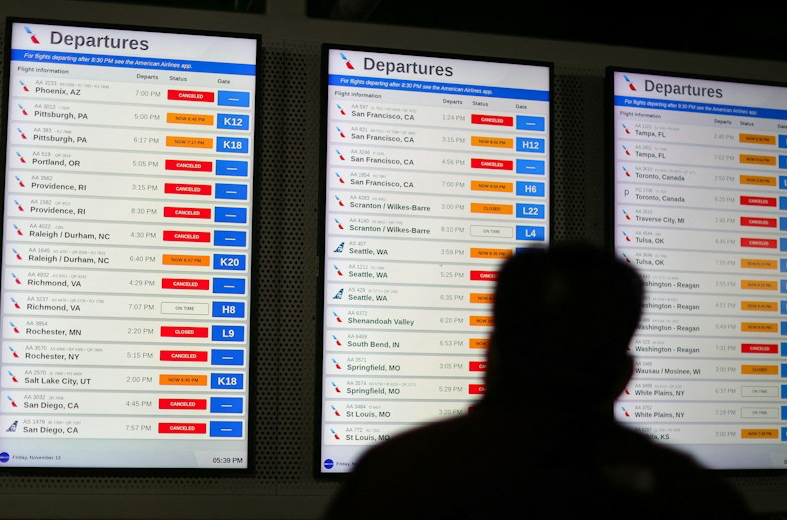
Passengers sat on floors, refreshed apps endlessly, and lined up for rebooking as departure boards glowed red with delays and cancellations. Some newly landed planes waited on the tarmac unable to reach gates as ramps clogged.
One pilot told passengers he had “never seen this before.” College sports teams and business travelers were among those caught mid-journey.
Even after the airspace reopened, Duffy cautioned that “it’s going to be slow” and that it would take time “to unwind what has happened.”
nbcwashington.com
Officials attributed the failure to the nation’s aging air traffic control infrastructure.
Duffy described “an incredibly old air traffic control system” relying on 1980s-era switches, routers, and copper lines.
These became overloaded with data, producing inconsistent radar and communications information at centers and Terminal Radar Approach Control facilities.
“Our routers actually got overloaded with data and they started to give us inconsistency in the data from those routers. And because of that, we shut the system down,” he said.
(Source: cbsnews.com)
Multiple sources pointed to an update or patches applied to the private FAA Telecommunications Infrastructure (FTI) network—the communications backbone linking the system and operated by contractor L3Harris—as triggering a reboot that crashed the network.
Homeland Security Secretary Markwayne Mullin said new technology being installed was overwhelming the older system.
“The new technology was overwhelming the older system,” he noted.
Officials stressed there was no indication of a cyberattack or “nefarious act,” distinguishing the event from the post-9/11 grounding and ruling out links to a concurrent Microsoft outage or artificial intelligence tools.
Preliminary assessments described it as a telecommunications and mechanical issue driven by legacy equipment.
(Source: wired.com)
Technicians worked through the afternoon and evening to restore stable communications.
The ground stop itself lasted about five hours from issuance to the 8:15 p.m. ET reopening.
Resumption was gradual and tiered as en-route facilities recovered, with some West Coast flights cleared earlier and operations restarting slowly nationwide. Full normalis
ation was expected to take many hours and stretch into the weekend as airlines repositioned planes and crews.
(Source: flightradar24.com)
The economic and human costs were immediate and substantial, though precise nationwide dollar figures were still emerging.
More than 1.5 million passengers had been scheduled to depart on roughly 11 000 flights after 4 p.m. ET.
Airlines absorbed cancellations, diversions, hotel and meal vouchers, and overtime.
Passengers faced missed connections, overnight stays, and lost productivity.
Broader ripple effects hit hotels, ground transportation, and businesses reliant on air travel.
The episode underscored chronic vulnerabilities: controller shortages, aging infrastructure, and repeated equipment failures that have caused regional disruptions in recent years.
(Source: reuters.com)
Duffy used the moment to press Congress for emergency funding—figures discussed included up to $50 billion—to fully modernise the system.
He warned that without a complete overhaul, similar failures would continue.
“It’s going to continue to fail,” he said, noting the president had been seeking full funding for a new air traffic control system.
The event was only the second nationwide ground stop since the 11 September 2001 attacks (the other was a roughly 90-minute NOTAM system outage in January 2023).
(Source: forbes.com)
As flights began trickling out Friday night, travelers and airlines faced a long cleanup.
The incident highlighted how a single communications glitch in a legacy network can freeze the world’s busiest airspace, imposing steep costs in time, money, and confidence.
Officials maintained safety was never compromised for those airborne, but the chaos on the ground served as a stark reminder of the urgency of replacing decades-old technology before the next overload hits.
Disclaimer: This article was compiled using the AI tool Grok on X and may contain inaccuracies