Johannesburg – Tiger Brands has delivered solid results for the year ended 30 September 2026, with key performance indicators ahead of guidance and continued capital allocation discipline.
Sustained improvements in underlying operational performance reinforce the sustainability of the Group’s operating model and strategy.
Significant progress was made in the multi-year structural investment programme, aimed at strengthening competitiveness and delivering a step change in the Group’s cost structure.
Of the R1.7 billion capital expenditure in FY26, 72.5% went to expansion, with the balance directed to optimisation and sustaining the reliability and productivity of existing assets.
The Paarl Culinary Mega-site in the Western Cape kickstarted the investment drive and was commissioned in the second half of the year.
The Mega Distribution Centre in Gauteng remains on track for commissioning at the end of FY27, while commissioning of the Super Bakery is now expected in the second half of FY27 following revised timings for regulatory approvals.
Good progress has also been made on the Snacks and Treats Mega-site consolidation and Beverages Primary Distribution Centre.
The operating environment remained challenging.
National protest action in the second half of FY26 disrupted the general trade channel, prompting significant de-stocking, while higher fuel prices added inflationary pressure, mitigated through continuous improvement initiatives focused on logistics optimisation.
Normalised volume growth exceeded short- to medium-term guidance. Normalised revenue grew 3.3%, with volume growth of 4.5% and price deflation of 1.2%.
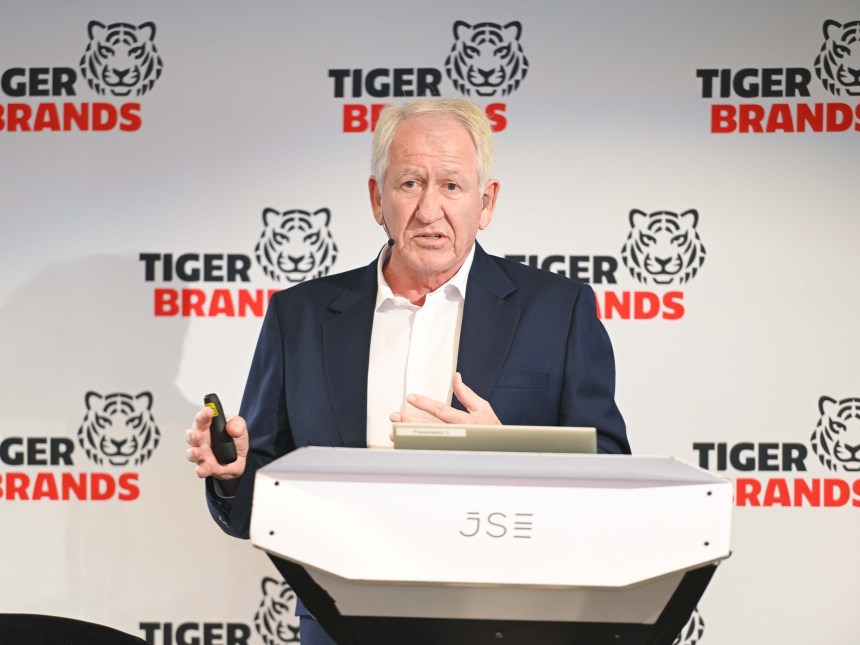
“As households continue to face mounting pressure on disposable income, our focus on driving affordability remains at the heart of everything we do,” Tjaart Kruger, CEO of Tiger Brands, said on Thursday, 26 November 2026.
“Our results reinforce our strategic choices as we build a more competitive, efficient and resilient Tiger Brands and accelerate strategic capital investments to expand our manufacturing capacity in South Africa while continuing to deliver sustainable value for shareholders and the broader society.”
Gross margin increased 228 bps to 33.6% (FY25: 31.3%), supported by favourable product mix, recipe and packaging value engineering, input cost savings and improved factory efficiencies from higher volumes.
Operating income rose 12.6% to R4.3 billion, with operating margin expanding to 12.6% (FY25: 11.1%) on gross margin expansion and additional continuous improvement savings.
The continuous improvement run rate exceeded expectations, and the two-year R500 million savings guidance is expected to be fully delivered in FY27.
Export revenue rose 5.8%, contributing meaningfully to margin expansion, supported by more consistent supply, stronger distribution execution and targeted product and market mix initiatives.
As expected, income from associates fell 63.0% to R139 million following the Carozzi disposal in FY25.
Net financing costs were R145 million (FY25: net finance income of R65 million), reflecting balance sheet optimisation and increased gearing in line with the capital allocation framework.
Net debt to EBITDA was 0.04x, well within the 1.0x long-term ceiling.
EPS from total operations decreased 5.8% to 2 337 cents per share (FY25: 2 482 cents per share), while HEPS increased 5.2% to 2 162 cents per share (FY25: 2 056 cents per share).
Portfolio optimisation
The portfolio optimisation strategy launched in FY24 is nearly complete. As announced on SENS on 1 June 2026, the Company confirmed Randfontein’s non-operational profit after tax of R157 million and its retention of King Foods following its turnaround.
Beacon chocolate update
The sale of the Beacon brand and equipment associated with chocolate slabs, Easter eggs and assortments has been concluded.
The sale of the Beacon property in H2 26 generated a net profit of R121 million after additional closure costs, advisory fees and tax.
Chococam update
Chococam is the only outstanding disposal. Regulatory approvals, including from the Economic and Monetary Community of Central Africa (CEMAC) competition authorities, were received without conditions.
Tiger Brands remains committed to the completion of the disposal by the end of 2027.
Listeriosis update
As previously communicated in the SENS announcement released on 12 May 2025, Tiger Brands’ lead reinsurer, QBE Insurance Group Limited (QBE), which has primary conduct of the defence of the class action against Tiger Brands, authorised the insurers’ attorneys to make settlement payments, without prejudice, to each of the claimants classified as urgent need cases as a result of listeriosis prior to liability being determined.
The remaining claimants form the subject of the ongoing settlement discussions, and management is pleased to confirm these are progressing positively.
Tiger Brands continues to manage the litigation in close cooperation with its insurers and its legal advisers, to ensure that the matter progresses in a disciplined manner consistent with the Court process and applicable insurance arrangements.
Tiger Brands and its insurers remain committed to an appropriate, fair and humane resolution of the matter.
Tiger Brands will continue to keep shareholders appropriately informed of material developments. As previously stated, Tiger Brands has adequate product liability insurance cover for a group of its size.
Business Unit performance
Milling and Baking – Strengthening the base and laying the foundation for growth
Operating income rose 8.5% to R826 million (margin 9.9%) on operational efficiencies.
The Super Bakery commissioning is delayed by regulatory approvals, without affecting existing operations.
Grains – Performance across portfolio delivers ahead of expectations
Operating income rose 52.9% to R1.1 billion and margin expanded 585 bps to 16.2%, driven by favourable mix and higher factory efficiencies.
Innovation and capacity investment remain priorities.
Culinary – Exceptional performance delivering margin enhancement and volume growth
Operating income rose 17.7% to R1.3 billion (margin 11.6%). Phase 1 of the Paarl Mega-site was commissioned.
Snacks, Treats and Beverages – Solid margin delivery, with strategic projects gaining momentum
Operating income rose 6.5% to R873 million (margin 14.6%) on procurement savings and factory efficiencies.
The Mega-site optimisation is on track for end of FY27, and the Beverages Primary Distribution Centre will be completed in the first half of FY28.
Home and Personal Care (“HPC”) – Home Care gains traction as the Ingram’s relaunch weighs on performance
Operating income dropped 24.0% to R400 million (margin 18.3%). FY27 focus is on Personal Care recovery.
Tiger Brands International (TBI)
International markets delivered strong growth, with revenue increasing by 5.8% and operating income significantly ahead of the prior year, contributing meaningfully to the group’s operating profit.
The key distributor model continues to drive broader market access.
“We are now focused on our next phase of sustainable, profitable growth,” said Kruger.
“With a more focused portfolio, a strong balance sheet and disciplined capital allocation, we are well positioned to invest in growth opportunities and deliver sustainable shareholder returns.”
In line with strategic priorities, Tiger Brands will be focused on the following:
· Deliberate growth platforms: Drive affordability, relevant innovation and cost leadership. Grow Bakeries market share through strategic pricing and execution, recover Personal Care volumes through the Ingram’s relaunch reset, and defend Doom’s market leadership.
· Superior channel presence: Accelerate Bakeries general trade penetration while maintaining modern trade volumes. Sustain above-average export growth through the distributor model and targeted in-market campaigns.
· Rejuvenating our brands: Leverage brand strength through targeted, effective marketing to maximise return on investment.
· Cost leadership: Sustain continuous improvement initiatives to mitigate macroeconomic volatility.
· Shaping our portfolio: Conclude the Chococam disposal process, anticipated by the end of 2027.
Accelerating sustainability and societal impact
Delivering on its purpose to cultivate and nourish lives, every day and every tomorrow, Tiger Brands made further progress against its 2030 sustainability commitments:
- 1 218 jobs created in the smallholder farming sector
- 19% reduction in Scope 1 and 2 GHG emissions
- Waste to landfill reduced to 6.3%
- 15% reduction in water-use intensity
- 114 332 people supported through food security and nutrition programmes
- 50% reduction in food production waste against the 2022 baseline, ahead of target
Langeberg & Ashton Community Trust
Following the sale of Langeberg and Ashton Foods, Tiger Brands donated R150 million to establish a community trust.
The Trust holds a 10% shareholding in the business and will support community development through welfare, humanitarian assistance, healthcare, education, land and housing initiatives.