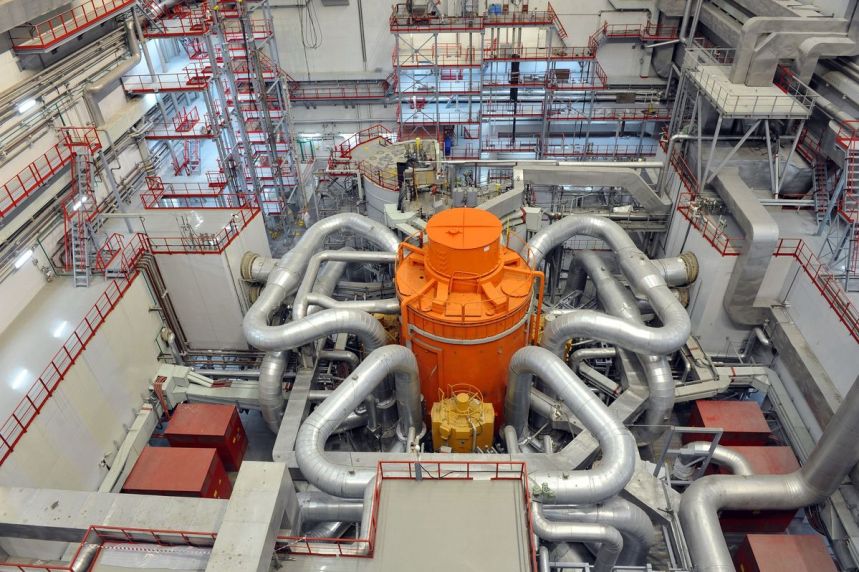
Zudilovo – At Unit 4 of the Beloyarsk Nuclear Power Plant (NPP) in Russia, the 880 MW BN-800 fast-neutron reactor has started operating an experimental fuel assembly made with plutonium recovered from its own used fuel.
This is the first time a closed nuclear fuel cycle has been proven in practice on a large commercial reactor.
Until now, fuel recycling in the same reactor had been demonstrated on experimental and prototype fast reactors.
The principle is simple: while a reactor operates, plutonium forms inside its fuel. It can be recovered from used fuel and made into fresh fuel for the same reactor, and the process can be repeated again and again.
The new fuel assembly at Beloyarsk was produced with an optimised plutonium-recovery process that uses fewer processing steps and keeps the same fuel quality, which makes recycling more economical.
The achievement brings closer a long-standing goal of nuclear science: an energy source that renews its own fuel.
The world needs ever more clean and reliable electricity, and in one IAEA scenario global nuclear capacity more than doubles by 2050, to 890 GW.
A fuel pellet the size of a fingertip holds about as much energy as a tonne of coal, and today’s reactors use only about 1% of uranium.
According to the IAEA, recycling all long-lived elements in fast reactors can cut the time needed for waste radiotoxicity to fall to the level of natural uranium from about 250 000 years to 300–400 years.
About 448 000 tonnes of used fuel have already been discharged from power reactors worldwide, IAEA data show, and with recycling this stock could provide energy for many centuries to come.
“Today, in closing the nuclear fuel cycle around fast reactors, we have moved from theory to practice,” Rosatom Director General Alexey Likhachev said.
“By overcoming this next technological milestone, we are proving the viability of a ‘renewable’ nuclear energy model.
“It will allow us to meet growing electricity demands without a proportional increase in the strain on natural resources or in radioactive waste volumes.”
Reliable power is a pressing need for Africa. According to the IEA, around 720 million people worldwide still live without electricity, and nine in ten of them are in sub-Saharan Africa.
Many African countries are looking at nuclear power: according to the IAEA, about a third of the almost 30 countries considering it are in Africa.
South Africa’s Koeberg is the continent’s only operating nuclear power plant, and Egypt is building its first plant, El-Dabaa (a Rosatom project).
Countries preparing for their first plant consider the fuel cycle from the outset: the IAEA Milestones Approach includes the nuclear fuel cycle and radioactive waste management among the 19 issues they need to address.
The successful operation of the new fuel assembly is a step towards future Generation IV reactors.
Pre-project work has begun at the Beloyarsk NPP for a larger fast-neutron unit, which will go online in the coming decade.
In the Tomsk Region (Russia), as part of its Proryv (“Breakthrough”) project, Rosatom is building a nuclear power plant with an on-site closed nuclear fuel cycle – the first time in the world such a facility is being built at a single location.