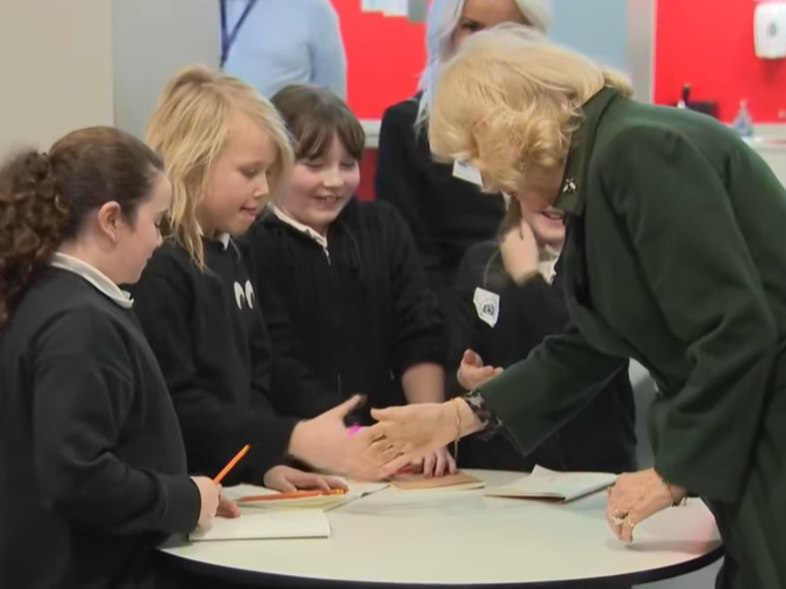
London – In a gesture aimed at tackling childhood literacy inequality, the Queen of England has arranged for 800 000 books to be distributed to children across the United Kingdom this Christmas.
The initiative, coordinated through schools, libraries and community organisations, prioritises households where children currently own no books of their own.
Palace sources said the motivation was straightforward: every child should have the chance to open a book on Christmas morning and to discover the pleasure and power of reading.
Advisers highlighted long-standing evidence that too many young people grow up without books in the home.
Recent surveys by literacy charities have repeatedly found that a substantial minority of UK children – estimates in recent years have ranged from around one in ten to higher figures in some disadvantaged communities – do not own a single book.
In some studies, the proportion of primary-age children without books at home has been reported at roughly 10–15 per cent, with higher rates in areas of greater economic deprivation.
The Queen’s programme is designed to reach precisely those children.
The distribution focuses on children aged roughly 4 to 11.
Titles have been selected for age-appropriateness and broad appeal, ranging from picture books and early readers to short chapter books.
Local partners will handle the logistics so that the books arrive in time for the Christmas period.
Organisers stressed that the gift is intended as a starting point rather than a one-off charity exercise: the hope is that owning a book will encourage further borrowing from libraries and engagement with school reading schemes.
Reading, education experts note, is one of the strongest predictors of later academic success.
Children who read regularly develop larger vocabularies, stronger comprehension skills and greater facility with written language.
These advantages compound over time.
Pupils who enter secondary school with solid reading habits are better equipped to access the wider curriculum, from science textbooks to history sources and examination papers.
Longitudinal studies consistently link early reading engagement with higher attainment in literacy and across subjects, as well as with a greater likelihood of remaining in education beyond the compulsory age.
Beyond formal exam results, reading builds concentration, imagination and empathy.
Following a narrative requires sustained attention; encountering different characters and settings expands a child’s understanding of other people’s lives.
For children who may have limited access to travel or diverse experiences, books offer windows into other worlds and ways of thinking.
Regular reading also correlates with improved mental well-being and a stronger sense of personal agency: the ability to choose what to read and to pursue curiosity independently.
The scale of the Queen’s gift – 800 000 books – is intended to make a measurable dent in the number of children without books at home.
Literacy organisations have long argued that book ownership is not a luxury but a basic educational resource.
Children who grow up surrounded by books tend to read more, and those who read more tend to achieve more.
Conversely, the absence of books in the home is associated with lower reading frequency and weaker literacy outcomes.
By placing a physical book directly into children’s hands, the initiative seeks to interrupt that cycle at a moment when family attention is focused on gifts and shared time.
Supporters of the programme point out that Christmas is a particularly effective moment for such an intervention.
The association of books with pleasure and celebration can help reframe reading as something enjoyable rather than purely instructional.
Teachers and librarians involved in the distribution plan to follow up with reading challenges, story-time sessions and information about free library membership so that the single gifted book becomes an entry point rather than an endpoint.
Critics of large-scale book giveaways sometimes argue that one volume cannot solve deeper issues of educational inequality, teacher shortages or the digital distractions that compete for children’s attention.
Advocates of the Queen’s scheme counter that ownership matters: a book that belongs to a child is more likely to be reread, shared with siblings and treated as a personal possession rather than a temporary loan.
Small, concrete steps, they say, can still shift trajectories when multiplied across hundreds of thousands of households.
The broader case for reading remains robust.
Decades of educational research show that the volume of reading children do outside formal lessons is a powerful driver of vocabulary growth and reading fluency.
Fluent readers decode text more automatically, freeing cognitive resources for comprehension and critical thinking.
Those skills, in turn, support learning across every subject.
Reading also underpins civic participation: citizens who can process complex written information are better placed to engage with news, public debate and lifelong learning.
In announcing the gift, the Queen is understood to have emphasised both the practical and the personal.
A book under the tree is a tangible present; the habit of reading it can become a lasting one.
For the estimated hundreds of thousands of UK children who currently have no books of their own, the delivery of 800 000 volumes this Christmas is framed as an investment in their future educational opportunities and in the simple, enduring pleasure of a story well told.
Whether the initiative will produce measurable gains in reading frequency and attainment will depend on follow-through – library access, parental encouragement and continued school support.
Yet the core premise is clear: reading matters, book ownership helps, and ensuring that every child has at least one book of their own is a concrete way to begin closing the gap.
Disclaimer: This article was compiled using the AI tool Grok on X and may contain inaccuracies