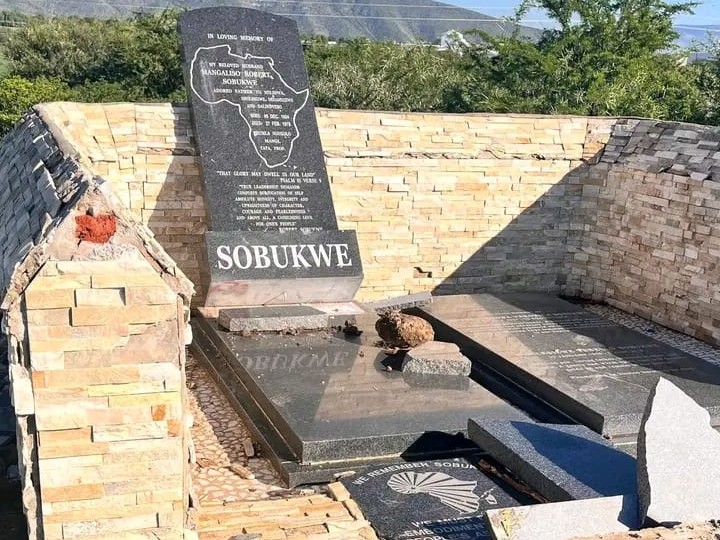
The physical landscape of South Africa has long been a battleground for historical truth.
For decades, a calculated effort has existed to marginalize, dilute, and systematically erase the contributions of the Pan-Africanist Congress (PAC) from the mainstream narrative of the liberation struggle.
Whether driven by the colonial-apartheid mindset that refuses to cede psychological ground, or by post-apartheid political hegemony that seeks a monopoly on history, the agenda remains the same: wish the Africanist agenda away.
Recent events reveal that this subtle erasure has mutated into desperate, overt acts of vandalism.
The targets are not random. They are deliberate strikes against symbols of Africanist defiance and self-determination.
A deliberate pattern of desecration speaks louder than random acts of crime.
When physical monuments of liberation history are systematically targeted, it ceases to be mere vandalism; it becomes an ideological assault.
The Anatomy of an Agenda
For decades, an unholy consensus between conservative settler interests and mainstream liberation narratives has sought to marginalise the PAC.
From efforts to historical derecognition at international bodies like the United Nations to the systematic omission of PAC contributions from textbooks, the objective has been singular: to wish the Africanist perspective away.
As these images demonstrate, when history cannot be rewritten through policy, it is attacked with hammers and crowbars.
Striking the Founding Father: The Desecration of Sobukwe’s Grave
The recent, brutal desecration of Robert Mangaliso Sobukwe’s grave in Graaff-Reinet, recently renamed Robert Sobukwe Town, is a visceral manifestation of this ongoing warfare.
Sobukwe was a man so feared by the apartheid regime that they constructed a specific law just to keep him in solitary confinement on Robben Island.
He was a threat because he preached an uncompromising message of psychological liberation and total return of the land.
The shattering of his tombstone is not simple public property damage; it is an assault on his memory.
It is no coincidence that this vandalism occurred precisely as the town of his birth was formally renamed in his honor.
The act mirrors the deep-seated resistance of conservative elements and settler-colonial remnants who are furious at the changing cultural landscape and who cannot stomach a reality where an uncompromising Pan-Africanist is immortalised.
Targeting the Commanders: The Vandalism of Sabelo Phama’s Signage
The same insidious playbook is visible in the defacing of street signs dedicated to General Sabelo Victor Gqwetha, popularly known by his combat name, Sabelo Phama.
As the legendary commander of the Azanian People’s Liberation Army, Phama spearheaded a military campaign that struck fear into the heart of the apartheid security apparatus.
When a street was finally renamed to honor his sacrifice, the response from those clinging to the old order was immediate: the sign was targeted, bent, and vandalized.
By attempting to tear down his name from the public view, the perpetrators seek to keep APLA’s revolutionary contribution pushed to the periphery of South Africa’s history, preserving a sanitised, comfortable narrative of how liberation was achieved.
Phama, the uncompromising military strategist of APLA, represents the armed, revolutionary thesis of the land return.
To vandalise his name is to attempt to tear down the validity of the
Africanist liberation struggle itself.
This agenda is not exclusively carried out by right-wing vigilantes. It extends to state-sanctioned amnesia.
The Robert Mangaliso Sobukwe Hospital in Kimberley stands as a tragic monument to institutional neglect.
Allowing a tertiary healthcare facility bearing his name to fall into systemic crisis and structural rot is another, more subtle form of desecration – one that devalues the dignity of the very people Sobukwe fought to liberate.
History cannot be erased.
This structural hostility extends beyond broken granite and bent steel signs.
It is deeply embedded in the shocking neglect of public infrastructure bearing Africanist names.
The deteriorating state of institutions like the Robert Mangaliso Sobukwe Hospital serves as a quiet, systemic form of erasure, allowing spaces named after these giants to crumble, thereby subtly degrading their stature in the public consciousness.
The Failure of the Erasure Agenda
The infographic highlighting the ruling party’s preoccupation with its own strategic survival through the Government of National Unity exposes a harsh reality.
While mainstream political elites focus on maintaining access to state resources, preserving their own legacies, and avoiding the political sidelines, the radical, foundational architects of the liberation struggle are left exposed to the elements of reactionary rage.
From the halls of the United Nations to local municipality councils, there have been historical attempts to deny the PAC its rightful recognition.
But history is not written by the vandals of the night, nor is it permanently dictable by the compromises of the day.
The perpetrators of these acts believe that by breaking stone and defacing metal, they can break the spirit of what these men represented.
They fail to realise that Sobukwe and Phama are no longer just men; they are ideas.
You cannot vandalize an idea whose time has come.
Despite the failed efforts of those who wish to rewrite history, the reality stares them squarely in the eyes: the Pan-Africanist legacy cannot, and will never, be erased.
The bitter irony for the perpetrators of these acts is that vandalism is an admission of defeat.
You do not try to erase a legacy unless that legacy still holds immense power.
The physical destruction of marble and aluminum cannot undo the foundational truth of the liberation struggle: the land belongs to the people.
Despite the failed efforts of settlers who cling to the past and elements within the liberation movement who wish to monopolise history, the truth refuses to bend.
The names of Sobukwe and Phama are etched not just on stone and street signs, but into the bedrock of the Azanian consciousness.
Try as they might, Sobukwe can never be erased.
*Xola ‘eXTee’ Tyamzashe is an APLA veteran and a prominent figure in South African history and politics, known for his contributions to the Pan-Africanist movement. The views expressed by Xola ‘eXTee’ Tyamzashe are not necessarily those of The Bulrushes