Johannesburg – A rare cosmic explosion has given astronomers an unprecedented view of a massive star in its final moments, revealing a previously missing link between ordinary supernovae and the most energetic explosions in the Universe.
The Southern African Large Telescope (SALT) obtained eight spectra of the supernova over nearly two months, allowing researchers to follow how the explosion evolved.
Combined with observations from facilities around the world, the results reveal a previously missing link between ordinary supernovae and the most energetic explosions in the Universe—and suggest a new pathway through which massive stars may end their lives.
Several NSF NOIRLab facilities and instruments helped to unravel the nature of this event, including the U.S. Department of Energy-fabricated Dark Energy Camera, the U.S. National Science Foundation Nicholas U. Mayall 4-metre telescope, and NSF–DOE Vera C. Rubin Observatory.
In March 2026, the Einstein Probe detected a brief flash of soft X-rays emitted from a galaxy about 500 million light-years away.
The flash, dubbed EP260321a, immediately triggered a worldwide observing campaign. Within an hour, ground-based telescopes began monitoring the source, revealing a rapidly brightening supernova later designated SN 2026gzf.
Two teams of scientists utilised several NSF NOIRLab facilities to observe the event and monitor its evolving light profile.
The teams were led by Brendan O’Connor, astronomer and McWilliams Fellow at Carnegie Mellon University, and Jillian Rastinejad, a NASA Einstein Fellow at the University of Maryland, College Park.
The teams present the results of their studies in papers published in The Astrophysical Journal Letters (O’Connor et al., Rastinejad et al.).
Both teams were able to independently identify the initial burst of X-rays as a “shock breakout” — the moment when the powerful shock wave from a stellar explosion bursts through the star’s surface and releases the first light of a supernova.
Although shock breakouts are expected to occur in all supernova explosions, they are notoriously difficult to observe because they last only seconds to hours.
In the past two decades, astronomers have confidently identified only one other clear X-ray shock breakout event [1], making EP260321a an exceptionally rare discovery.
Each team was also able to independently confirm that the explosion was a broad-lined Type Ic (Ic-BL) supernova.
These supernovae typically possess jets of relativistic material — material that is moving close to the speed of light — and they are commonly linked to gamma-ray bursts, which are the brightest and most powerful class of explosions in the Universe.
However, SN 2026gzf stands out as a unique case for multiple reasons.
First, the initial shock breakout is the faintest to ever be associated with a Ic-BL supernova, even though the explosion itself was not similarly weak.
Additionally, researchers were surprised to find no evidence of a gamma-ray burst following the supernova, despite the event appearing to match other Ic-BL supernovae that were followed by gamma-ray bursts.
“SN 2026gzf looks remarkably similar to other energetic supernovae that have been previously linked to gamma-ray bursts,” says O’Connor.
“Yet multi-wavelength follow-up observations using the most sensitive facilities found no evidence for a relativistic jet or an afterglow, which are typically seen in those events.
“One possibility is that the jet was ‘choked,’ either by the surface of the star or by circumstellar material surrounding the star.”
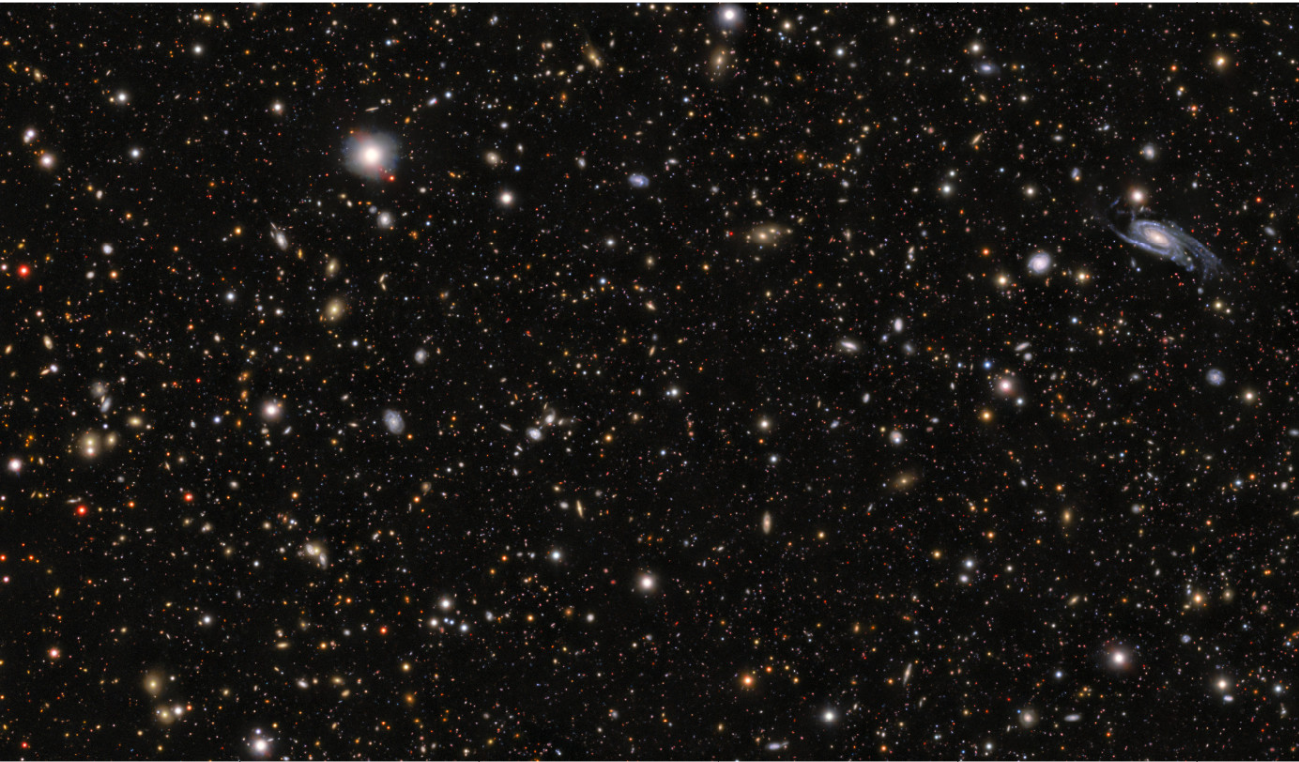
For their investigation into this puzzling event, O’Connor and his team acquired deep imaging of the supernova as it brightened and reached peak luminosity using the 570-megapixel DOE-fabricated Dark Energy Camera (DECam), mounted on the NSF Víctor M. Blanco 4-meter Telescope at Cerro Tololo Inter-American Observatory (CTIO) in Chile, a Program of NSF NOIRLab.
Archival DECam images taken ten years before the explosion revealed a blue source at the same location [2], offering rare clues about the progenitor system and its environment before the star died.
The event also occurred within the NSF–DOE Vera C. Rubin Observatory’s COSMOS Deep Drilling Field. Public commissioning data from the Rubin alert broker, Babamul, supplied additional multi-band observations that helped track the supernova’s evolution and revealed evidence of activity from the progenitor system shortly before the explosion.
Thanks to Rubin’s rapid cadence and unprecedented sensitivity, continued observations are expected to provide detailed, long-term records of the supernova as it evolves for years to come.
Additionally, the Dark Energy Spectroscopic Instrument (DESI), mounted on the NSF Nicholas U. Mayall 4-meter Telescope at Kitt Peak National Observatory (KPNO), a Program of NSF NOIRLab, obtained multiple spectra through its spare-fiber transient program.
This program is aimed at using spare fibers on DESI that are not already matched to a target to follow up on transients identified by Rubin.
These observations allowed the team to watch SN 2026gzf evolve over time and confirm its nature as a Ic-BL supernova.
“DESI’s spare-fiber program gave us the opportunity to return to SN 2026gzf repeatedly and follow how its spectrum changed as the explosion evolved,” says Xander Hall, graduate student at Carnegie Mellon University, member of O’Connor’s team, and second author of the paper.
“This sequence of observations demonstrates the power of using DESI’s spare fibers for rapid transient follow-up and classification as Rubin continues to ramp up its transient alert stream over the next decade.”
For their study, O’Connor and his team also acquired observations from NASA’s Chandra X-ray Observatory, the National Radio Astronomy Observatory’s Very Large Array (VLA), the Fraunhofer Telescope at Wendelstein Observatory of Ludwig-Maximilians-Universität, Caltech’s Palomar Observatory telescopes, the Hobby-Eberly Telescope, and the Southern African Large Telescope (SALT).
Rastinejad and her team simultaneously conducted a multi-wavelength follow-up investigation of the event using both of the Gemini Multi-Object Spectrographs (GMOS) mounted on Gemini North in Hawai‘i and Gemini South in Chile, which compose the International Gemini Observatory, and the Goodman spectrograph mounted on the SOAR 4.1-meter Telescope through its AEON queue; both Gemini and SOAR are supported in part by the NSF and operated by NSF NOIRLab.
They also used data from NSF–DOE Rubin Observatory, Palomar Observatory, and the VLA.
These observations helped Rastinejad and her team confirm that SN 2026gzf was a Ic-BL supernova, determine the absence of relativistic jets, and understand the star’s structure and surroundings just prior to collapse.
“Our observations allowed us to study the physics of three pieces of this explosion: the X-ray shock breakout, the accompanying supernova, and the interaction of the supernova with material previously cast out by the dying star,” says Rastinejad.
“With this information we were able to map out the structure of the material surrounding the star and understand the star’s violent lifestyle before it collapsed.”
They determined that the progenitor is a Wolf-Rayet star — a star born with about 20 times the mass of the Sun that burns through its hydrogen early on in its life.
They found that in the lead-up to its explosive death, the star underwent irregular episodes of mass loss, ejecting all of its hydrogen and helium and leaving behind a stripped star made mostly of carbon and oxygen.
The turbulent mass loss created multiple shells of material around the star: a nearby, compact shell of low-mass material that emitted the initial X-ray signal, plus an extended, non-symmetric shell of material that emitted the optical supernova signal.
“This is the first time we’ve mapped out the pre-explosion environment of a star that has been stripped of hydrogen and helium,” says Gokul Srinivasaragavan, a recent PhD graduate from the University of Maryland, a member of Rastinejad’s team, and second author on the paper.
“Going forward, I’m excited to observe more shock breakout events in similar detail to test if all stripped stars have a similar ‘lifestyle’ prior to collapse and what, if any, differences we see.”
With an exceptionally faint X-ray shock breakout and no relativistic outflows, EP260321a/SN 2026gzf acts as a unique bridge between ordinary supernova shock breakouts and the more extreme explosions that generate low-luminosity gamma-ray bursts.
By establishing that energetic Ic-BL supernovae do not always produce a gamma-ray burst, relativistic outflows, or a long-lived afterglow, this discovery suggests that massive stars can die through a wider range of pathways than previously recognised.
The result also demonstrates the growing power of coordinated time-domain astronomy, where space missions and ground-based observatories work together to capture transient cosmic events in real time.
By combining observations from Einstein Probe, NSF NOIRLab facilities, and partner observatories around the world, researchers were able to reconstruct a rare explosion in unprecedented detail.