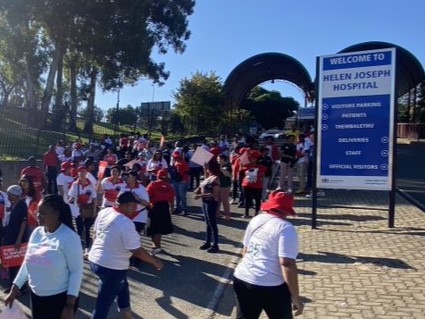
Johannesburg – The Gauteng Department of Health (GDoH) on Monday warned that public hospitals and clinics have been affected by the National Education, Health and Allied Workers’ Union (NEHAWU) strike over wage hikes.
The GDoH added that – in some instances – ambulances were unable to attend to emergencies as they could not leave or enter facilities because striking workers had blocked the exits and entrances.
“This is affecting the Gauteng Emergency Medical Services’ incident response time leading to delays in responding to distress calls from the public,” the GDoH said.
“The department apologises for the inconvenience the situation is causing to patients including to family members who might be trying to reach them.
“We advise the public to use alternative facilities near them which are not affected.
“Despite the situation, care continues to be given to patients already in our facilities even with limited staff.”
Some of the facilities affected include;
- Helen Joseph Provincial Tertiary Hospital,
- Chris Hani Baragwanath Academic Hospital,
- Bheki Mlangeni District Hospital in Johannesburg,
- Thelle Mogoerane Regional Hospital,
- Tembisa Provincial Tertiary Hospital,
- Goba Clinic,
- Magagula Clinic in Ekurhuleni,
- Kopanong Hospital,
- Sebokeng Regional Hospital,
- Heidelberg District Hospital,
- Johan Heyns Community Health Centre,
- Levai Mbatha Community Health Centre,
- Sebokeng Zone 17 Clinic in Sedibeng,
- Leratong Regional Hospital, Carletonville District Hospital,
- West Rand District Hospital in West Rand.
“There have been reports of damage to property including a car that was set alight at one of the hospitals in the West Rand,” said GDoH.
“Further action will be taken against those responsible for damaging property or endangering the lives of health workers and patients.
“The Department continues to monitor the environment. Law enforcement agencies are on site attending to the situation.”
In the rest of the country, the National Department of Health said it “noted with concern the violent and disruptive actions” by some members of NEHAWU at some health facilities around the country, which were preventing access to some facilities, mainly major hospitals.
The department said it respects the right to strike by members of the trade unions as enshrined in the Constitution of the country.
“However, such right should not violate the constitutional rights of others to life and access to healthcare,” said the department.
“Any form of violence and intimidation directed at health workers, patients and infrastructure is condemned in the strongest terms.”
The department said it was working closely with the provincial health authorities and law enforcement agencies to monitor the situation to ensure rapid response and necessary urgent interventions to minimise the impact of the strike on the provision of essential health services.
“The participation of employees rendering essential services or maintenance services in the strike during working hours will constitute misconduct, and the principle of ‘No-Work No Pay’ will also be strictly and timeously applied without fear or favour,” said the department.
Apart from the health facilities mentioned earlier by the GDoH, the national department of health said other affected health facilities in the country include;
- Pelonomi and Manapo Hospitals in the Free State,
- Khayelitsha Hospital in the Western Cape,
- Tshepong and Moses Kotane Hospitals in the North West,
- Kimberly and Upington Hospitals in the Northern Cape