Nairobi – Democracies across the globe have faced multiple challenges over the past decade, and Africa has been no exception.
Between 2020 and 2022, the continent experienced six coups and three coup attempts: a sharp rise from the previous two decades.
Drawing on its organisational mandate and its country-level presence across Africa, the United Nations Development Programme (UNDP) conducted a ground-breaking study to make sense of rising constitutional manipulation and the alarming uptick in military coups in Africa.
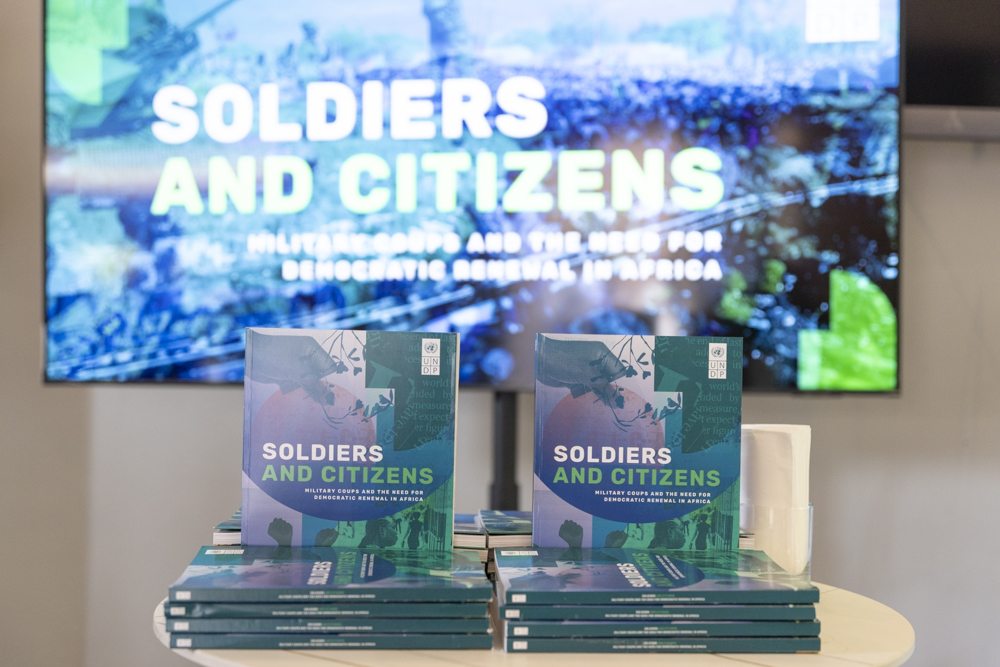
The findings are captured in a flagship new report titled “Soldiers and Citizens: Military Coups and the Need for Democratic Renewal in Africa”.
The report was launched in partnership with Chatham House on the margins of the 5th Mid-Year Coordination 5th Mid-Year Coordination meeting between the African Union, the Regional Economic Communities, and Regional Mechanisms in Nairobi, Kenya held on 15 July 2023.
The research is rooted in a vast perceptions survey, which captures the views of 8 000 citizens across Africa.
Among them, 5 000 lived through recent coups or unconstitutional changes of government (UCG) as defined by the 2000 Lomé Declaration on OAU response to UCG.
These countries include Burkina Faso, Chad, Guinea, Mali, and Sudan.
Their views were contrasted with those of 3 000 citizens from sample countries on a path of democratic transition or consolidation, namely The Gambia, Ghana, and Tanzania.
This unprecedented survey yielded a uniquely people-centered dataset to reveal insights both for preventing further coups and for harnessing opportunities for transformative change and sustained constitutional order.
Three key findings emerged prominently from the research.
The first is a preference for democracy by citizens, which culminates in a resounding call for states to deepen democracy and prioritise a reset of the social contract.
The majority of citizens surveyed across both settings indicated that democracy remains their preferred style of government.
In fact, only 11% of the 5 000 citizens interviewed from the UCG context preferred a non-democratic form of government.
Yet, for governments across Africa to build coup resilience, better governance, deeper democracy, and inclusive development progress should therefore be a guiding star.
A reset of the social contract is needed both to assist coup-affected states in moving forward and to help prevent future coups.
To achieve this, governments should shift their focus to practical delivery that directly improves the quality of life and opportunity for all segments of society.
The second is that a development lens is essential to mitigate coup risk, as it shows how hybrid circumstances rooted in triggers, proximate and structural factors lead to coup risks.
There are clear correlations between heightened coup risk and low development indicators, for instance, particularly in combination with governance deficits.
Poor government performance, corruption, and failure to deliver security, inclusive development gains, and related opportunities create a deep appetite for change.
This calls for comprehensive and integrated solutions.
Instruments like the newly launched Africa Facility to Support Inclusive Transitions (AFSIT) represent a unique programmatic intervention that could contribute significantly to resolving gaps in current international and regional responses.
The third key finding highlights the risks of coups in countries with a prolonged history of military rule.
The findings show that countries with a history of military governance and the close involvement of the military in political life are far more likely to experience a recurring pattern of military coups.
They are also among the African countries where military spend represents the highest proportion of the state budget.
These findings highlight a critical need to reset the role of the military in political life, and across wider civil-military relations.
The report calls for a re-focus on development including good governance, human rights and access to basic services such as education and healthcare as a critical means to not only prevent coups but also sustain peace,” says Ahunna Eziakonwa, UN Assistant Secretary-General, UNDP Assistant Administrator and Director of the Regional Bureau for Africa.
“This is particularly crucial in regions like the Sahel, which face a heightened risk of coups.
“That investment will also drive game-changing progress in the 2030 Agenda and the African Unions Agenda 2063.
Nigeria President Bola Tinubu, in a statement delivered on his behalf by Ambassador Adamu Ibrahim Lamuwa, Permanent Secretary in the Ministry of Foreign Affairs, said: African leaders must disincentivize coups détat and called on all African leaders at all levels to make concerted efforts in respecting the tenets of democracy and the rule of law, in order to ensure political stability on the continent.
Tinubu was recently elected as the Chairperson of the Economic Community of West African States (ECOWAS) Authority of Heads of State and Government, the sub-regional body with a membership of 15 West African countries.
The report was produced in the context of the abovementioned new Africa Facility to Support Inclusive Transitions (AFSIT) (https://apo-opa.info/3K5jIqZ), a joint initiative of UNDP and the AU Commission to provide integrated programmatic support to countries in Africa undergoing complex political transitions.
The primary objective of AFSIT is to assist in the development of credible, inclusive, and legitimate transition roadmaps, mechanisms, and institutions, ultimately leading to the restoration and consolidation of constitutional rule, democracy, and stability in relevant countries.
Comprehensive and integrated responses are called upon, and instruments like AFSIT represent a unique programmatic intervention that could resolve the gaps in current international and regional responses.
Other high-level speakers at the Soldiers and Citizens report launch included Minister Dr. Mamadou Tangara, Minister for Foreign Affairs, International Cooperation, and Gambians Abroad, The Gambia; Hanna Tetteh, Special Envoy of the UN Secretary-General for the Horn of Africa; Nefértiti Mushiya Tshibanda, Permanent Representative of the Organization Internationale de la Francophonie (OIF) to the African Union and the UN Economic Commission for Africa; and Dr. Yero Baldeh, Director, Transition States Coordination Office, African Development Bank (AfDB).
The launch also featured the attendance of high-level participants from the diplomatic, development, and research communities including the Permanent Representatives of Burundi, the Democratic Republic of Congo, The Gambia, and Ghana to Ethiopia and the African Union who are also members of the Peace and Security Council.
Download the report at www.SoldiersandCitizens.org and watch Soldiers and Citizens: A short film by UNDP Africa (https://apo-opa.info/44sXpUn).