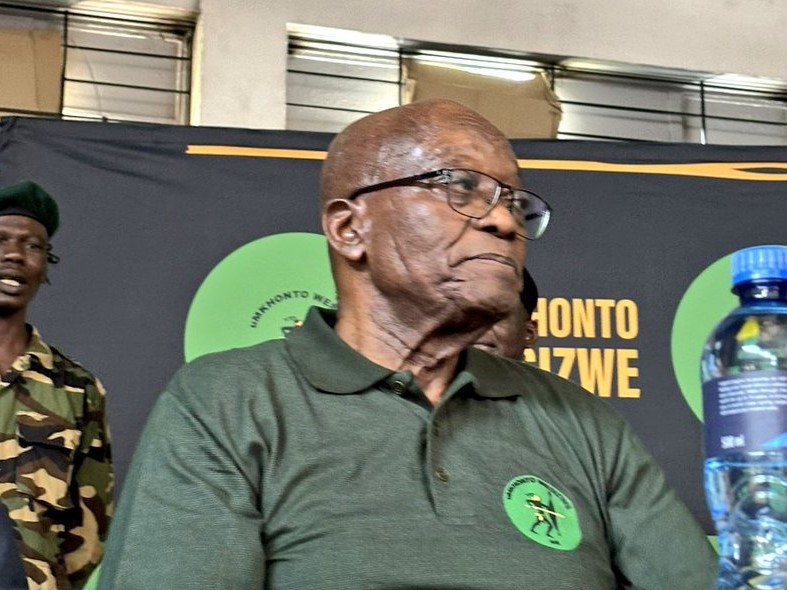

It is unfortunate and disturbing that the Durban High Court today will be delivering its judgment on the ownership of the Umkhonto weSizwe trademark.
This was round two of the legal contest between the ANC and uMkhonto weSizwe (MK) party.
Round one ended with the Electoral Court ruling that party leader, former president Jacob Zuma, is eligible to stand for membership of Parliament on the MK party slate despite his conviction and sentence by the Constitutional Court.
Effectively the Electoral Court’s order overruled the Electoral Commission’s (IEC) disqualification of Zuma.
Inexplicably the Electoral Court still has not furnished a reasoned judgment even though it heard the dispute about the electoral eligibility of MK party before the trademark dispute.
The order of the Electoral Court also has far-reaching implications for other ambitious aspirant would-be parliamentarians with convictions and direct imprisonment sentences that were construed all along as a legal bar from parliamentary membership eligibility.
The likes of Tony Yengeni come to mind.
This judicial omission by the Electoral Court is regrettably fueling the conspiracy theories and accusations of bias against the IEC.
If ever there was an out-of-order Court, it is the Full Bench of the Electoral Court consisting of five Electoral Court judges.
How did the Electoral Court arrive at the order they issued?
Without transparent reasons for that Electoral Court order, questions remain begging for a judicial answer.
What happened to the saying that two heads are better than one?
Or is it now too many cooks spoil the broth?
By failing to deliver the reasons for their judgment, these five esteemed electoral judicial heads, are compounding the already toxic situation, in the run-up to the May 29 general elections.
The inordinate delay is fueling the controversy, and inadvertently feeding the speculative frenzy on why the judges issued that Electoral Court order.
The omission of the Electoral Court could affect other institutions like the IEC, Constitutional Court, and other courts.
South Africa is currently an environment infested by political grandstanding and opportunism that casts aspersions on the independence of the IEC and its work.
Whenever the Electoral Court delivers its judgment, the horse would have long bolted because it put the cart before the horse.
With a legal dispute like this, electoral (and judicial) transparency and accountability, the Electoral Court should not have been quick to issue a court order without a judgment.
How does one explain that the Durban High Court is delivering its full judgment in a related matter when the Electoral Court heard its matter first?
To date, the Electoral Court has failed to furnish its reasons in the form of a proper and full judgment.
Within the stroke of the pen, the Electoral Court created unforetold legal uncertainty by failing to deliver a reasoned judgment.
As a result of the Electoral Court’s fractured approach of issuing an electoral court order without factual and legal reasons furnished to support it, now all of us are subjected to the vanity of those who are reducing the general elections to being an egotistical contest between JZ’s MK party and CR’s ANC from those with fertile and creative minds to conjure up non-existent conspiracy theories.
*The writer of this article is Nhlanhla Mbatha, an independent media practitioner based in Johannesburg. The views expressed by Nhlanhla Mbatha are not necessarily those of The Bulrushes