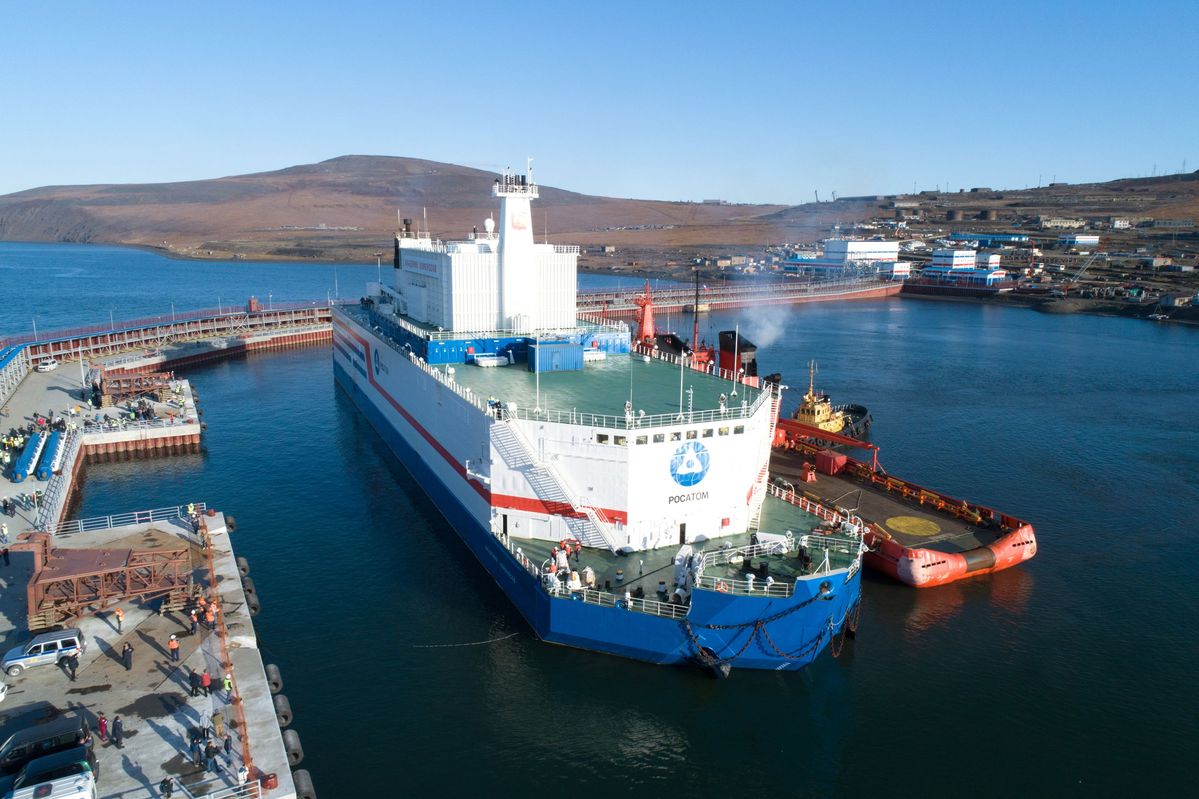
Moscow – The world’s first and only floating nuclear thermal power plant (FNPP) “Akademik Lomonosov” – owned by Rosatom – has reached a five-year milestone since it started operating and supplying electric power to the citizens of the Russian North.
The Akademik Lomonosov FNPP significantly contributes to economic growth, infrastructural development, and environmental sustainability.
The project has cut Greenhouse gas (GHG) emissions by 390 000 tons.
The Akademik Lomonosov FNPP demonstrates how innovative nuclear projects can address environmental challenges while also improving local communities’ quality of life.
This example emphasises the potential for international cooperation, as other countries, including African nations, could adopt similar solutions to meet both their energy and social needs.
Nations across the globe make continuous efforts to address environmental challenges due to greenhouse gas emissions and strive for a balanced energy mix.
Numerous associated issues – for instance, lack of proper infrastructure in remote areas – emerge along the way.
These challenges also affect Africa and advanced nuclear technologies can provide sustainable solutions.
The Akademik Lomonosov FNPP proves that innovations in nuclear energy are the key to success in providing local communities with a clean and stable power supply.
For almost five years, Akademik Lomonosov, the world’s first and only FNPP has been supplying heat and electric power to the citizens of Russia’s northernmost city of Pevek.
Rosatom Africa said in a statement that over the period of Akademik Lomonosov’s operation, there have been numerous achievements and highlights, including a 390 000-ton reduction in greenhouse gas emissions, and 905 million kWh of nuclear electric power generated.
More than 4 000 citizens of Pevek enjoy a continuous supply of heat and electric power supplied by Akademik Lomonosov.
Victor Yelagin, the FNPP Director, stated: “The floating NPP has proved to be reliable and efficient.
“It is a real flagship of small-scale nuclear power technology.
“As in other regions of operation, Rosenergoatom is implementing a range of social initiatives in Pevek to improve the life quality of the local population.
“This year we renovated the hall, internal and external heating and water supply systems of the City Education Centre.
“We are also donating computers and office equipment.
“We also donated RUB75 million to build an indoor skating rink.
“The contractor has been selected, and the rink should be ready next year.”
The statement said the FNPP’s successful operation demonstrates that small nuclear power plants (SNPPs) are a reliable and uninterrupted source of clean energy offering a lot of advantages, including scalable power generation due to their modular design.
“Furthermore, advanced RITM reactors behind SNPPs are upgradeable and can operate in any climatic conditions,” Rosatom Africa said.
“As numerous regions of the African continent suffer from an unstable power supply, the introduction of such technologies as part of a balanced energy mix can be a key to a reliable and affordable source of energy.
“A large number of companies involved in the development of NPPs prioritise corporate social responsibility activities, focusing on community impact through initiatives that improve local living conditions while providing sustainable energy.”
Rosatom said it was equally committed to housing construction, improved medical services, and infrastructure development initiatives not only in Russia but also at its overseas project sites, including Africa.