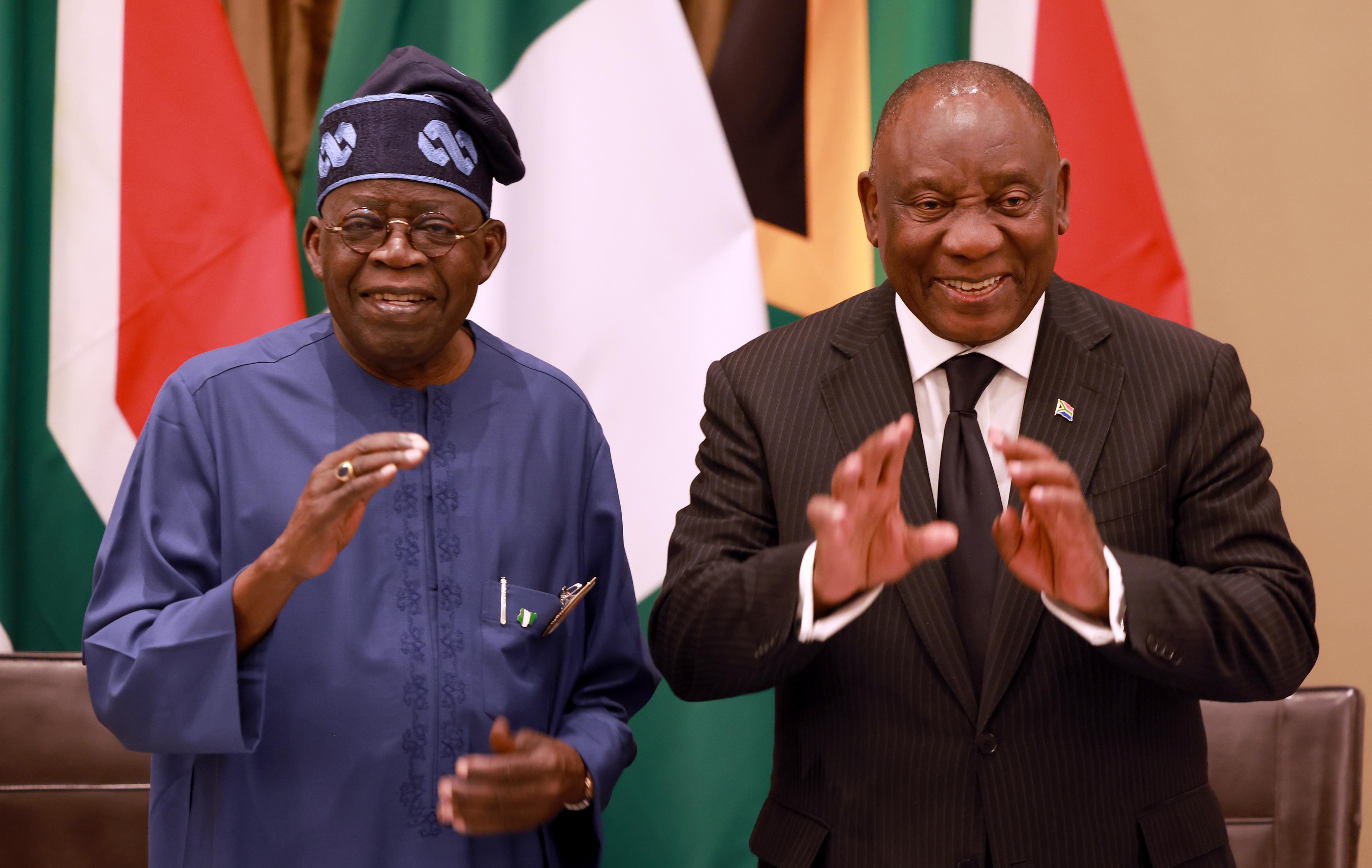
Cape Town – President Cyril Ramaphosa has told his visiting counterpart, President Bola Ahmed Tinubu, that South Africa and Nigeria were “united in purpose and vision”.
In his welcome remarks at the South Africa-Nigeria Binational Commission, President Ramaphosa on Tuesday, (3 December 2024), said: “I warmly welcome you and your esteemed delegation to our country.”
Welcoming President Tinubu at Tuynhuys, Cape Town, President Ramaphosa added: “As we gather here on the occasion of the 11th Session of the Bi-National Commission between our countries, we reaffirm our close bonds of friendship, solidarity, and cooperation.
“We are two countries united in purpose and vision.
“We will remain forever grateful to Nigeria for its leading role in the international campaign to end apartheid in South Africa.
“As we mark 30 years since the establishment of diplomatic relations, we see a bright future for our relationship.
“Our strong bonds of friendship provide a firm foundation for more meaningful economic cooperation.”
Nigeria is host to several South African companies.
South Africa has always been open for Nigerian business, reflected in a number of investments and operations established in this country.
“But there is much more we need to do,” President Ramaphosa said.
“We need to remove the remaining constraints to greater investment, just as we need to address some of the challenges that companies have experience.
“We are encouraged by the actions being undertaken under your leadership to further strengthen and foster a business environment in Nigeria that offers assurances to investors, including from South Africa.
“Our government continues with its efforts to improve the ease of doing business in South Africa.”
PresidentRamaphosa said South Africa wants to enable investors to operate, trade, and pursue opportunities in various sectors.
“We look forward to seeing more Nigerian companies investing in South Africa,” said President Ramaphosa.
“Our efforts to create a favourable environment include our simplified visa process for Nigerian business people to travel to South Africa.
“Qualifying Nigerian business people can be granted a five-year multiple entry visa.”
In addition, President Ramaphosa announced that tourists from Nigeria were now able to apply for a visa without submitting a passport.
“We expect that this 11th Session of the Bi-National Commission will enable us to consolidate cooperation in several key areas,” he said.
“We need to implement the many decisions that have already been made and to follow up on progress achieved.”
Nigeria is South Africa’s largest trading partner in West Africa.
However, there is much more opportunity for growth.
The African Continental Free Trade Area will allow our two countries to trade in a more seamless manner across a wide variety of products. Let us seize this moment.
South Africa and Nigeria are important countries in our respective region and on the African continent more broadly.
“We are also important voices in the international arena,” said President Ramaphosa.
“As responsible members of the community of nations, we ought to be concerned about the future of our global systems of governance.
“In an increasingly volatile environment, we are witnessing the erosion of the principles that underpin the peaceful conduct of relations among nations, respect for international law and the development of our societies.”
President Ramaphosa said multilateralism is under threat.
The rise of impunity, unilateralism, conflict and war highlights the urgent need for the reform of the UN Security Council and other global institutions.
The Global South needs to lead efforts to achieve an international system that is fair, inclusive and reflects current realities.
“We commend your work as chair of ECOWAS to promote dialogue, mediation and conflict resolution in the pursuit of peace,” the President Ramaphosa.
“We applaud Nigeria’s unwavering support to regional and continental unity.
“Our regional body, the Southern African Development Community – SADC – has been working to address challenges in our neighborhood.
“We are seized with the situations in the eastern Democratic Republic of the Congo and the post-elections developments in Mozambique.
“There is agreement that these challenges will be resolved through peaceful means.
“We are witnessing progress in the consolidation of democracy on our continent.”
This year alone, 19 major elections would have taken place in African countries.
President Ramaphosa said it was important that regional and African Union instruments underpinning elections and governance are promoted and strengthened.
South Africa has just assumed the Presidency of the G20.
It will be the first time that the G20 Leaders’ Summit will be held on African soil.
“We will place Africa’s development and the challenges facing countries of the Global South firmly on the G20 agenda,” said President Ramaphosa.
“We will seek to galvanise support for the AU’s Agenda 2063, as we pursue an inclusive global agenda.
“For South Africa, it is our view that in shaping global discourse, programs should be tailored to ensure that in our societies, no one is left behind.
“The challenges of inequality, poverty and unemployment also need to be addressed.
“Our premier continental organisation, the African Union, will be having a change of leadership in its Commission.”
President Ramaphosa added: “As we approach the elections of the Chairperson, Deputy Chairperson and Commissioners at our Summit early in the new year, we should emphasise the need for cohesion, unity and sense of purpose”.
He urged the commission to rededicate itself to addressing the development needs of “our peoples” as reflected in our continental programmes.
“Once again, Mr. President, we are pleased and honoured that you are here in our country to co-chair this session of the Bi-National Commission,” said President Ramaphosa.
“We look forward to receiving the reports of the Ministers as our countries continue to strengthen cooperation.
“Our strong foundations of mutual respect, trust and collaboration must endure.
“Together, we must work to position Africa as the continent of the future and to realise the vision of our forebears.”