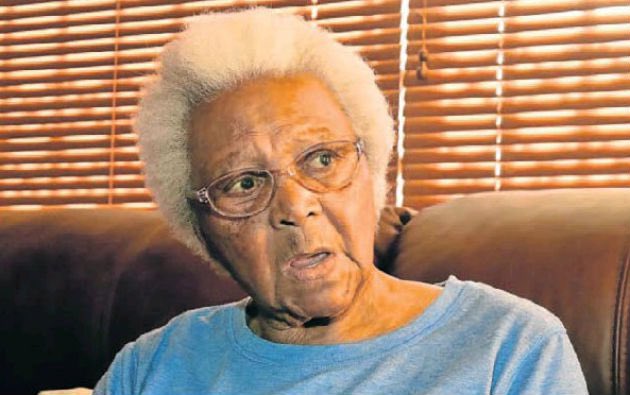
Tshepo, mom Lillian Diedericks passed away this morning.
That was a text message sent to me, on Tuesday 21st December at 18:44 by mama Pinky Sithole, a longstanding member of the African National Congress (ANC).
I met mama Sithole as part of my on-field research regarding “Naledi Townships obscurity apropos the 1976 Uprisings”, in Soweto.
Mama Sithole and her younger fellow comrade Fundi Skweyiya are acknowledged as my key interlocutors, concerning Lillian Lily Diedericks (1925-2021).
The crux of our dialogues consisted of lamenting, against the marginal reminiscence about Diedericks.
This concern extended to other womxn activists, in the longue durée of South Africas body-politic, as contributors to the local liberation struggle.
A highlight, from our dialogues about Diedericks, was reference to the DRUM ANNIVERSARY ISSUE, which marked the “70th anniversary of DRUM Magazine”.
This commemorative edition, featured an interview with Diedericks (on pages 50-51), conducted by Nosipiwo Manona.
Any shred of doubt I may have had, from mama Sitholes text message was shattered, on Wednesday morning, the 22nd of December 2021.
Diedericks death was trending on news outlets including SABC, eNCA, and Herald Live.
Contrary, however, to mama Sitholes text, the time of Diedericks death was not in the morning.
Media reports such as Herald Live mentioned Diedericks daughter Eugene Plaatjies (a retired teacher), who stated that her mother passed away at 2.35 pm, at her home in Gelvandale, Port Elizabeth (PE) now Gqeberha.
She had just celebrated her 96th birthday, on Friday 17th December 2021.
None of the media sources reported medical details, vis-à-vis her cause of death.
Plaatjies, however, divulged that her mother complained about tiredness.
Plaatjies further said, at the time of her mums final breaths, they had surrounded her as a family, to pray for her.
Diedericks’ funeral, took place on Friday, 24 December 2021, in Korsten, Gqeberha.
Funeral attendees included Eastern Cape Premier Oscar Mabuyane, who waxed lyrical about Diedericks, on behalf of the ANC.
He atypically cited Diedericks’ disdain, of maladministration.
Im curious how others, construed those remarks in the light of ANCs venal record, on governance.
To me, Mabuyanes remarks summed up ANCs abjuration.
Nosipiwo Manonas interview with Diedericks is among the sources referenced here detailing her biography.
Diedericks was born in Ezivranda Red Location Township, in New Brighton (PE).
Her parents were Victoria and Phillip Bailey.
Her siblings included her brother Richard and sister Magdalene (both deceased). Details about who fathered her two daughters, Mavis (1948-2017) and Eugene (born in 1955) were not proffered.
Owing to the Group Areas Act of 1950, Diedericks family was classified as “coloured” and evicted from her birthplace in the 1940s, as it was designated a “black only zone”.
They moved to Schauderville and this is where my life of politics was born.
Diedericks intolerance of apartheid led to her immersion with trade unions in the early 1950s in P.E.
Her proficiency in Afrikaans, English, and isiXhosa was utilized accordingly.
As a member of the Food and Canning Workers Union (FCWU), she was elected as a shop steward.
She acknowledged that the South African Communist Party (SACP)s study groups, conscioutised them as the working class.
Trade Unions were among the few spaces where women could be active because political parties, undermined women leaders.
Oddly unlike with FCWU and SACP, data about Diedericks’ affiliation to ANC, is murky.
In 1954 Diedericks co-sponsored alongside Frances Baard (1909-1997), Lillian Ngoyi (1911-1980), Ray Alexander Simons (1913-2004), and Hilda Bernstein (1915-2006), the motion to host the inaugural conference of the Federation of South African Women (FEDSAW).
Its successful launch on 17th April 1954 in central Johannesburg, produced a Womens Charter, this ascertains Diedericks’ position as a co-founder of FEDSAW.
Their Womens Charter overall demanded empowerment and equality, for both men and women of all races.
As part of FEDSAWs resolutions, Diedericks alongside Lillian Ngoyi, Helen Joseph (1905-1992), Rahima Moosa (1922-1993), and Sophie de Bruyn co-led the womxns protest march, to the Union Buildings on 9th August 1956.
Thats why the latter date is commemorated, as National Womens Day in South Africa, since 1995.
Diedericks informed Manona that she never planned, to be part of that march.
Her involvement resulted after fellow activist Florence Matomela (1910-1969) asked her to go to Pretoria, to represent our region in the resistance action the collective of women was taking part in.
Diedericks reluctance was based on her responsibility, to her minor two daughters.
Her sister Magdalene intervened but was later assassinated by the “special branch” police, mistaking her for Diedericks.
Still, in 1956 Diedericks, Baard and Matomela were among the incarcerated at the Old Fort (today a museum at Constitutional Hill precinct in Braamfontein) and charged for treason, for protesting against the mayor of P.E.
Although Diedericks was acquitted in 1961, she was banned from 1963-1968.
It is worrying that post 1968, most sources are ambivalent about Diedericks.
It is appalling how most sources, can recall Diedericks’ support to Raymond Mhlabas (1920-2005) family however amongst others, do not question the downplaying of her leading role as a liberation activist?
Then-president Jacob Zumas omission of Diedericks in 2016, which marked the 60th anniversary of the womxns march, reflected such amnesia.
Zumas address in 2017, that Diedericks statute will also be erected in Tshwane, didnt repair his initial damage.
Lets close, on a more positive note.
Port Elizabeths Brister House, was renamed after Diedericks in 2009.
Throughout 2014 the Red Location Museum exhibited Diedericks, among five heroines of the struggle.
In 2018 President Cyril Ramaphosa conferred Diedericks, with the Order of Luthuli in Silver, for her contribution to South Africas liberation struggle.
Alas on August 30th 2021, Bhisho State House (the building which hosts the offices of the Eastern Capes Premier), was renamed Lillian Diedericks House.
Ultimately the selective amnesia about Diedericks, supports that she is a symbolic metaphor, among ample other local womxn activists, such as Alice Kinloch (1863-1946), Nokutela Dube (1873-1917), Nosipho Dastile (1938-2009), Boniswa Ncukana (1946-1985) and Nontuthuzelo Mabala.
Malibongwe!
*Dr. Tshepo Mvulane Moloi is Postdoctoral Research Fellow at Johannesburg Institute of Advanced Study and Research Associate at the Center for African Epistemology and Philosophy of Science (ACEPS)