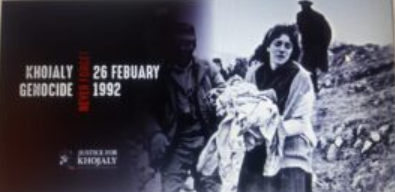
The Armenian armed forces brutally captured the City of Khojaly between the night of February 25 and 26 in 1992, using complex military equipment and personnel from the former Soviet Union’s infantry guards’ regiment number 366.
The assault on the city preceded the mass firing of heavy weapons and artillery that began on February 25.
The bombardment set the city on fire, and by five in the morning, the whole city was alight.
About 2 500 people who remained in the city were compelled to leave their homes to get to Aghdam, the district centre, and the closest location primarily populated by Azerbaijanis.
But this contingency did not work out.
Armenian forces supported by the infantry guards’ regiment destroyed Khojaly city and mercilessly and brutally slaughtered the peaceful population.
The consequences were as follows:
- 613 people were killed, among them 63 children, 106 women, and 70 elderly:
- 8 families were completely eliminated
- 25 children lost both parents
- 130 children lost one of their parents
- 487 people were wounded, including:
- 76 children
- 1 275 people taken hostages
- 150 people have gone missing
These figures depict the outcomes of the bloodiest tragedy of the Karabakh conflict, which began in February 1988 with the illegal demands of ethnic Armenians living in the Nagorno-Karabakh Autonomous Oblast of the Azerbaijan SSR.
They demanded to join the Armenian SSR.
The ruling elite in the Armenian SSR sparked and consented to these demands, which were compounded by central Soviet authorities’ inertia and lethargy.
Targeting Khojaly
The Armenian army’s attack on Khojaly was predetermined by the city’s strategic location.
Khankendi can be found 10 kilometres to the South East of the 7 000 person city.
Khojaly hosts the only airport in Karabakh and is on the Aghdam-Shusha, Askeran-Khankendi route.
Khojaly is a historical location where ancient monuments can still be found.
Near the Khojaly village are the relics of the Khojaly-Kedabek culture of the 14th to 15th Century BC.
The round crypt (1356-1357), mausoleum (14th Century), and funeral memorials – stone boxes, barrows, and necropolis of the late Bronze Age and early Iron Age were discovered here.
During the archaeological excavations, a variety of stone, bronze, bone jewelry, and ceramic household goods were discovered.
The city had two secondary schools, two partial secondary schools, and textile factories.
54 Turk-Meskhets families – refugees from Fergana (Uzbekistan) and Armenian expatriates from Azerbaijan sought refuge in this city because of the events of the previous year.
Residential structures and other sites were developed in Azerbaijan because of the establishment of branches of large industrial corporations.
Later, the Armenians admitted that one of the first things their armed forces wanted to do, was to get rid of the Khojaly base so that the only airport, which was under Azerbaijani control, could be unblocked and a corridor could open between Khankendi and the Askeran village across the city.
The phrase “the liquidation of Khojaly base” was instructive in this regard.
These words, which still reverberate today, shed light on the motivations behind the Armenians’ bloody massacre and the mass extermination of women and children.
Recognition of the genocide
Azerbaijan embarked on a path to seek justice for Khojaly, and its diplomatic efforts have resulted in an increasing number of States recognising the genocide.
The following is the list and the year of commemoration and condemnation:
As a massacre
Bosnia and Herzegovina: – The House of Peoples passed a resolution condemning the Khojaly Massacre as a crime against humanity in 2014.
Czech Republic: – The Foreign Affairs Committee of the Czech Parliament condemned the Khojaly Massacre as a crime against humanity in 2013.
Colombia: – The Foreign Relations Committee of the Colombian House of Representatives recognised the Khojaly Massacre in 2013.
Mexico: – Foreign Relations Committee of the Mexican Chamber of Deputies recognised the Khojaly Massacre in 2011.
Panama: – The National Assembly of Panama adopted a resolution condemning the Khojaly massacre in 2013.
Slovenia: – The National Council of Slovenia passed a resolution condemning the Khojaly Massacre as a crime against humanity in 2016.
Sudan: – Foreign Affairs Committee of the Sudanese National Assembly recognised the Khojaly Massacre in 2014.
As genocide:
Azerbaijan: – National Assembly of Azerbaijan recognised the Khojaly massacre as genocide.
Djibouti: – The National Assembly of Djibouti recognised the Khojaly Massacre as an act of genocide in 2017.
Guatemala: – The Congress of Guatemala recognised the Khojaly Massacre referring to it as genocide in 2015.
Honduras: – The National Congress of Honduras recognised the Khojaly Massacre as an act of genocide in 2014.
Pakistan: – Foreign Relations Committee of the Senate of Pakistan recognised the Khojaly Massacre referring to it as genocide in 2012.
Paraguay: – The Parliament of Paraguay recognised the Khojaly massacre as an act of genocide in 2017.
Peru: – The Congress of the Republic of Peru adopted a resolution recognising the Khojaly massacre as genocide in 2013.
Turkey: – Foreign Relations Committee of the Turkish National Assembly recognised the Khojaly Massacre referring to it as genocide in 2012.
Estonia: – Estonian Parliamentary recognised the Khojaly Massacre as genocide in 2021.
*First published in The Diplomatic Informer