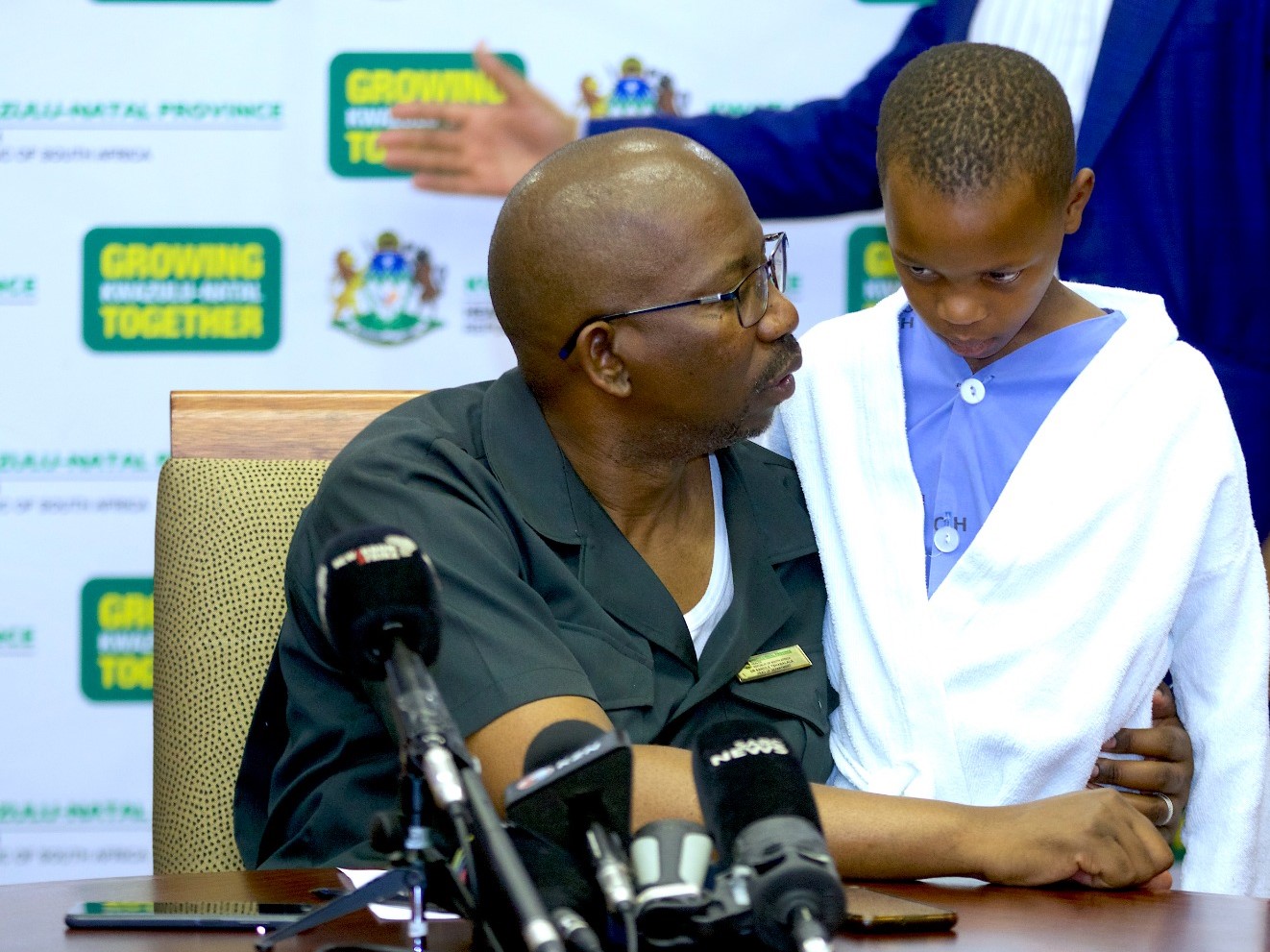
Durban – Brave Siyabonga Mthethwa, from the Mahlabathini area in uLundi, KwaZulu-Natal, has been given a second chance at life.
The 10-year-old had a unique heart operation at Inkosi Albert Luthuli Central Hospital.
The successful 10-hour operation was the first of its kind in a public hospital in KwaZulu-Natal.
Aunt, Nokuphila Mthethwa, said Siyabonga could not play for long with his friends or participate in strenuous physical activity.
“He would go out and play for about 10 minutes or so and come back complaining about chest pains,” Mthethwa said.
She also recalled that her nephew Siyabonga would catch the flu easily and lose weight very fast.
‘This was until we sent him to Nkonjeni Hospital, where he was diagnosed with a heart problem, and then referred to Inkosi Albert Luthuli Central Hospital,” said Mthethwa.
Doctors found that Siyabonga had a serious congenital heart problem, and the family was made aware of the health risk he faced if he was treated.
“We had no choice but to allow the procedure to take place. We prayed that it becomes successful,” said Mthethwa.
“By God’s will, all went well and he has been granted a second chance at life. He is fine now and very jovial, and looking forward to playing with his friends.
“We hope he will be able to play like any normal child now. As a family, we would like to pass our sincere gratitude to the team of doctors who performed this surgery and all the staff members who were involved.”
Speaking at a media briefing to celebrate this successful operation, KwaZulu-Natal Health Head of Department Dr. Sandile Tshabalala commended the team of cardiothoracic surgeons for pulling off the “miraculous” operation using technology that was used to treat Covid-19 patients who could not breathe on their own.
“The report that we have received from one of the cardiac surgeons involved, Dr. Sanvir Maharaj, indicates that this miracle patient presented with a large hole in his heart, and also had a problem of abnormal heart valves,” said Dr. Tshabalala.
Medically, this condition is known as a “Primum Atrial Septal Defect”.
“As a result of this, his growth and development was adversely affected. And he could not participate in much physical activity without feeling excessively tired,” Dr. Tshabalala.
“Under normal circumstances, this medical condition is surgically corrected when children are much smaller in age, usually between the ages of 3 to 5 years, at this hospital.
“However, despite the late presentation to our facility, the patient was still assessed and deemed suitable for surgery.”
Elaborating on the procedure, Dr. Tshabalala said: “The hole in the patient’s heart was successfully closed.
“And the abnormal valves were repaired through a cardio-pulmonary bypass, using a heart and lung machine.
“‘his entails literally stopping the patient’s heart from beating completely, in order to undertake the surgery.”
Dr. Tshabalala said the only chance of survival for the patient was through the usage of a machine called ECMO – Extra-Corporeal Membranous Oxygenation), which reportedly costs about R1,5 million.
The ECMO is described as a type of artificial life support that can help a person whose lungs and heart aren’t functioning correctly.
The ECMO process continuously pumps blood out of a person’s body, and sends it through a series of devices that add oxygen and remove carbon dioxide.
This machine was available to a different department, which is the General ICU, but had never been used in the history of Cardiac Surgery in the public healthcare sector in KZN.
The operation was undertaken on 11th July 2023 and lasted more than ten hours.
Dr. Tshabalala thanked the hospital’s chief cardiac surgeon, Dr. Manogran Moonpanar, and his team of cardiac surgeons, anaesthetists, paediatric cardiology, the cardiac ICU nursing team, as well as all involved in this groundbreaking surgical operation.
“Even with our limited resources, the success of this operation challenges us to do our best to ensure that these medical experts have all the tools of their trade, such as these ECMO machines, and others,” Dr. Tshabalala said.