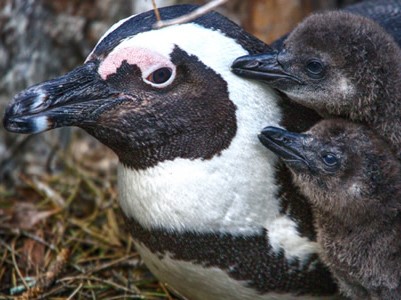
Cape Town – The African penguin is critically endangered and the Department of Forestry and Fisheries and Environment has moved to protect the species by imposing fishing limitations in the waters around their colonies.
“If this situation is not addressed, with current rates of population decline, science tells us these iconic creatures could be functionally extinct by 2035,” Forestry Fisheries And Environment Minister Barbara Creecy said Friday.
“Competition for food is thought to be one among a set of pressures that are contributing to the decline of the African Penguin population.”
The minister said other pressures include ship traffic together with their associated noise and vibrations, pollution, and degradation of suitable nesting habitats.
She said the species, which is endemic to South Africa and Namibia, has decreased from more than a million breeding pairs to just about 10 000 pairs over the last century.
“Today, following the report of the Export Review Panel I have taken a decision to implement fishing limitations in the waters around penguin colonies for a minimum of 10 years, with a review after 6 years of implementation and data collection,” said Minister Creecy.
“Fishing limitations are established for the following penguin colonies: Dassen Island, Robben Island, Stony Point, Dyer Island, St. Croix Island, and Bird Island.”
She said the transition to implementing fishing limitations will continue with the current interim closures, while both the fishing industry and the conservation sector study the Panel’s Report.
“If there is agreement on fishing limitations over the next few weeks or months across these sectors, these will be implemented as they are agreed upon,” said Minister Creecy.
“If no alternate fishing limitation proposals are concluded by the start of the 2024 Small Pelagic Fishing Season (January 15th, 2024) the current interim fishing limitations will continue until the end of the 2033 Fishing Season, with a review in 2030 after six years of implementation from the start of the 2024 fishing season.
“Today marks the end of the complex and lengthy process of stakeholder consultations in the quest to find science-based measures to protect the critically endangered African penguin from extinction.”
Last year in December, Minister Creecy appointed an Expert Review Panel, under Section 3A of the National Environmental Management Act, to assess the science related to managing the interactions between the small pelagic (anchovy and sardines) fishery and the conservation of African penguins.
The Panel is Chaired by Professor Andre Punt (USA), with members Dr. Ana Parma (Argentina), Dr. Eva Plaganyi (Australia), Professor Philip Trathan (UK), Professor Robert Furness (UK), and Professor James Sanchirico (U.S.A).
The Panel members all have several decades of experience in science to policy matters in marine ecosystems, with a combined science publication list of several hundred.
“The establishment of the panel aimed to assess the appropriateness and value of fishing limitations for penguin success,” said Minister Creecy.
“These are key discussions as the sardine stock in South African waters continues to be at relatively low levels.
“This included science outcomes and insights achieved during of the Island Closure Experiment undertaken by the Department over the preceding decade.
“This experiment aimed at understanding what, if any, benefits are derived from limiting fishing adjacent to penguin colonies.”
The Terms of Reference for the science review and the panel members were established in consultation with the representatives from the fishing industry and bird conservation sectors.
Minister Creecy said while the Expert Review Panel undertook their work, the Department, in September 2022, declared some areas around the major penguin colonies closed to commercial fishing for anchovy and sardine.
“Although not representative on a consensus agreement, these fishing restrictions were established after much collaboration and negotiation with the seabird conservation groups and the small pelagic fishing industry representatives,” Minister Creecy said.
She said a stand-out feature of the process to achieve a decision on fishing limitations, over the last two years, has been the level of engagement from the conservation and fishing industry sectors.
“I want to thank you for your cooperation and assistance in this process. I do know that some of you are already in discussions on reaching compromises and agreements and I ask that you continue to find each other on this,” said Minister Creecy.
“The Department and myself will be keen to implement any consensus you may reach – as first prize.
“The DDGs Fisheries and Oceans & Coasts will assist if you require some planned meeting time and space.”
To continue the engagement, Minister Creecy said she has asked officials from the Fisheries and Oceans & Coasts Branches to report to you at least annually on the implementation of these closures, the expanded science plan, and also progress on other non-fishery interventions in the Penguin Management Plan.
“Fishing limitations alone will not be sufficient to help the penguins recover,” Minister Creecy said.
“In conclusion, I want to thank the panel, professors Punt, Furness, Trathan, Sanchirico, and doctors Parma and Plaganyi.
“I appreciate that you reviewed more than 200 documents and that you undertook new analyses as well.
“I believe that the Report and my policy decisions here start a new cycle of refinement and assessment for both fisheries and penguin management.
“It is a material step in implementing our ambition on an ecosystems approach to sustainable ocean management and dynamic marine spatial planning.”
Link to the report: https://bit.ly/3KpduCk