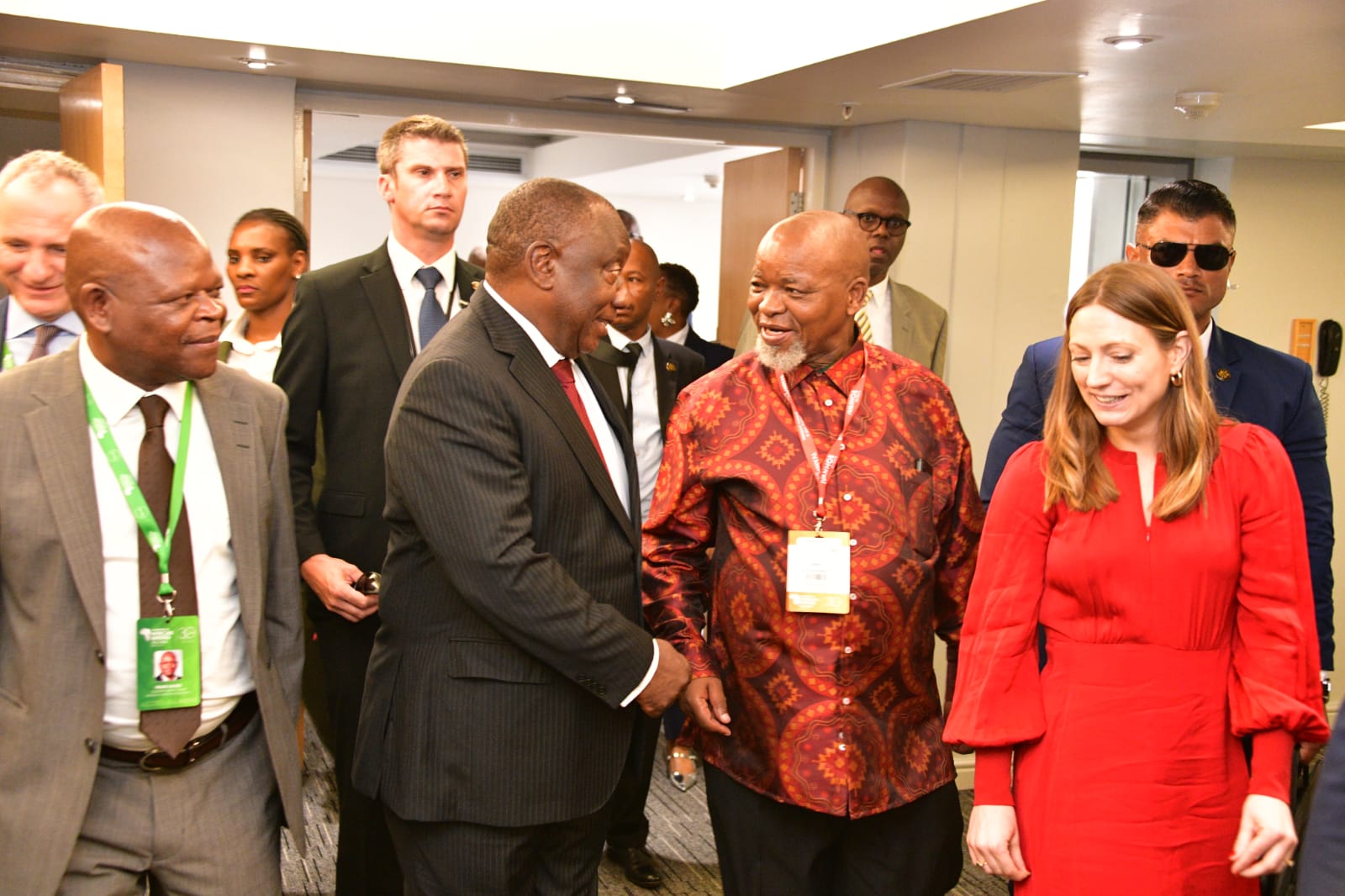
Cape Town – SA President Cyril Ramaphosa on Monday opened the African Mining Indaba by remembering the late Namibia President Hage Geingob, who succumbed to cancer at the weekend.
“As we gather here for this, the 30th Investing in African Mining Indaba, I wish to pay tribute to Dr Hage Geingob, the President of Namibia, who passed away yesterday,” Ramaphosa said.
“President Geingob was one of Africa’s foremost leaders, a champion of development and progress.
“He was a visionary leader who saw in Africa’s abundant natural resources great opportunities to improve the lives of its people.
“We once more extend our deepest sympathies to President Geingob’s family and to the government and the people of Namibia.”
President Ramphosa said it was fitting that the 30th Mining Indaba is taking place in the year that South Africa celebrates the 30th year of its democracy.
Over the last three decades, South Africa’s mining industry has undergone significant transformation.
For nearly 150 years, mining has been a pillar of the South African economy.
It currently contributes roughly 7.5 percent towards GDP and accounts for some 60 percent of South African exports by value.
President Ramaphosa said working with industry and labour, the democratic government has been able to effect the wide-ranging and sustainable transformation of the sector over the past three decades.
In 2004, the year the Mining Charter was first introduced, black ownership in the industry stood at some 2 percent.
Today this stands at approximately 39 per cent.
During apartheid, the mining sector was notorious for labour exploitation, human rights violations, and poor health and safety standards.
Today, miners employ approximately 476 000 people.
Mineworkers can organise and rights are protected.
A legal regime confers responsibility on mining companies to provide quality services and promote development in the communities, where they operate.
“There are also a number of employee share ownership schemes through which mineworker participation in mining companies is being promoted,” said President Ramaphosa.
“We are all acutely aware that we face strong headwinds, and a number of persistent challenges are impeding mining performance.”
Globally, commodity price volatility, high energy prices, geopolitical tensions, and a global cost of living crisis are playing a significant role in dampening the business operating environment.
Domestically, the energy crisis and port and rail bottlenecks are putting serious pressure on miners’ operational costs.
Illicit mining, cable theft, and infrastructure vandalism place a further strain on mining output and returns.
“We are committed to work hard and work together to overcome these serious challenges,” said President Ramaphosa.
“Last year, we outlined four objectives to develop the sector, improve its global competitiveness and harness the global drive towards sustainable development.
“The first is to achieve a secure supply of electricity.”
South Africa has been struggling with inadequate electricity generation for years, which has become more acute in recent times, with the frequent implementation of load-shedding – the deliberate shutdown of electric power in a part or parts of a power-distribution system, generally to prevent the failure of the entire system when the demand strains the capacity of the system.
Nova Economics estimates that load-shedding cost the South African economy nearly R45 billion (in 2022) between 2007 to 2019 (subtracting a cumulative 5% points from GDP growth), and almost R225 billion between 2020Q1 to 2023Q1 (subtracting a cumulative 15% points from GDP growth).
However, on Monday President Ramaphosa told the audience at the Mining Indaba that: “Through the Electricity Action Plan, government has taken several critical measures to improve the performance of our existing generation fleet and to add new electricity capacity”.
He added: “The Department of Mineral Resources and Energy has secured 1 384 MW of new generation capacity that is currently in construction or already in operation.
“The Department has released requests for proposals for the procurement of 5 000 MW of renewable energy under Bid Window 7, 2 000 MW of gas-to-power and 615 MW of battery storage.
“Transmission capacity remains a challenge, especially in the Cape provinces.”
President Ramaphosa said Eskom has, therefore, recently published a curtailment regime that unlocks 3 470 MW of additional capacity in these provinces, and which will be essential to the success of Bid Window 7.
“The second objective we identified was to accelerate economic reforms to improve the operating environment,” President Ramaphosa said.
“We have instituted a number of reforms to enable businesses to operate optimally.”
Since the removal of the licensing threshold for embedded generation, the National Energy Regulator of South Africa has registered no less than 1 312 generation facilities with a combined capacity of over 6 300 MW. Around a third of this capacity supplies the mining load.
“It is encouraging that more and more mining companies, including Gold Fields, Anglo American, Seriti and Exxaro, are beginning to take advantage of these reforms to power their mining operations and curtail their operational costs,” President Ramaphosa said.
“‘The third objective we identified was to tackle illegal mining and damage to infrastructure.
“Since the establishment of a specialised police unit, working with the defence force, we have seen a number of arrests, prosecutions and convictions of the perpetrators of this crime.”
The Department of Mineral Resources and Energy, through Mintek, continues to seal ownerless and derelict mines.
Since 2019, the department has closed and sealed 251 derelict holes and shafts.
He said over the next three years, the department intends to close a further 352 shafts.
Criminal activity, and copper cable theft, in particular, has had a serious impact on key rail freight corridors, including the supply of coal for export through Richard’s Bay.
Cooperation between the private sector, Transnet, and the security services has resulted in an improvement in the security situation over recent months.
President Ramaphosa said South Africa’s freight logistics system itself is undergoing a process of rapid and fundamental change to improve its efficiency and position it for the future.
“Working with the private sector under the auspices of the National Logistics Crisis Committee, we are working to overcome the challenges with ports and rail,” said President Ramaphosa.
“The Freight Logistics Roadmap, which has recently been approved, sets out a clear plan to guide this process.
“By introducing competition in freight rail operations, while maintaining state ownership of the routes, we will unlock massive new investment in South Africa’s rail system.”
President Ramaphosa said this will support jobs in every sector of the economy, from mining to manufacturing to agriculture.
“Similarly, by upgrading and expanding our port terminals through innovative public-private partnerships, we aim to position South Africa as a leading player in global markets,” said President Ramaphosa.
“As government we are alive to the reality that without bold, transformative reforms to the logistics sector, mining cannot flourish.
“We are working hard, in partnership with industry, to ensure this roadmap is implemented without delay.
“Finally, we committed in 2023 to improve the regulatory environment by developing and putting in place a new cadastral system to assist in the operation of a modern mining rights administration system.”
President Ramaphosa said added: “Now that we have a preferred bidder in place, we are confident that the speedy implementation of a modern world-class solution will clear the backlogs in prospecting and mining applications and pave the way for the development of new mines”.
The theme of this year’s Mining Indaba is about embracing the power of positive disruption.
The transition to a low-carbon, climate resilient economy, society and world is one of the most significant positive disruptions of our modern age.
The vast majority of the minerals that are key to the global energy transition lie beneath the soil of our continent.
These include manganese, iron ore, copper, cobalt, nickel and platinum group metals.
Africa has the potential to be the fulcrum of the global energy transition, with mining at its core.
This Indaba must prioritise deliberations around how we can leverage these changes to breathe new life into mining, to strengthen mining value chains, and to enhance beneficiation.
South Africa is pursuing a just energy transition – one that is at a pace and scale that our country can afford, and in a manner that ensures energy security and creates new opportunities for those affected.
“Our Just Energy Transition Investment Plan outlines a pathway to create new industries and support more livelihoods in the green economy,” said President Ramaphosa.
“The delivery of this plan is premised on strong collaboration between government and all social partners.
“It cannot be overstated how crucial the mining sector is to the success of just outcomes, notably in regions like Mpumalanga.
“We ask you to walk this journey with us through embedding just transition principles in your Social Labour Plan projects, community trusts initiatives, and by driving innovative green technology development.
“Mining has crucial role to play in building the economy of tomorrow.
“We look forward to deepening our collaboration with industry as we write a new chapter in the history of South African mining.”
A story of inclusion, growth, transformation and innovation – and one in which no one is left behind.
“We are working hard, in partnership with industry, to ensure this roadmap is implemented without delay.
“Finally, we committed in 2023 to improve the regulatory environment by developing and putting in place a new cadastral system to assist in the operation of a modern mining rights administration system.”
President Ramaphosa added: “Now that we have a preferred bidder in place, we are confident that the speedy implementation of a modern world-class solution will clear the backlogs in prospecting and mining applications and pave the way for the development of new mines”.
The theme of this year’s Mining Indaba is about embracing the power of positive disruption.
The transition to a low-carbon, climate-resilient economy, society, and the world is one of the most significant positive disruptions of our modern age.
The vast majority of the minerals that are key to the global energy transition lie beneath the soil of our continent.
These include manganese, iron ore, copper, cobalt, nickel, and platinum group metals.
Africa has the potential to be the fulcrum of the global energy transition, with mining at its core.
This Indaba must prioritise deliberations around how we can leverage these changes to breathe new life into mining, strengthen mining value chains, and enhance beneficiation.
South Africa is pursuing a just energy transition – one that is at a pace and scale that our country can afford, and in a manner that ensures energy security and creates new opportunities for those affected.
“Our Just Energy Transition Investment Plan outlines a pathway to create new industries and support more livelihoods in the green economy,” said President Ramaphosa.
“The delivery of this plan is premised on strong collaboration between government and all social partners.
“It cannot be overstated how crucial the mining sector is to the success of just outcomes, notably in regions like Mpumalanga.
“We ask you to walk this journey with us through embedding just transition principles in your Social Labour Plan projects, community trust initiatives, and by driving innovative green technology development.
“Mining has a crucial role to play in building the economy of tomorrow.
“We look forward to deepening our collaboration with industry as we write a new chapter in the history of South African mining”.
“A story of inclusion, growth, transformation and innovation – and one in which no one is left behind.”
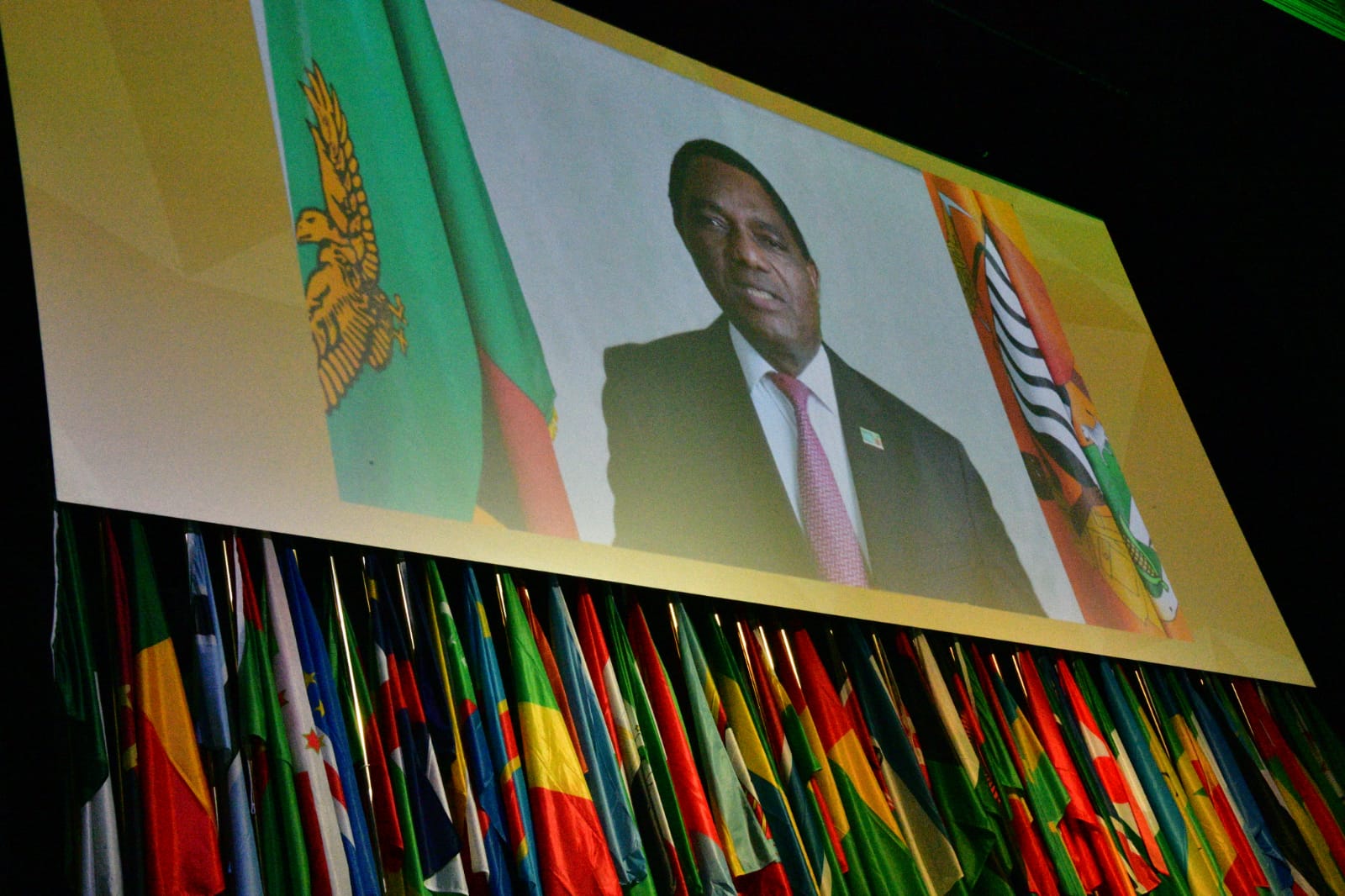
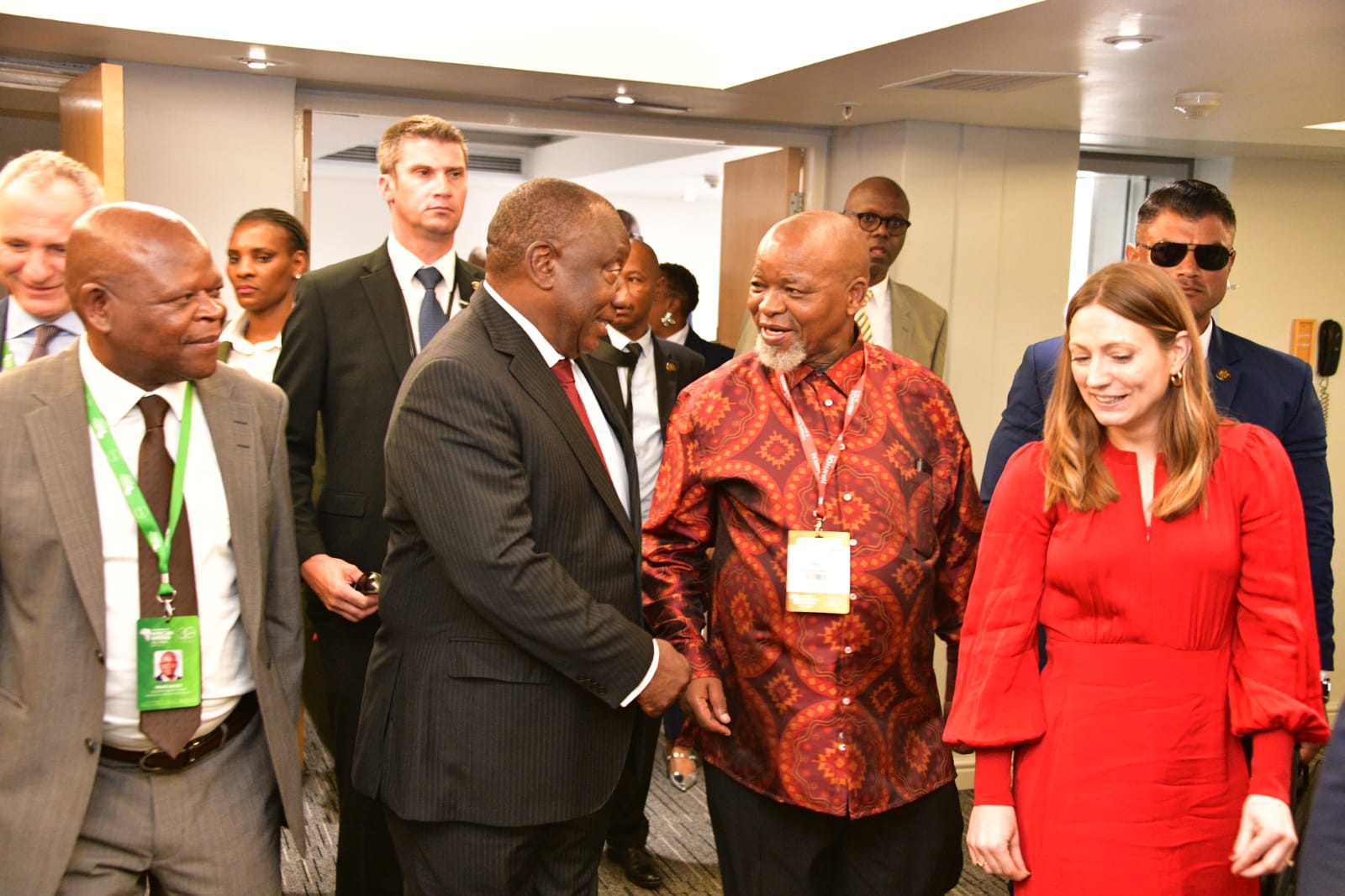
Some of the notable dignitaries at the Mining Indaba included; the President of Zambia Hakainde Hichilema, Prime Minister of the Democratic Republic of Congo Sama Lukonde, Mineral Resources and Energy Minister Gwede Mantashe, Executive Mayor of Cape Town Geordin Hill-Lewis, and Chairman of the Investing in African Mining Indaba Frans Baleni.
Meanwhile, organisers said the number of attendees to the Indaba has hit record levels with an increase of about 18 percent of visitors from Africa and further abroad.