Johannesburg – The South African Zionist Federation (SAZF) has rejected and condemned the advisory opinion issued today, (Friday 19 July 2024), by the International Court of Justice (ICJ).
Earlier Friday, the ICJ also known as the World Court in The Hague ruled that Israel’s settlement policies were in breach of international law.
World Court President Nawaf Salam read out the non-binding advisory opinion on Israel’s occupation of Palestinian territories, which said Israel was in breach of the sixth paragraph of Article 49 of the Fourth Geneva Convention.
The article explicitly states that the occupying power should not deport or transfer part of its civilian population into the territory it occupies.
However, the SAZF in Johannesburg issued a statement in which it “rejected and condemned” the ICJ advisory opinion.
“This opinion, proffered by a United Nations court, is merely another explicitly political gesture from a partisan institution, deeply flawed on both legal and moral grounds,” said SAZF.
“Initiated in 2022 through a Palestinian-led resolution at the UN General Assembly, this advisory opinion is separate from the ongoing case where South Africa falsely accuses Israel of committing genocide.”
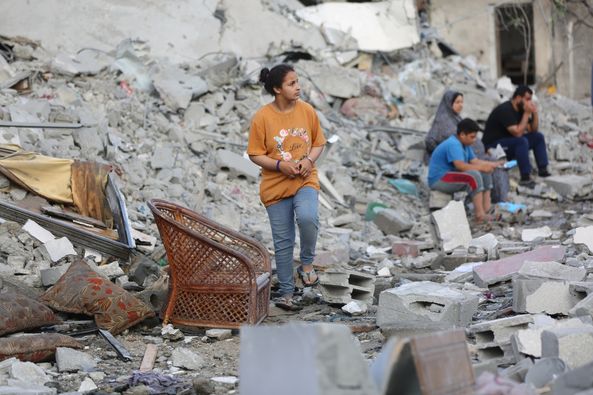
South Africa filed the lawsuit at the ICJ end of December, accusing Israel of genocide in its war on Gaza and seeking a halt to the brutal military assault that has killed thousands of Palestinians, many of them children.
SAZF added: “These accusations are a transparent attempt to delegitimise Israel’s right of self-defence and to deflect attention from Hamas’s actions”.
Since the October 7 attacks in Israel by Hamas which killed over 1 100 Israelis and abducted hundreds of others, Prime Minister Benjamin Netanyahu has launched a relentless bombing campaign on Gaza.
At least 38 713 Palestinians, including more than 15 000 children have been killed and many others injured in the attacks.
The Zionist Federation said, notably, countries that voted against these advisory proceedings include some of South Africa’s largest trading partners, including the United States, “which is currently reviewing its bilateral relations with South Africa due to Pretoria’s anti-Western foreign policy”.
SAZF said the South African government’s support for these proceedings exemplifies a foreign policy trajectory that risks severe economic repercussions, as evidenced by Minister Parks Tau’s upcoming shuttle diplomacy in the US to protect South Africa’s preferential trade access under AGOA.
“It is crucial to note that the ICJ’s opinion is non-binding. Nevertheless, it will likely embolden a South African government that persistently uses the ICJ as a propaganda tool,” said SAZF.
“This stance is unfortunate. South Africa has chosen not to support Israel’s rights as a sovereign democratic nation and a safe haven for the Jewish people, placing it on the wrong side of history.
“Only a directly negotiated agreement with the Palestinians, which Israel has sought for decades, will lead to a resolution of the conflict. A solution cannot be forced upon Israel.
“The ICJ’s finding on the legal consequences of Israel’s presence in the West Bank and East Jerusalem once again infringes upon Israel’s international right to defend itself from terrorist organisations that continually threaten Israeli citizens.”
The ICJ advisory opinion demands that Israel end its rule in these areas, dismantle Jewish communities cease all new activities, and provide restitution and reparations to Palestinians.
“Such a move would inevitably result in the areas suffering the same fate as Gaza after Israel’s 2005 withdrawal: a breeding ground for violent acts of terror and rocket attacks threatening Israel’s existence,” SAZF said.
“Following Israel’s exit from Gaza, Hamas took power and spent two decades developing an extensive network of tunnels and weapons, allowing fighters to live undetected and wage war against Israel. Hence, Israel cannot unilaterally withdraw from all territories.
“The ICJ’s opinion also distorts geographical history and disregards the pain and death faced by many Israelis.
“It oversimplifies the complexities that necessitate Israel’s presence in the West Bank and East Jerusalem.”
SAZF said Israel has unequivocal historical, legal, and indigenous rights to these areas, which are also essential for Israel’s security.
“Moreover, the partisan and politically-motivated ICJ judge, Nawaf Salam, repeatedly expressed anti-Israel opinions during his tenure as Lebanon’s UN ambassador, where he consistently voted against Israel,” SAZF said.
“Salam’s clear bias against Israel should have led to his recusal from the case. His failure to uphold judicial independence principles undermines the credibility of the ICJ and global justice.”
Meanwhile, in a statement, Netanyahu also rejected the ICJ opinion, saying, “Jewish people cannot be regarded as occupiers in their historic homeland”.
He added: “No false decision in The Hague will distort this historical truth, just as the legality of Israeli settlement in all the territories of our homeland cannot be contested.”
However, the government of South Africa has welcomed the ICJ advisory opinion.
South Africa International Relations and Cooperation Minister Ronald Lamola, stated: “Today’s ruling by the ICJ affirms South Africa’s long-standing position that the occupation by Israel of Palestinian territory remains unlawful under international law.
“The international community must act to bring an immediate end to the occupation and the gross violations of international humanitarian and human rights law being perpetrated by Israel against the Palestinian people.
“There is now an additional legal obligation for all States to end complicity in Israel’s illegal actions and to act to ensure respect for international law.”
Minister Lamola said South Africa attaches particular importance to the Court’s finding that Israel violated Article 3 of the International Convention on the Elimination of All Forms of Racial Discrimination.
He added: “This finding of the court reaffirms that the Israeli government is guilty of practicing the crime of apartheid”.