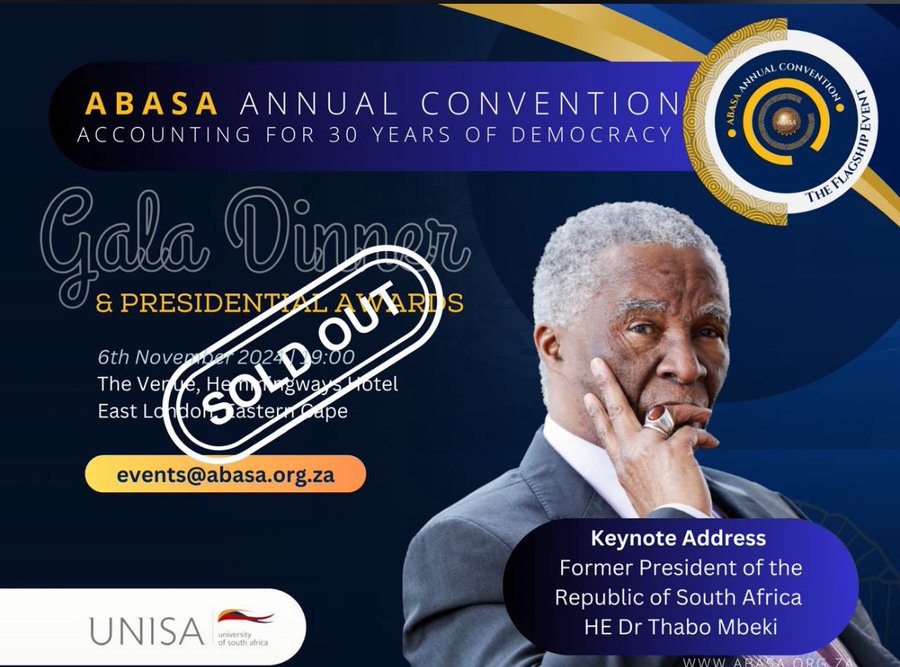
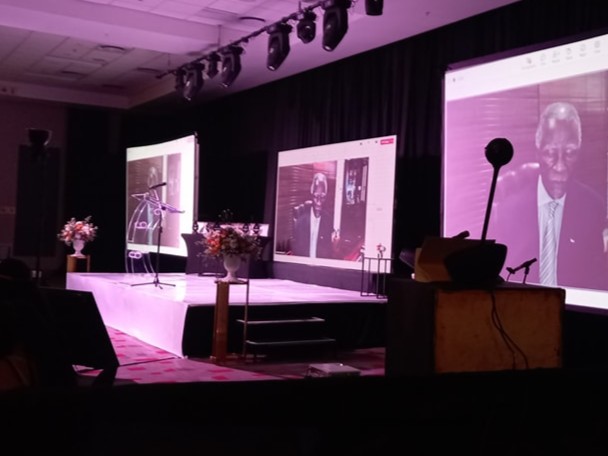
Former President Thabo Mbeki’s recent address to the Advancement of Black Accountants of Southern Africa (ABASA) was a powerful call for the accounting profession to step up and lead South Africa in its fight against corruption, inequality, and ethical decline.
Speaking directly to ABASA members at Unisa’s College of Accounting Sciences in East London this week, Mbeki challenged accountants to act as custodians of integrity and transparency, upholding standards that have become worryingly compromised across many sectors of public and private life.
His speech was not only a call to action but a wake-up call for the accounting community to reclaim its critical role in preserving democratic ideals.
Mbeki’s words come at a time when South Africa faces alarming levels of corruption and economic stagnation.
With countless scandals in recent years, both in government and the private sector, the role of accountants and auditors has never been more critical.
Mbeki reminded ABASA members that true democracy is built on accountability and a steadfast commitment to ethical practices.
In a society struggling with a crisis of trust, accountants have the power – and responsibility – to lead the way back to integrity.
At the heart of Mbeki’s address was the urgent need for accountants to serve as the nation’s moral compass.
He urged ABASA members to be more than just silent observers, emphasising that the profession must champion transparency and resist the temptation to compromise principles for profit.
South Africa’s accountants occupy a unique position in society, often as the guardians of corporate and financial information.
Their signatures and approvals can open doors to immense resources, shape public perception and either prevent or enable corruption.
Mbeki’s message was also a rallying cry for young accountants.
He urged ABASA to focus on mentorship, to shape a new generation of professionals who understand that their role extends beyond financial management – it is about nation-building.
With so many young South Africans striving to build careers in an uncertain economy, Mbeki highlighted the opportunity for established accountants to guide these aspiring professionals, not only through technical expertise but through a commitment to ethical practice.
One of the most striking aspects of Mbeki’s speech was his assertion that the accounting profession must take up the responsibility of challenging economic injustice.
He argued that accountants, particularly black accountants, have a role to play in addressing economic inequality that continues to stymie growth and reinforce divisions in society.
While South Africa has made progress in increasing representation within the accounting field, Mbeki urged that true transformation requires addressing structural issues that perpetuate inequality.
For him, accountants must be advocates for inclusive economic practices, not just gatekeepers of financial records.
The former president also spoke candidly about the dangers of “tick-box” compliance, where regulatory requirements are met only at a superficial level, without real commitment to the ethical foundations they represent.
He called on ABASA members to go beyond compliance, to truly embody the principles behind the policies and regulations they uphold.
This message is particularly relevant as public scrutiny of professionals in finance and governance is at an all-time high.
Mbeki’s call for ethical integrity goes beyond avoiding scandals – it’s about setting a new standard for accountability across the country.
But Mbeki’s address was not only a warning; it was a vision for the future.
He emphasised that ABASA, with its influence and access, can play a transformative role in shaping a South Africa that truly works for all its citizens.
To do this, however, ABASA members must recognise their role in the bigger picture, seeing themselves as more than individuals within a profession, but as active contributors to a just and prosperous society.
Some might see Mbeki’s message as an idealistic call but his words remind us that ideals are the bedrock of a thriving society.
In a time of low public trust, ABASA and the accounting profession have a rare opportunity to lead by example, demonstrating that ethical leadership is not just possible but essential.
Mbeki’s challenge to ABASA members is clear: it is up to them to restore faith in South Africa’s institutions by upholding the highest standards of honesty and integrity.
As Mbeki spoke, it became evident that he was challenging every accountant to recognise the weight of their role and the ripple effects of their actions.
His message is a reminder that true change requires a commitment that goes beyond the individual – it demands collective action from a profession that has the power to influence the country’s direction.
For ABASA members, Mbeki’s words are a call to rise above the status quo, to redefine the accounting profession not just as financial custodians but as defenders of South Africa’s moral fabric.
The question Mbeki leaves with ABASA is one of courage and conscience.
Will accountants rise to this challenge and reshape the future of their profession, and by extension, their country?
The answer lies in whether they are willing to step up and embody the ideals that Mbeki so eloquently advocated.
*The author of this article is Nhlanhla Mbatha, an independent current affairs observer. The views expressed by Nhlanhla Mbatha are not necessarily those of The Bulrushes