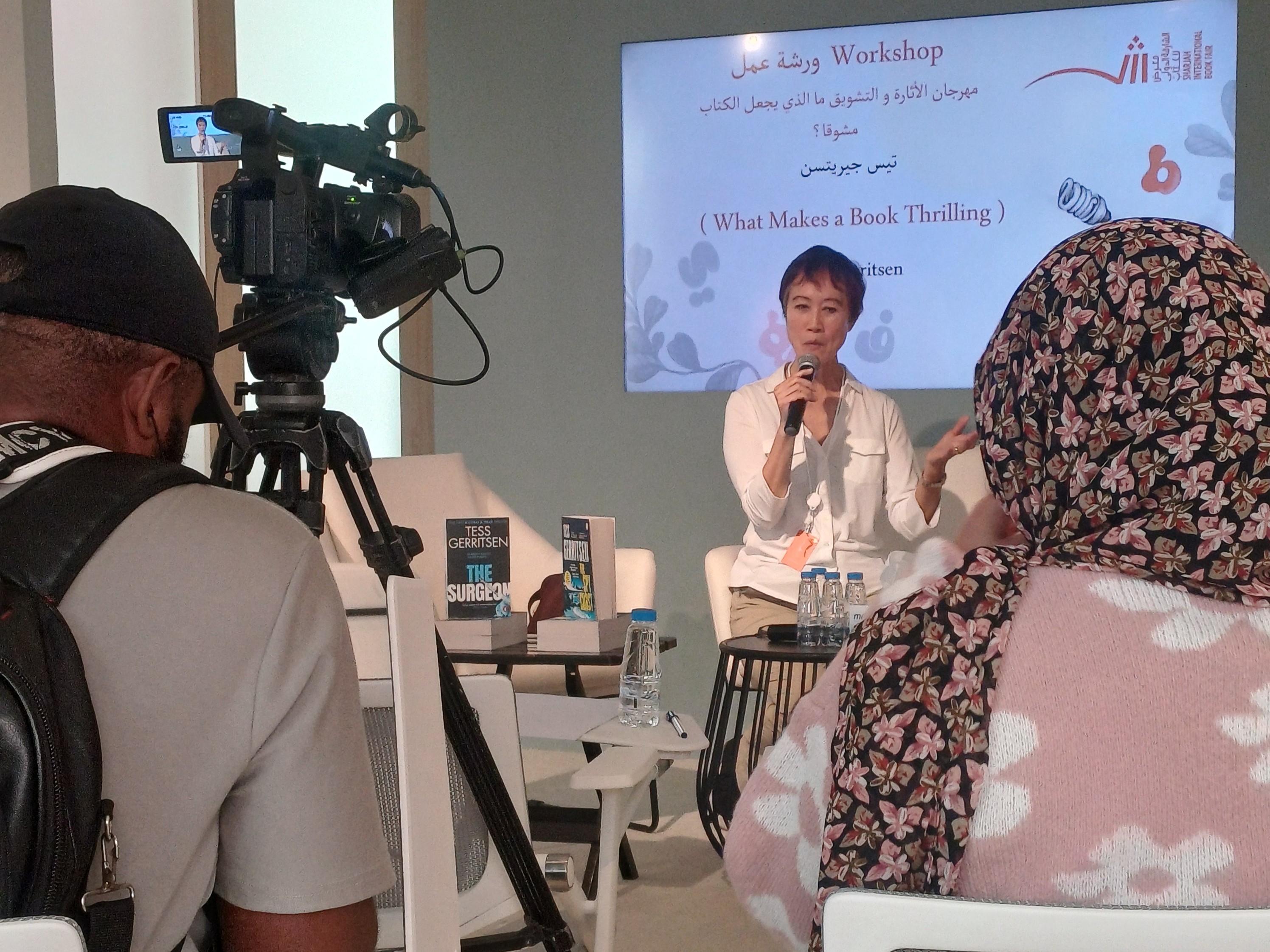
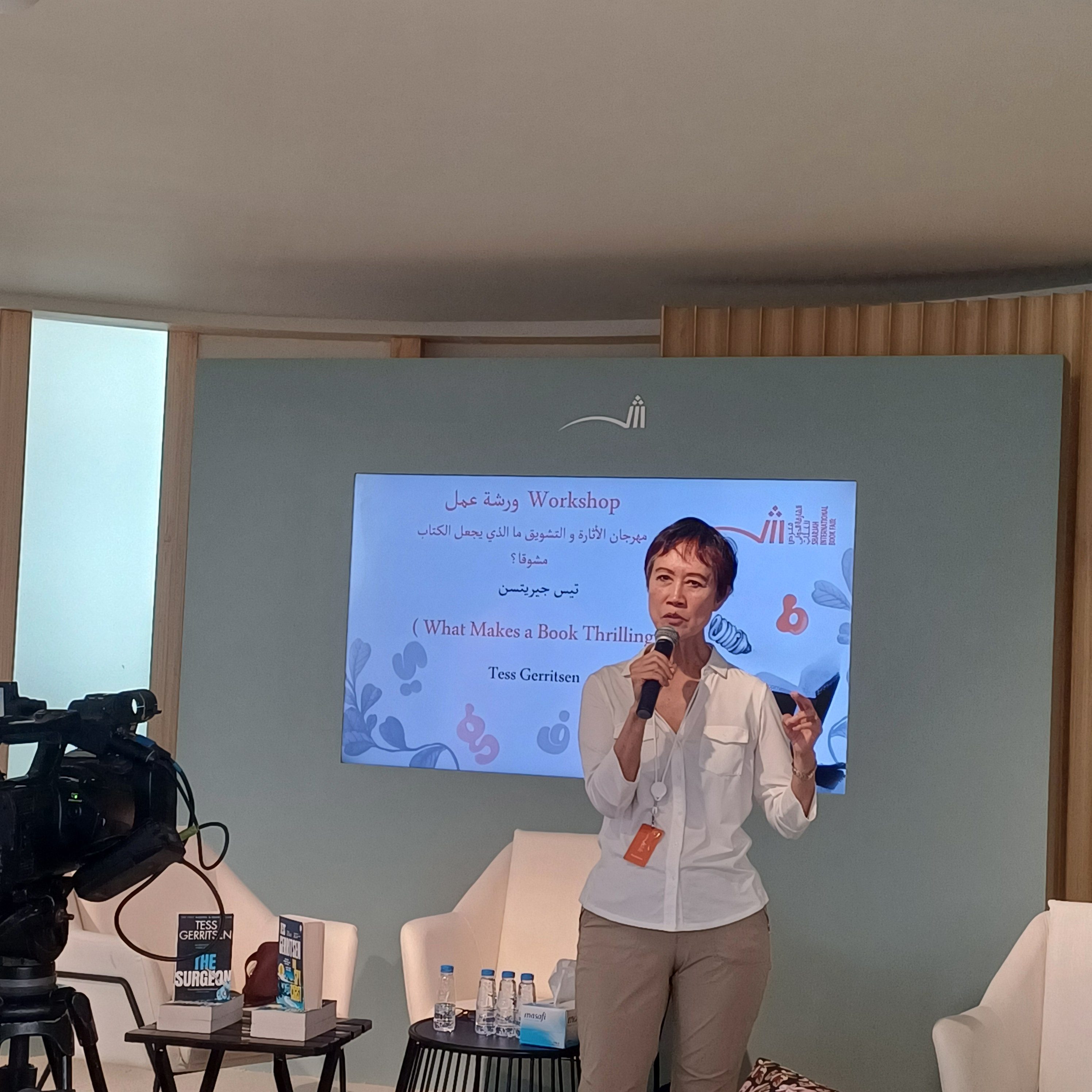
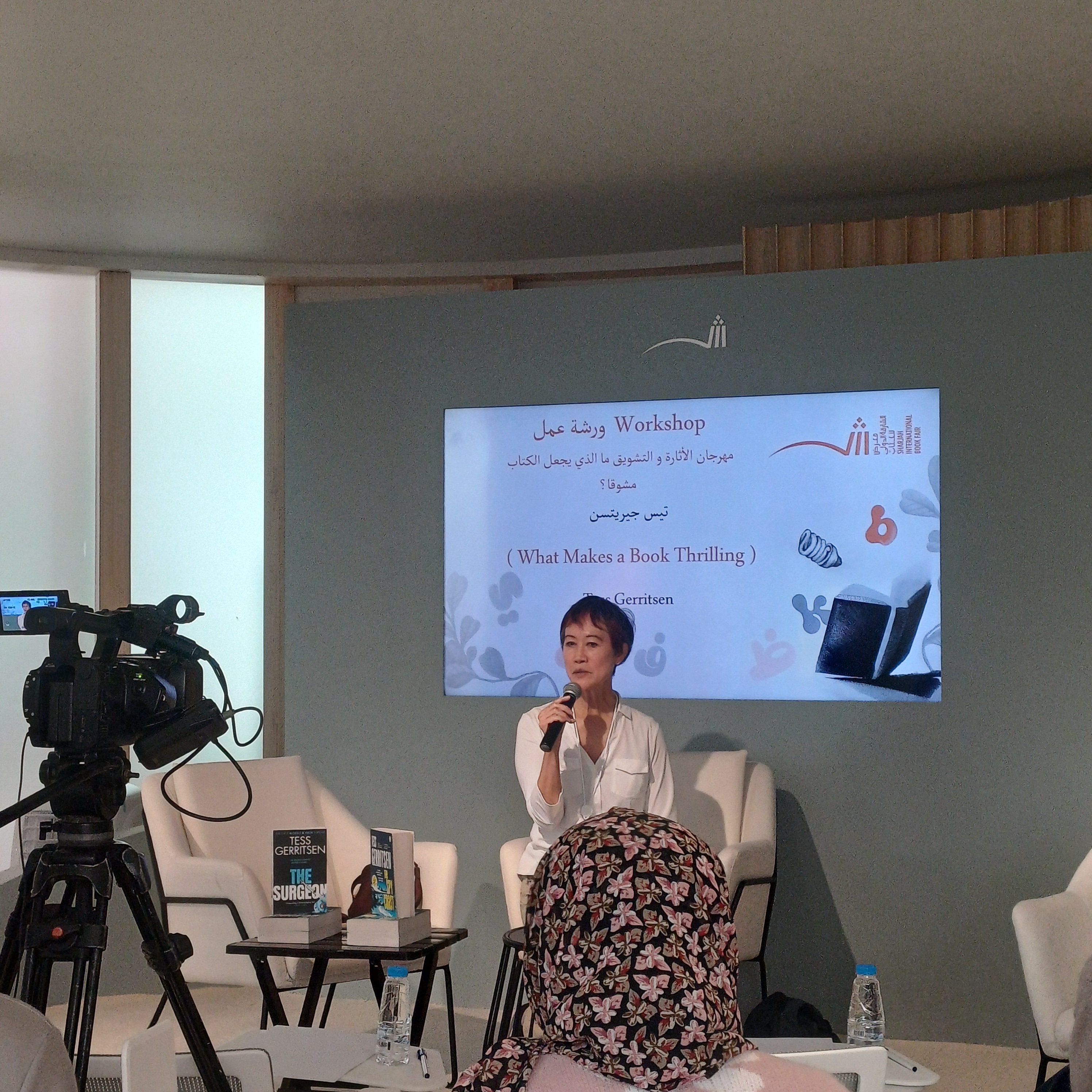
Sharjah – In a masterclass that captivated aspiring authors and established writers alike, renowned novelist and former general physician Tess Gerritsen shared her unique approach to crafting thrillers during a workshop at the 43rd Sharjah International Book Fair.
The acclaimed author, known for her gripping narratives and intricate plots, emphasised the importance of weaving real-life events with imagination and emotional depth to keep readers on the edge of their seats.
At 71, Gerritsen continues to inspire writers as she explains her creative process, drawing on her dual expertise as both a medical professional and a storyteller.
“Every writer has to generate ideas, develop plots and characters, master pacing, and execute compelling resolutions,” Gerritsen told attendees at the workshop.
“The most effective thrillers often stem from a blend of reality and the writer’s imagination.”
Drawing from her acclaimed novel, The Keepsake, Gerritsen shared a fascinating anecdote that highlights her innovative approach to storytelling.
The book begins with the startling discovery of a perfectly preserved 2,000-year-old mummy, found in a dusty basement of Boston’s Crispin Museum.
A routine CT scan, however, reveals a bullet wound, setting the stage for a modern homicide mystery interwoven with ancient history.
“A friend of mine at the hospital so he wrote to me and said we’re about to do a CT scan on a mummy in New York. Would you like to come?” Gerritsen reminisced.
“While observing the scan, I speculated: What if we found something unexpected?
“A bullet deep within the mummy’s leg?
“Realising the potential for suspense in such strange findings became the crux of The Keepsake.”
In an intriguing twist, Gerritsen revealed that her seemingly original concept had its roots in reality.
An Egyptologist later told her of a real-life case where a mummy, also containing a bullet, was uncovered, leading to investigations into a modern homicide case.
“Life can be stranger than fiction,” she noted.
“You might think you’re creating something unique, only to discover reality has already laid the groundwork.”
For many aspiring writers, one of Gerritsen’s key takeaways was the significance of maintaining an “ideas folder” for those intriguing thoughts that may not immediately find their place in a narrative.
“If an idea doesn’t fit, save it; combine it with something else later,” she advised.
“Follow your emotions as you write – let them guide you on what brings out the curiosity and excitement in your storytelling.”
Gerritsen’s muse often emerges from the unlikeliest of sources. She cited a newspaper article about a young man who discovered that both his father and grandfather were serial killers.
Intrigued by the implications of such a dark legacy, she channelled that into her novel Body Double, exploring complex family dynamics through the eyes of an adopted protagonist who grapples with her own identity as she uncovers these shocking familial truths.
“What would it be like to learn such terrible things about your lineage?” she pondered.
“It raises questions about our own nature and the darkness we might inherit.”
As Gerritsen concluded her workshop, she left attendees with the message that being a writer involves both passion and patience.
“Embrace your ideas, even the unusual ones,” she declared, as she encouraged budding authors to explore the depths of their creativity.
Through her exceptional storytelling and infectious enthusiasm, Gerritsen reaffirms that the art of thriller writing lies not only in the twists and turns of the plot but in the emotional resonance that keeps the reader engaged until the very last page.