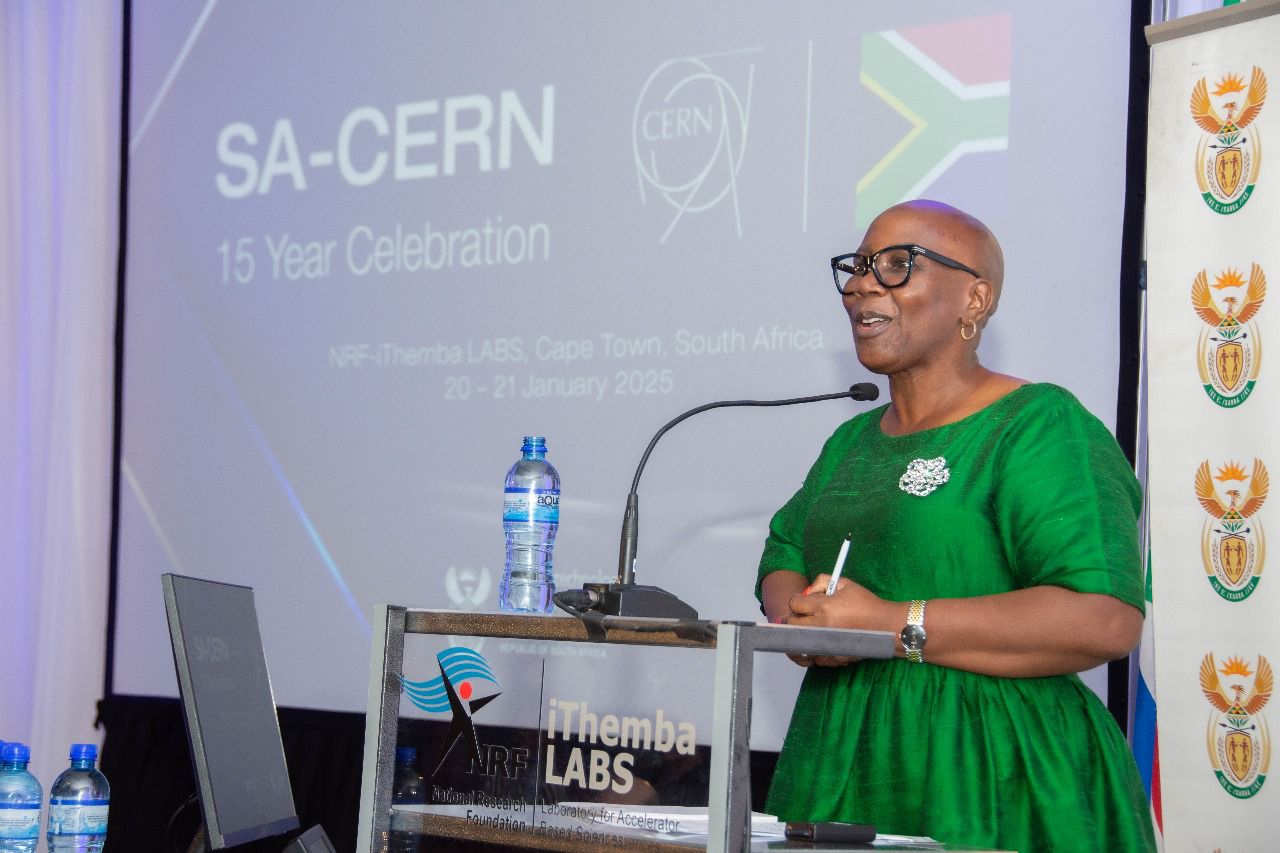
Cape Town – The collaboration between South Africa and the European Organisation for Nuclear Research (CERN) has significantly enhanced the country’s research capabilities and human capital, positioning it as a key player in global scientific innovation.
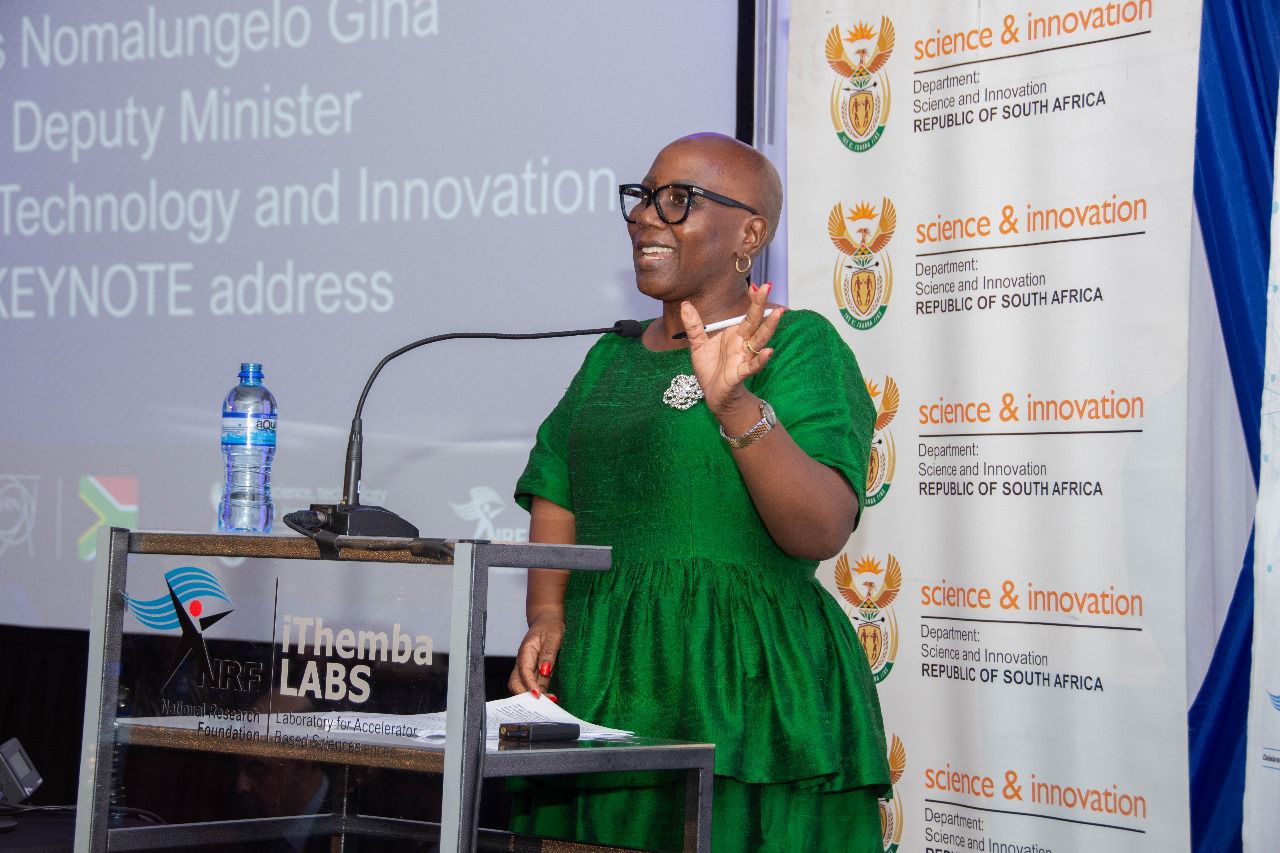
This milestone was celebrated in Cape Town on Tuesday, (21 January 2025), where the Deputy Minister of Science, Technology, and Innovation Nomalungelo Gina, highlighted the transformative impact of the 15-year partnership.
Since its launch in 2008, the SA-CERN programme has seen South African participation at CERN’s Geneva-based particle accelerator expand from just 15 researchers to over 60, with postgraduate beneficiaries increasing from fewer than 25 to more than 70.
“The initiative has allowed South African researchers to actively participate in large-scale experiments such as the ATLAS experiment, which was essential in the discovery of the Higgs boson particle,” explained the Department of Science, Technology and Innovation.
This achievement demonstrates South Africa’s potential to contribute meaningfully to international scientific pursuits.
“This collaboration has not only exposed our research community to cutting-edge science but also equipped our nation with skills and technology that extend far beyond physics,” said Deputy Minister Gina.
The collaboration has empowered South African researchers to contribute meaningfully to large-scale international experiments, including the ATLAS experiment, which was instrumental in the discovery of the Higgs boson particle in 2012.
The Higgs boson discovery, a milestone in modern physics, provided key insights into how particles acquire mass and fundamentally altered the understanding of the universe.
The Higgs boson was discovered in 2012 at the Large Hadron Collider (LHC), a massive circular tunnel that smashes protons together at incredibly high energies to recreate the conditions that existed in the early universe.
CERN, a global hub for scientific research, innovation, and collaboration, its main mission is to advance our understanding of the universe by studying the fundamental nature of matter, energy, space, and time.
To achieve this, CERN operates a range of complex and sophisticated scientific instruments which South Africa has been part of in the past 15 years.
Detectors such as ATLAS and CMS are designed to detect and analyse the particles produced in these high-energy collisions.
CERN also has a massive computing infrastructure that processes and analyses the vast amounts of data generated by the LHC and other experiments.
Deputy Minister Gina emphasised the programme’s impact on South Africa’s research community exposure to cutting-edge science and technology.
The celebratory event highlighted achievements such as contributions to sophisticated data analysis, computing, and engineering solutions.
It also highlighted the partnership’s larger socio-economic benefits, such as the development of local talents and technology relevant outside of physics.
South Africa’s collaboration with CERN is motivated by, among other things, the strategic goal of getting access to important and world-class global research facilities, infrastructure as crucial to the progress of several of the country’s major scientific sectors.
The Deputy Minister said global research infrastructure provide an enabling environment for established researchers to improve their performance, knowledge and innovation outputs.
“The complexity as well as the high development, construction and operation costs, teaches us that it is impossible for one country or a region to build or operate these facilities on its own,” said the Deputy Minister.
She emphasised the significance of continuing to encourage and empower young people, particularly those from underprivileged backgrounds, to pursue careers in science, technology, and engineering.
Deputy Minister Gina believes that the SA-CERN programme is an excellent effort that will pave the way.
Dr Mike Lamont, the Director for Accelerators and Technology at CERN said science as a tool brings nations together, and the power of collaboration in science helps nations to tackle global challenges collectively, building capacity, knowledge and opportunities.
Bringing delegates to the latest developments at CERN, Dr Lamont said the facility was embarking on hard, expensive and complex experiments, pushing the limits of what is available such as producing radioactive isotopes for medical research.
He added that remarkable achievements of experiments at the large hydrogen collider in the past year were also realised, surpassing the set targets compared to the previous year.
“Working together politically, culturally, intellectually in the spirit of innovation, modernism and cosmopolitanism, we make progress on the back of the enlightenment values of reason, science and humanism with technology and wealth generation playing their part,” said Dr. Lamont, adding that South Africa and CERN have come a long way.
Professor Azwinndini Muronga, Deputy Vice-Chancellor for Research at Mandela University in Port Elizabeth highlighted the collaboration’s impact on historically disadvantaged institutions in South Africa, as well as schools in rural and township areas which continues to help identify talent.