Johannesburg – During the 2024/25 festive season, the Border Management Authority (BMA) managed the movement of 5 084 251 travellers – an increase of over 51 000 compared to the previous year.
The Department of Home Affairs said the cross-border movement included processing 395 189 private vehicles, 12 974 mini-bus taxis, 6 071 buses, and 58 938 trucks for import and export.
Additionally, 9 491 aircraft and 660 vessels were processed.
“These movements were generally efficient, with 66% of imports and 74% of exports cleared within 30 minutes – although this is an area that can be improved upon through automated procedures,” the department said in a statement released on Friday, (31 January 2025).
The top 10 ports of entry, which include OR Tambo International Airport, Beitbridge, and Lebombo, accounted for 81% of all processed movements, highlighting the strategic importance of these border posts.
The statement said the 2024/2025 festive season marked a turning point in the BMA’s quest to improve the operations of South Africa’s ports of entry.
Following the long lead time involved in setting up a new institution, the department said the past festive season presented the biggest test to date of the BMA’s ability to act as the single command-and-control structure to improve the management of all border crossings.
Home Affairs Minister Leon Schreiber said: “It is now time for the BMA to permanently acquire these capabilities, as we accelerate our work to digitalise South Africa’s port environment, including by automating all entry and exit procedures”.
Illegal border crossings prevented Turning to the figures:
“Thanks to the focus on coordination, technology and collaboration by the BMA, the number of attempted illegal border crossings by undocumented persons that were successfully prevented increased by 215% this past festive season,” said the minister.
“In 2023/24, 15 924 undocumented persons who tried to come into our country illegally were intercepted.
“In 2024/2025, this number increased to 50 312. Another 6 159 people were detected for overstaying, and a further 1 923 were refused entry due to fraudulent documentation or non-compliance with entry requirements.”
Minister Schreiber said BMA border guards, in collaboration with the South African Police Service, made 322 arrests, including 132 wanted criminals, and seized illicit goods that included R690 million worth of illegal cigarettes.
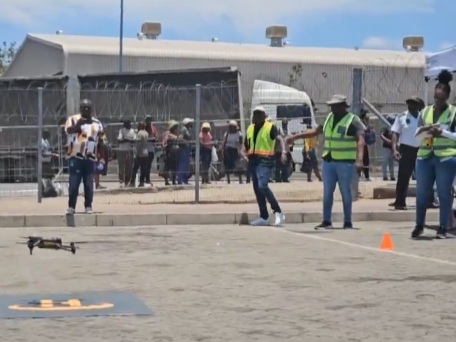
“The use of drones at just five ports of entry on a pilot basis made an immediate and visible impact,” he said.
“The Department of Agriculture, Land Reform, and Rural Development generously assisted with the deployment of drones at Beitbridge, Maseru Bridge, Lebombo, Kopfontein, and Oshoek.”
Minister Schreiber revealed that 42 pilots were assigned and effectively operated those drones across the five ports of entry.
This led to:
- Enhanced real-time monitoring of border movement, especially in high-risk areas;
- Real-time responses to attempted illegal crossings and smuggling activities; and
- Integrated coordination between BMA, SANDF, SAPS, and SARS, ensuring quick deployment of ground teams.
“The use of these drones on a pilot basis at just five ports, led to the detection of 2 188 additional people who attempted to illegally enter our country,” said the minister.
“That is 2 188 people who would be walking among us illegally now if it was not for the use of this technology.
“Furthermore, the drones led to 2 326 breaches in the border fence being identified and sealed.
“This is clear evidence of the impact this technology can have in improving border management, and we must now work to make this a permanent tool in the arsenal of the BMA.”
Minister Schreiber thanked BMA Commissioner Michael Masiapato, the senior management team, and all border management officials – from port commanders to junior border guards.
BMA said its guards participated in 237 joint law enforcement operations, conducted 3 252 vehicle patrols, 4 477 foot patrols, and raided about 1 115 hotspot areas within the border law enforcement areas.
On the 58 394 intercepted individuals, BMA said about 50 312 were undocumented (no documents at all), 6 159 undesirables (found to have overstayed in the country), and 1 923 inadmissible (invalid passport, fraudulent visas, no yellow fever certificates).
“These intercepted individuals were fingerprinted and banned from re-entering South Africa for a period of five years,” BMA said.