Johannesburg – South African car buyers have traditionally been slow to adopt new-energy vehicles (NEVs), but that’s starting to change.
According to the recently released AutoTrader 2024 Annual Car Industry Report, interest in hybrids, plug-in hybrids (PHEVs), and electric vehicles (EVs) continues to rise as more consumers explore efficient and eco-friendly alternatives.
While manufacturers are working towards a fully electric future, hybrids and PHEVs remain important stepping stones to emissions-free mobility.
Electric vehicle and hybrid sales are anticipated to increase in the coming years, driven by a significant policy shift in the South African government.
In December 2024, President Cyril Ramaphosa approved a tax incentive to encourage electric vehicle production in South Africa.
The Chinese automakers, already gaining significant market share locally, are expected to make substantial investments in the automotive sector.
This is expected to bring more affordable EVs to the market, driving widespread adoption of NEVs nationwide.
“South Africa’s growing interest in new-energy vehicles highlights the growing appetite towards more sustainable mobility solutions,” said George Mienie, CEO of AutoTrader.
“As the market evolves, we are witnessing a notable rise in the adoption of hybrids and plug-in hybrids, with consumers increasingly seeking efficient, eco-friendly alternatives.”
The popularity of NEVs is apparent, with sales exceeding 2023 figures by 60% in the third quarter of 2024.
However, once the year ended, a combined total of 3,449 NEVs were purchased on the used car market, representing a year-on-year increase of +92%.
While charging remains one of the biggest obstacles to NEV (PHEV and EV) adoption, pricing is a significant factor for consumers, too, with the average price of an NEV sitting at R804,391 in 2024.
That said, stakeholders are making great strides in increasing the number of charging stations available in South Africa.
According to Gridcars, there are more than 350 public charging stations across the country.
With new initiatives like Zero Carbon Charge (CHARGE) intending to introduce approximately 120 solar-powered EV chargers on busy routes, owning an EV in South Africa is set to become stress-free in the coming years.
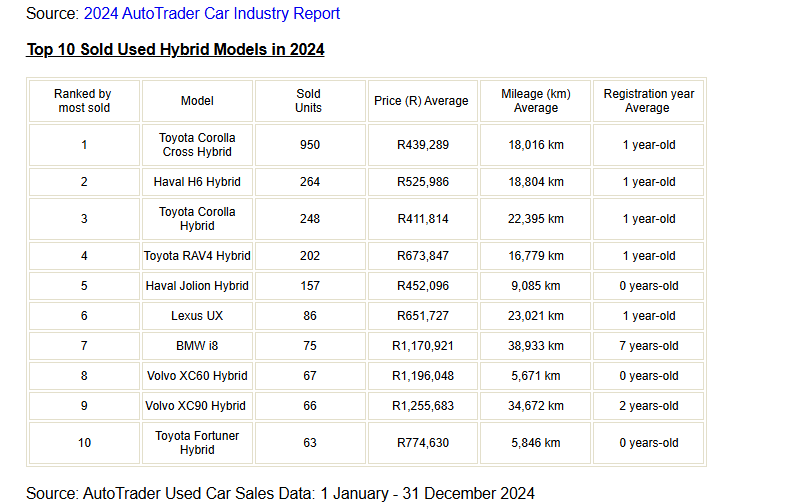
Overall, the Toyota Corolla Cross Hybrid is South Africa’s favourite used NEV, with the most sales of any hybrid, PHEV, or EV.
It is affordable, hugely efficient, and offers a usable driving range.
According to AutoTrader, the popular crossover has an average selling price of R439,289, significantly lower than the average NEV price in 2024.
According to the manufacturer, it returns an average fuel-use figure of 4.3L/100 km and an estimated range of 837 km.
Hybrids account for most NEV vehicles listed and sold, making up 84% and 83%, respectively.
Remarkably, used battery-electric cars are priced, on average, 46% higher than their hybrid counterparts.
However, the average selling price is 8% lower, at 38%.
Hybrids currently represent the sweet spot when it comes to addressing the needs of South African consumers, with lower prices than battery-electric vehicles, no charging times, and no range anxiety, as they predominantly function as combustion-engined vehicles.
It’s no surprise then that, in 2024, 2,864 used hybrids were sold via AutoTrader.
This has been spurred on by the -14% decrease in the average price of a used hybrid car, from R872 180 to R748 096.
Hybrid sales increased by +96% in 2024 despite a slight decline in overall vehicle sales.
Advert views, vehicle supply, and EV sales for battery-electric vehicles have also increased.
Notably, the average listing and sale price of electric cars in SA has declined, making them more attainable to customers and promoting their adoption.
Last year, 2024, saw the highest number of EV listings, with 1,589 vehicles, while sales increased +76% year over year.
However, the average sold price for an electric car is -5% lower than the average listing price.
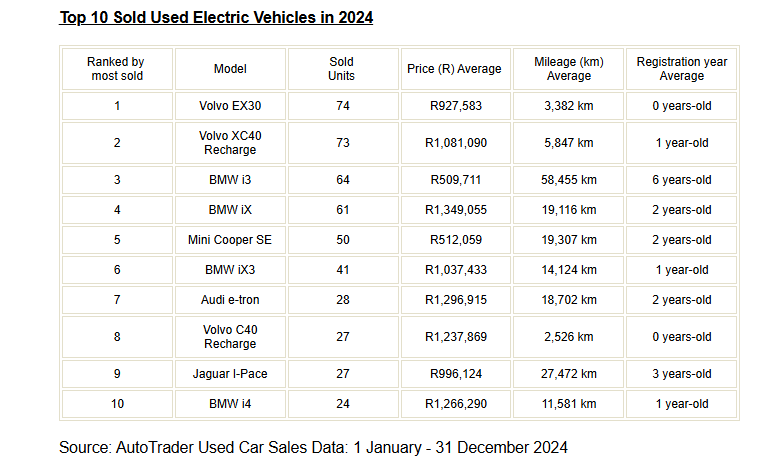
German automaker BMW is the top-selling EV maker on the used car market, but the best-selling EV is the Volvo EX30, with 74 units sold in 2024.
The Swedish electric vehicle sells for an average price of R927 583; its average mileage and registration age are 3 382 km and one year, respectively.
“The continued growth of battery-electric vehicles and the decrease in their average pricing highlight the progress we’re making in making electric mobility more accessible,” said Mienie.
“We are closely monitoring this shift as it’s shaping the future of mobility.
“By providing a platform where buyers can access an expanding range of these vehicles, we’re witnessing firsthand how affordability and innovation are driving this change.”