Johannesburg – Today is the last day to register Spaza Shops and other food-handling outlets.
The deadline will not be extended.
The move to register Spaza Shops and other food-handling outlets was prompted by the multiple deaths of children from eating contaminated food bought from such outlets.
Many children died in the widespread rise of food-borne illnesses across the country linked to the sale of contaminated food.
At least 23 children died from poisoned food in Gauteng last year.
In a statement made available to The Bulrushes, the Inter-Ministerial Committee (IMC) on foodborne illnesses and illicit goods on Friday, (28 February 20250, announced the arrival of the deadline for registration for Spaza Shops and other food handling outlets.
On 15 November 2024, President Cyril Ramaphosa ordered the registration of Spaza shops and food-handling businesses within 21 days.
However, this deadline was extended on 18 December 2024 to 28 February 2025.
“Following several engagements within the IMC and in consultation with the President, a decision has been taken not to extend the deadline of the 28th February 2025 as ample time was given to business owners to comply with the Presidential directive,” the statement said.
Ministers Aaron Motsoaledi and Velenkosini Hlabisa as the Co-Chairs of the IMC said they were “pleased with the progress achieved thus far regarding the implementation of the government interventions” as previously announced by President Ramaphosa.
“We have learnt valuable lessons in a short space of time during this period, especially regarding the need for strengthened enforcement of regulation of the Spaza Shops and other food handling outlets” the ministers were jointly quoted as saying in the statement.
The IMC has overseen the implementation of the Action Plan by the multi-disciplinary teams at the NATJOINTS drawn from the commitments made by the President in his 15 November address to the nation, in which he announced three key objectives:
1. The first intervention is to get hazardous pesticides off the street.
2. The second critical intervention is to protect children from exposure to these substances.
3. The third critical intervention is to prevent future outbreaks.
“It is important to emphasise that the work of multi-disciplinary teams under the NATJOINTS will continue beyond this deadline,” the statement said.
Enforcement of the law is not an event, and we are committed to ensuring a continuation of the work to formalise, regularise the sector and compliance with the law.
This includes warehouses and other establishments that unlawfully stock hazardous chemicals, banned substances and pesticides.
“We have strengthened our capacity and systems to monitor and database this sector,” the IMC said.
“This will enhance our ability to support and encourage their growth and formalisation, while at the same time ensuring adherence to business registration and food safety laws including municipal by-laws.”
The IMC emphasised that registration alone does not mean that a business is eligible to trade.
To obtain a licence or a permit to trade, business owners must comply with all health regulations and municipal by-laws related with conducting a business.
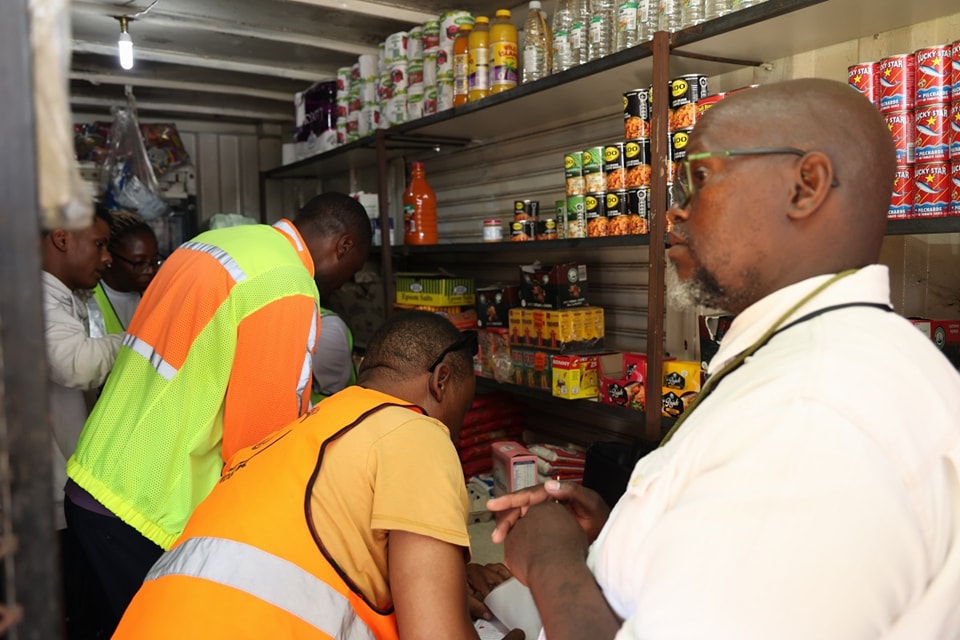
Where business owners are found to be non-compliant, the law will be enforced and this includes fines, arrests and closures as applicable.
In conclusion, the Co-Chairs said; “We want to emphasise that our cardinal aim is to help businesses to comply with the law and to ensure the safety of our citizens and children.
“Working together we can build a safer, healthier, and more equitable food ecosystem for all South Africans.”
Mid-December last year, Cooperative Governance and Traditional Affairs Minister Velenkosini Hlabisa stated that 42 000 applications had been received and 19 385 spaza shop registrations had been approved.
The was an expected rush of owners trying to register their Spaza shops and food-handling outlets.